Showing posts with label Robert Pinsky. Show all posts

Wednesday, February 05, 2014

Shades of Oppen and Rimbaud


The other day Robert Pinsky said, a propos an insightful essay on his work by David Kaufman in The Yale Review, "it's good to be seen," meaning, of course, that he felt the review got at something central about his work.  Today the new issue of The Notre Dame Review came out, including Mark Scroggins' review of my book The Poet Resigns: Poetry in a Difficult World, and I feel much as Pinsky did. Firstly, Scroggins sees exactly what it is that has interested me most over the decade or so in which the essays in the book were written:

The shades of Oppen and Rimbaud stalk unmentioned through much of The Poet Resigns: Rimbaud, the intransigently avant-garde Communard sympathizer who abandoned poetry for gun-running; Oppen, who bailed out of the Objectivist “movement” (and poetry itself) in order to organize strikes for the American Communist Party. The two men are as it were limit-texts for the collision of poetry and active politics. But in their wake there have been whole generations of poets, in both Rimbauldian and Oppenian genealogies of influence, who have argued that making poems can be in itself a way of doing political labor. Archambeau’s subtitle, “Poetry in a Difficult World,” evokes Adrienne Rich (An Atlas of the Difficult World): where Rich’s poems aim to examine and perhaps even to intervene in a world of disquiet, cruelty, and injustice, Archambeau is interested in the place poets stake out for their art, the claims they make about the relationship of poetry and power—and the motivations for such claims.

Secondly, Scroggins nails something about how I tend to think.  He notes that the essays in the book were all written for one sort of occasion or another, then adds:

And they have the advantage of the best occasional writing: immediacy, a sense of responsiveness, conversationality. But Archambeau is a “big ideas” critic: he invariably wants to spin his momentary interpretations of texts into larger insights about the place of poetry in the world. Sometimes, as in the more general essays in the first half of the book, this results in excellent and provocative meditations; sometimes individual poets, poems, and passages from poems become grist for a relentless point-making mill.  There is enough to think about in The Poet Resigns to fill a shelf of books, and if Archambeau has the tendency sometimes to answer the big questions of our poetic moment a bit more rapidly than I’m comfortable with, he’s to be given abundant kudos for raising them in such a clear and thoughtful manner, and for tackling them in such lively and intelligent prose. There are many moments in The Poet Resigns when Archambeau’s affection for poetry (in all of its forms) and his sensitive critical intelligence align perfectly with his structure-making impulses. And the more personal moments of this collection, such as the delightful “My Laureates,” show that the poet-critic, whether his resignation be temporary or permanent, is by no means afraid to subject his own socio-politico-theoretical position to the same examination he has brought to bear on others.
He's got my number, Scroggins has: every time I read a poem I do want to spin the interpretation out into a general discourse on the history of Western aesthetics since the Enlightenment, and a concomitant social analysis!  And I do love giving an outline of an entire system of thought as a prelude to making often relatively minor observations (see, for example, the blog post preceding this one).  This can certainly be a vice, even as it can, on a good day, perhaps be a virtue.  Scroggins isn't the only person to have noticed this.  During the recent MLA convention in Chicago I was several drinks into the evening with the writer of another, forthcoming review of The Poet Resigns, who told me "most of those essays ought to be books!"  I took this as a compliment at the time, but I suppose there's a very different way of seeing it, too.

Anyway: I get what Pinsky means: its good to be seen for exactly what you are, and Scroggins sees pretty damn clearly.

The whole review can be found here.


Monday, January 17, 2011

Let's Hear it for the Boys, or: The Plinko Theory of Poetry


“Let’s Hear it for the Boys” is not a title I expected to find on a review of my book Laureates and Heretics, but I think I see why Brian Reed chose it for his piece on the book in the latest issue of Contemporary Literature: my book does, after all, treat a bunch of white guys as they make their way through the cultural politics of the sixties, seventies, and eighties — the very decades when the hegemonic cultural position of American white guys was starting to break apart.  There have been other bright things said about the book (notably by Henry King in the English journal PN Review) but Reed’s the first guy to make much of the way the book treats how people from the old dominant group react to the changes they live through and try to understand.

Here’s how Reed’s review opens. It had me a bit worried, really:


Robert Archambeau’s Laureates and Heretics: Six Careers in American Poetry begins by offering a reassessment of the irascible, archconservative poet-critic Yvor Winters. It then proceeds to discuss several poets from the“last generation of students” to work with Winters at Stanford University, all of whom “arrived in Palo Alto around 1962” and were later featured in the Carcanet Press anthology Five American Poets (1979): Robert Hass, John Matthias, James McMichael, John Peck, and Robert Pinsky. Each of these figures receives a chapter that summarizes his career, comments on his principal publications, and accounts for his reception history. Described in this manner, the book might not sound promising.

But then things warm up:
Despite these obstacles, Laureates and Heretics turns out to be a compelling meditation on the mechanics of canonization. Building on the work of David Kellogg, Alan Golding, and Jed Rasula, the study focuses on the institutional and social dynamics that produce different levels of popular and critical success among authors active during the same time period.

And soon thereafter Reed turns to the business of the effect of identity politics on “the boys”:
No longer could white men speak unreflectively “of, for, and to a presumably general community.” A comparative study of Winters’s students proves to be a new and inventive means of supporting this last proposition. Hass, Matthias, McMichael, Peck, and Pinsky all came of age in an era of intense ideological demystification. They did not, however, respond to that challenge in the same way. Just as the counter- cultural poetries of the period were internally diverse and mounted a variety of critiques of entrenched authority, so too the elite-educated individuals with easier access to prominent venues for publication, employment, and promotion likewise exhibited a range of behaviors. To understand the literary system of the later twentieth century, Archambeau contends, one has to set aside reductive accusations of sexism, homophobia, and racism and understand that the establishment, too, was a mercurial, complex, self-contradictory entity, fitfully and unpredictably responsive to shifts in the larger poetry field.
Reed's got it, dead-on.  After the rise of identity politics and feminism, you really couldn't go around acting like "Robert Lowell, National Voice of Poetry" or even "Allen Ginsberg, National Voice of Rebellious Poetry."  Things were different, and you had to figure out how, and why, and what to do, not from above or after the event, but during the changes as they happened.

Soon after this part comes my favorite image in the review: the depiction of The Plinko Theory of Poetic Reputation, which is actually a pretty good way to hold in one’s mind the nature of poetic reputation-making, which isn’t primarily about the quality of the work, but about how your trajectory happens to intersect with the various forces at work in the cultural field (this does not mean that bad work gets rewarded, or good work shunted aside, only that one’s work will be popular if it has affinities with cultural imperatives, and finds its way to light through channels that happen to serve large or powerful or coherent constituencies):
Laureates and Heretics offers a theory of canonization that resembles the game Plinko on the television show The Price Is Right. A contestant drops disks from different possible starting points and then watches how initial conditions affect their paths as they descend toward more or less lucrative possible outcomes. Pinsky and Hass could never have predicted that their specific swerves away from Winters would lead plink-plink-plink to their selection as poets laureate. In retrospect, however, one can see that the “poetry field” of the 1970s and 1980s tended to reward certain moves while penalizing others. This kind of experiment could easily be repeated, perhaps with a more eclectic group. What would it be like to read a book that devotes a chapter each to the likes of Agha Shahid Ali, Mary Jo Bang, Charles Bernstein, Rick Kenney, Dana Levin, Eileen Myles, and Tupac Shakur? Would it be chaos, or a way of gaining a more comprehensive overview of poetic production in the late twen- tieth century? Archambeau has shown that there is now enough historical distance on the post–Vietnam War era that one can fruitfully approach its poetry with the cool gaze of a sociologist.

From now on, I’m going to refer to the Archambeau-Reed Plinko Theorem as if it were the General Theory of Relativity or something.

Anyway, here’s the grand finale, which I think gets me exactly right, depicting me as a man aiming at disinterested objectivity and almost but not quite getting there:
One senses that Pinsky and Hass interest him primarily as literary-historical riddles (how did they come out on top?).  He writes well about McMichael, but Peck appears to intrigue him more, and his admiration for Matthias is patent. One suspects that, if pressed, he would admit that his money is on modernist ambition and seriousness as the true route to lasting achievement. The beauty of Laureates and Heretics is Archambeau’s ability to restrain himself from making such pronouncements. He takes the tools of practical criticism and puts them in the service of a relatively unbiased literary history. No matter who their favorite poets might be, others will be able to build on his arguments. The field needs more books like Laureates and Heretics.
And I can't resist ending with this, a celebration of Brian Reed's title (I couldn't quite bring myself to post Deneice Williams' "Let's Hear it for the Boy"):


Saturday, January 08, 2011

The Poet Dreams of Power: Part Two


When last we checked in with our hero, The Poet Who Has Lived Through All of History, he'd come some distance in his dreams of power.  In the Elizabethan era, he actually had power, but not through his capacity as poet: the literary elite and the power elite were, generally, one and the same.  Poetry was mostly an ornament, a game, a semi-private meditation, a pastoral escape, or an attempt to get laid.  When we next checked in with The PWHLTA of H, it was the eighteenth century.  By this point he was beginning to learn how to work in the marketplace, but for the most part he hung on his aristocratic patron, and envisioned his relation to power in quite immediate, face-to-face terms, as the guide and gentle advisor to His Lordship.  By the Romantic period, though The PWHLTA of H found himself alienated, an on-the-run semi-bohemian, radically critical of the world that seemed to have no place for him.  He dreamed that posterity would come to his rescue, and that his works would slowly become the foundations for how everyone thought and felt.  This went on until the Victorian period, when for various social reasons the poet was recruited by the middle class to speak their values back at them.  The poet worried a bit over this, since the values of the bourgeoisie were only partially his (he also had the values of the aesthetic producer).  But they offered him a lordship and a lot of praise, and he felt he was defending the responsible classes against chaos, so on her wrote.  Then further changes in publishing, literacy, and the valuation of poetry lost him his big public, and in a new, modernist guise, the poet (now going by the name Ezra Pound) picked up the old Shelleyan idea of being a kind of unacknowledged legislator.  Well, that's the story so far — full of lacunae, deeply oversimplified, but not entirely wrong, I hope.


To add just a little subtlety to the picture of the modernist poet's dreams of how he might relate to power, let's increase our sample size from one (Pound) to two, and take a quick look at how Eliot dreamed of the poet's relation to power.  In his quiet, understated, uptight way Eliot actually dreamed of immense power for poets — or, at any rate, for the right kind of poet, the poet who, like himself, was a kind of Christian intellectual.  Like Pound, he dreamed of having enormous cultural authority, and like Pound, he had to find some kind of way to get past the enormous fact of poetry's relative marginalization after it's brief Victorian high-water mark.


I suppose I should pause here and say that it's probably not a good idea to uncritically valorize the high Victorian period just because it was the last period in which an Anglo-Saxon country put poets on a pedestal and, en masse, turned their yearning eyes to poetry for moral guidance.  The idea is enough to make many poets drool, but we have to remember that the conditions that created such reverence for poetry involved things like the lack of working-class literacy, the lack of inexpensive books and mass education, a deep insecurity on the part of the middle class about their status vis-a-vis aristocrats, and the absence of the social sciences as a means of gaining knowledge about society (if you're interested in this kind of excruciating minutia, you might be the few who will actually want to read my essay "The Discursive Situation of Poetry," which is coming out right about now in The Monkey and the Wrench: Essays into Contemporary Poetics).

Anyway.  Eliot had to deal with the question of the relative decline of poetry's importance in Britain and America in the twentieth century.  He felt deeply that intellectuals should have some kind of leading role in culture, but, as he said in a letter to Philip Mariet: "the whole question of the popularization of ideas (and the avoidance of perversion of them) deserves our consideration, and I don't know where to begin."  What to do, in a modern age that seemed (as his pal Pound put it) to demand "a mould in plaster,/Made with no loss of time,/A prose kinema, not, not assuredly, alabaster/Or the "sculpture" of rhyme"?  


Rather than face the problem of modernity full-on, Eliot does a kind of end-run, and dreams of a return to the kind of pre-modern world where (he imagines) the poet and man of letters could take a leading role in culture and society.  Eliot's most notorious presentation of this dream of premodernity comes in his weird little book of criticism After Strange Gods.  Here he tells us that "stability is obviously necessary" in society, and that the most stable kind of society is the agrarian.  The modern industrial world is too fraught with perpetual change, and too prone to creating a culturally fragmented world. "The population should be homogenous," says Eliot, and "what is still more important is unity of religious background." He then makes his odious comment about not wanting too many Jews around (this, in 1934, is even harder to excuse than it would be otherwise).


Why is this social and religious homogeneity so important to Eliot?  Not everyone is aware of how much commentary Eliot wrote for the specifically Christian press, but if we root around in this considerable body of work, we can come up with quite a clear picture of what a Christian society meant for Eliot.  One thing it meant was this: a society that was to be guided, ultimately, by humanistic intellectuals.  As he said in a 1945 issue of the Christian News Letter "expert and authoritative theological minds" should be final judge of goals of a society, and other kinds of experts (economists, say) should stick to working out the means to those ends.  Eliot's book The Idea of a Christian Society makes if even more specific.  Here, he tells us that the general populace should be thought of as a "Christian Community," and this community should be led by a "Community of Christians" composed of "the consciously and thoughtfully practising Christians, especially those of intellectual and spiritual superiority."  This all sounds a little bit like the guardians in Plato's Republic, but Eliot hastens to clarify the informality of this community: 
The Community of Christians is not an organization, but a body of indefinite outline; composed of both clergy and laity, of the more conscious, more spiritually and intellectually developed of both.  It will be their identity of belief and aspiration, their background of common culture, which will enable them to influence and be influenced by each other, and collectively to form the conscious mind and the consciousness of the nation.[if you want to know more about this, check out Stefan Collini's chapter on Eliot in Absent Minds, to which I am indebted here].

Like Pound and Shelley, Eliot dreams of influencing the consciousness of the masses, of being a kind of unacknowledged legislator.  But instead of dreaming of an unrealistic power within the existing society, Eliot dreams of an entirely plausible kind of power — in a society that doesn't exist.  That is: Shelley and Pound were aware of their social conditions, and decided, despite evidence to the contrary, that poets had enormous unseen influence.  Eliot dreamed of a society where a poet could, by being part of an informally ruling elite, have an important role, but the society he dreamed of simply didn't exist.  Not in his time, and probably not at any time.  I'm sure his desire for a kind of cultural authority is behind his crackpot-ish theory of a time before a "dissociation of sensibility," and behind his relocation to England, where the mixing of literary and social and political elites did — and, to a very limited degree, still does — exist more than in the United States.


Robert Pinsky makes for an interesting contrast with Eliot, in that the kind of ideal society he imagines couldn't be more different than Eliot's.  In contrast to the Eliot's stable, homogenous, theologically oriented society, Pinsky celebrates the now-old ideal of the American melting pot.  Pinsky's poem "The Figured Wheel" is all about cultural syncretism, and his poem in praise of the saxophone is really a poem in praise of cultures mixing and melding (it is, after all, the tale of how a Belgian instrument became a jazz instrument — that is, an African-American instrument).  This is progressive, compared to Eliot.  Some might argue that it's a bit reactionary in the age of identity politics: Pinsky is not about celebrating particularist identity, except at the scale of the nation as a whole.  He's interested in the idea of America as a modern, polyglot place of cultural melding.  It's not quite a utopia, though, especially because of the racial inequities.  And it's in the discussion of race in the book-length poem An Explanation of America that we can see Pinsky trying out different ideas of how the poet might relate to power.  


Racial division, says Pinsky in An Explanation of America, makes America “as Malcom X once said,/A prison.”  “Living inside a prison,/Within its many other prisons, what/Should one aspire to be? a kind of chaplain?” he asks.  The role of chaplain, the comforter of the people, appeals to him, but only momentarily.  His faith in that role soon fades: “But chaplains, I have heard, are often powers,/Political, within their prisons, patrons/And mediators between frightened groups.”  Consoling will solve nothing.  Indeed, the very possibility of consolation seems beyond reach:
No kind of chaplain ever will mediate
Among the conquering, crazed immigrants
Of El Camino and the Bergen Mall,
The Jews who dream up the cowboy films, the Blacks
Who dream the music, the people who dream the cars
And ways of voting, the Japanese and Basques…
The chaplain idea — the notion of being a kind of mediator between different groups with conflicting interests — comes straight out of Matthew Arnold's ideal role for cultured people in Culture and Anarchy (Lionel Trilling nailed it when he said what Arnold really wanted was for intellectuals to serve as a kind of "umpire class" mediating social conflict).  But if Pinsky dreams of having such a role, he's also skeptical of it, thinking it both impossible and prone to co-optation.  Here we see a self-critical side of Pinsky that his detractors don't often mention.


In actuality, I think Pinsky tries to act out a kind of Tennysonian role as public moralist, but he does so in both literary and cultural circumstances that limit the possibilities for success. Firstly, the public moralist is didactic, and we live in a literary climate radically at odds with the notion of the didactic.  Pinsky's early critical book The Situation of Poetry sets out to defend statement-oriented, discursive, and even didactic or moralistic poetry against fragmentation, hermeticism, and communication by image (the old modernist premises), but this is a reactive move, and no matter how much more didactic and discursive Pinsky is than the norm of our time, he doesn't come close to the didacticism of the public side of Tennyson.  Everything has a bit of negative capability to it, even a trace of inconclusivity — which makes public moralism difficult.  But the more serious factors limiting Pinsky's ability to take on a kind of Tennysonian role are social: the reading audience, now, is more fragmented than in Tennyson's day, and one cannot speak to it with the confidence that one is voicing its views for it.  If you want to speak of and for a group, now, you kind of have to specify which group (hence the success of identity-politics oriented poetry, at least for a while).  I once went to some length arguing that Pinsky pitched his work to not to poetry-professionals, but to the professional wing of the upper-middle class (you know: psychiatrists, lawyers, professors of things other than English, that sort of thing).  I still think I was mostly right.  Anyway: I think one thing Pinsky's career shows us is the limited degree to which one can now succeed at the Tennysonian game.  Compare their sales figures (especially in relation to the size of the book market), the degree to which they were talked about, the meaning of their laureateships, and then stack the pile of awards Pinsky has received from foundations up and see if they even reach knee-high on Tennyson's lordship.


Pinsky, we should remember, has a seemingly unlimited supply of hustle (we were talking, once, about how much he traveled, and when I asked him how long it had been since he'd slept anywhere but a hotel, he had to stare off into space for a while, brow furrowed while he tried to remember).  If the Tennysonian game won't work for him, under current conditions, it isn't likely to work for anyone.  And most poets don't seem to want to try, anyway.   For reasons that I once tried to pin down in an essay, most poets in America (among other places) now feel quite alienated from power, and are prone to the kinds of worries Pinsky raised in his passage about the complicity of chaplains.  And for many, the old Shelleyan solution seems to be back in vogue: the notion that somehow (how one doesn't know) the work will get out there and have an influence.  I once argued with some of the people who'd written on Jeremy Prynne, and claimed that his poetry (read by a tiny but often intense audience) had smashed the public sphere and had an enormous political impact. I suppose I was arguing against this kind of semi-Shelleyean view.  It made a bunch of people angry: Simon Howard, for instance, asked "Even if you are 'right' about the limits of what poetry can achieve in the world, why so important to insist upon it? Or to quarantine poetry in this way? Why can't poetry be part of a series of actions, interventions?"  I thought this was interesting — in that Howard seemed to think that the fact that I was saying there was no evidence of poetry acting as a political powerful entity was what kept it from being so.  I mean, it's not like I'm the one stopping Prynne from influencing public discourse.


Anyway.  What I think we really need is a way of understanding the situation of poetry that explains why it functions the way it does, why it has the capabilities it has and why it lacks the capabilities it lacks.  I'd also like to understand more why so many poets want so badly for poetry to have powers of the kind it so rarely seems to have had in modern metropolitan societies.  I suppose what we need, really, are answers to Howard's questions about actions and interventions.

Friday, January 07, 2011

The Poet Dreams of Power: Part One


The critic Robert von Hallberg has retired from the faculty at the University of Chicago, and the editors of the Chicago Review have marked the occasion by running a series of essays on poetry and poetics in his honor.  In true, inimitable Hyde Park style, they honor von Hallberg by beginning the feature with a short essay picking him to pieces, saying the claims of his book Lyric Powers "are extraordinary, even irresponsible."  I like this, mostly because it embodies the best spirit of the Chicago Review: serious about the life of the mind, and a bit unworldly and impolitic.  I think this must have something to do with the fact that the journal has always been edited by graduate students: they're not in charge long enough to become too complacent, and they're not hooked into networks of mutual academic or literary obligation that might keep them from saying what they mean when they disagree with someone.


One of the essays dedicated to von Hallberg, Keith Tuma's "After the Bubble," speculates on the fate of poetry after the financial crisis, and its inevitable effect on the university creative writing programs where so many American poets currently find themselves employed.  In the course of pursuing some larger points, he makes a comment about Robert Pinsky that got me thinking about the relationship between poets and power — or, more precisely, that got me thinking about how poets have dreamed about how they would like to relate to those in positions of power.  Here's Tuma's remark:
In Robert von Hallberg's recent book Lyric Powers (2008), Pinsky's poetry, which is rooted, von Hallberg thinks, in "imitation of speech," is linked to "the premise that civil, secular values properly govern cultural life." While von Hallberg admits that some readers find Pinsky's poetry boring, he views Pinsky's "patient hypotactic style" as a credible and considered alternative to modernist juxtaposition and speed.  To take on a claim like that would make for serious debate.  Von Hallberg is not shy about identifying Pinsky with power.  But without a critical discourse about poetry and power and these other matters, criticism of Pinsky will continue to operate like gossip...
I'm in agreement with Tuma that we need some kind of a deep, non-anecdotal understanding of the relationship between poetry and power, something that gets beyond claiming that one or another poet is resistant to, or complicit with, the powers-that-be.  I hope the book I've been working on, formerly called The Aesthetic Anxiety, now called Poetics and Power — a social history of the idea of aesthetic autonomy in poetry — will be a contribution to such an understanding, but I'm only about halfway done, and by no means assured that the outcome will be of interest to anyone.  So, in the absence of an understanding of the actual relations between poetry and power, let me offer instead a brief, highly selective history of the way some poets writing in English over the past two centuries have dreamed about how they would like to relate to power.  Robert Pinsky certainly appears from some perspectives (von Hallberg's and, I think, Tuma's) to have a somewhat cozy relationship with power.  But seen in historical perspective, things change a bit: compared to some poets, Pinsky is neither close to power, nor desirous of such proximity.  Compared to others, he just appears more successful in realizing his dreams.


It's tough to know where to begin a discussion of the poets and their dreams of how they might relate to power.  I suppose some small gesture to an era when the differentiation of literary elites and power elites had not yet occurred is in order.  Consider the Elizabethans: Sir Thomas Wyatt, Henry Howard, Earl of Surrey, Sir Edward Dyer, Sir Philip Sidney, Christopher Marlowe, Sir Walter Raleigh, William Shakespeare, Thomas Campion, Sir Henry Wotton, John Hoskins, Edmund Spenser.  All those "sirs" give a pretty clear picture of the situation: for the most part, the literary elite and the power elite were one and the same.  Of the non-knighted and non-nobel, Spenser was a big landowner in Ireland, and Hoskins was a member of parliament, so they too were members of a power elite.  Campion was a successful physician, and therefore an exception to the power elite rule, as were the two playwrights Marlowe and Shakespeare, who were part of the fledgling world of commercial writing.  As for how they dreamed of their relations to power: well, it varied.  But for the most part they saw their roles as poets as subordinate to their roles as movers-and-shakers, and poems as either pastoral escapism or as the jewels on the pommels of the weapons they used in the cut-and-thrust of courtly life.  Spenser did try to convert The Faerie Queen into a big cash payment from the sovereign (the idea was nixed by Lord Burghley, with the famous comment "all of that for a song?"), but even here it was less a matter of trying to influence power with poetry than of trying to put poetry at the service of power (huge, now-unread, tracts of The Faerie Queen are dedicated to Church politics, and propagandizing against Catholicism).


There's a long, slow differentiation of elites in the centuries that follow.  But let's fast-forward to Alexander Pope in the Augustan eighteenth century.  Pope's interesting for all sorts of reasons, not just for the snazzy hats he wore.  For one thing, he was among the first English poets to make a lot of money by selling poetry in the marketplace.  He lived at a kind of liminal period, when the system of relying on aristocratic patronage hadn't yet died off, and the market system was just kicking into gear.  The relation he had with power may, in fact, have been as a kind of housecat (one noble patron liked to stop Pope during readings and revise lines, such being the patron's prerogative).  But he dreamed of himself as a kind of spirtitual and moral advisor, not speaking so much on matters of immediate political urgency, but offering general principles that might inform the decisions of the powerful at a more abstract level.  Consider the opening of "An Essay on Man":
Awake, my St. John! leave all meaner things
To low ambition, and the pride of kings.
Let us (since life can little more supply
Than just to look about us and to die)
Exatiate free o'er all the scene of man;
A mighty maze! but not without a plan;
A wild, where weeds and flowers promiscuous shoot,
Or garden, tempting with forbidden fruit.
Together let us beat this ample field...
The "St. John" is Henry St. John, Lord Bolingbroke, and one of Pope's most powerful friends.  Pope envisions himself as a companion of the good Viscount Bolingbroke, and envisions the two of them engaged in aristocratic activities together (to beat the field was to send runners out into it with sticks to scare the birds, who would then fly up to be shot by the noble hunter and his companions).  The tone is friendly, if a bit deferential, and the relationship to his Lordship is as philosophical guide: the word's a maze, but not without a plan — a plan the poet will explain to the Great Man in ways that will enable him to carry out his duties of state in a philosophically informed manner.  If the deference might make some of us cringe, now, the proximity to power would make more than a few poets blanche with envy.


We start to get closer to a recognizably modern relationship of poetry and power with the Romantics — if only because the Romantics were often either radical bohemians with no direct influence on power (think Shelley) or government-sponsored former radicals whose views now seemed less threatening (think Wordsworth).  The document of the time that seems most representative of the poet's dream of his relation to power is Shelley's "Defense of Poetry." It was never published in his lifetime, but has had a huge allure for generations of poets since — and why wouldn't it?  It really lets you have your cake and eat it too.  On the one hand, the poet is responsible only to his private vision, not the demands of the market or the audience of any kind of patron, none of which were much available to Shelley anyway.  On the other hand, the poet has enormous influence: his ideas shape the consciousness of the ages to come.  All of this has its origins in Shelley's arguments with his father in law, the philosopher William Godwin: Godwin said philosophers were the primary thinkers of society, and poets should serve as publicists for philosophical ideas.  Shelley turned the relationship around, saying that poets inspire everyone, including philosophers, to think in new ways.  The process is gradual, spreading bit by bit through readers of the poet to those who are influenced at second or third or fourth hand — the original viral marketing.  Hence the unacknowledged legislator: sure, no one knows you influenced the world, but that's not important: what's important is that the influence happens.  Of course there's no proof that the influence really takes place.  As Lou Reed might put it, you need a busload of faith to believe in this sort of thing.  But poets tend to have a lot of faith in poetry: when I was arguing about the political impact of poetry with Andrea Brady in the pages of The Cambridge Literary Review last year, I couldn't help but think she was a bit of a Shelleyan, and that I was a bit of a nay-saying grinch.  Anyway, the point is this: Shelley's dream of enormous influence is the product of a kind of alienation of the poet from power: Sir Walter Raleigh didn't look for such indirect influence on politics.  When he wanted to make things happen politically, he schemed with other courtiers.  Nor did Alexander Pope look for some secret, long-term, possible-but-unprovable political influence: if he wanted political influence, he buttered Lord Bolingbroke's toast and made some subtle, inoffensive suggestions.  You have to be pretty removed from actual legislators to pin your hopes on small scale, but just possibly viral, influence on public opinion.


It's not quite a straight line from Shelley to us, though.  I mean, think about Tennyson.


“Tennyson,” Eliot once wrote, was “the saddest of all English poets, among the Great in Limbo, the most instinctive rebel against the society in which he was the perfect conformist.” Eliot is certainly right to sense a conflict at the heart of Tennyson.  But to explain the dissonance in Tennyson in psychological terms — as a matter of rebellious instincts and the urge to conform — is to miss the way those very instincts were conditioned by Tennyson’s peculiar moment in the history of English society and the history of poetry.  His was a time when social disorder and growing middle-class power — both products of industrial development — weighed on every thinker’s mind.  It was also a time when ideas of the autonomy from power, fully developed by the Shelley and other Romantics, were bequeathed to new generations of writers.

Tennyson, in ways more instinctive than calculated, came to embrace a role on offer to many writers of his time: that of public moralist.  Literary public moralists both propagated the values of the middle class and urged the amelioration of those values in an effort that, collectively, made a major contribution to the cementing of a social order beneficial to the middle class.  This public moralist is the Tennyson most famous in his own day, the teacher of domestic order in The Princess and Idylls of the King, the prophet of self-denial in Maud and Enoch Arden, the instiller of faith in progress in “Locksley Hall,” and the obedient servant of empire in “The Charge of the Light Brigade.”  The public moralist acting on behalf of the bourgeois order did not, and could not, sit at ease with another side of Tennyson, the late-Romantic poet who’d loved Keats’ poetry, and who had carved “Byron is dead” into stone when, as a youth, he’d heard of the great Romantic’s passing.  Part of Tennyson was always loyal to one of the big Romantic ideas of the poet — as an alienated outsider creating works that sought not so much to speak to the world but to form themselves into mysterious symbolic wholes, or to hover in the delicious indecisiveness of negative capability (this isn’t the Shelleyan idea — it’s more Coleridge and Keats).  Tennyson spent a lifetime at war with himself, his intellectual and aesthetic inheritance ever at odds with the social role he was asked to play, and was so richly rewarded — in sales, in status, in honors — for playing.  His path is that of the poet divided.

Tennyson was, I should stress, far from insincere in his moralism, however much at odds it may have been with his equally sincere aestheticism.  He was, after all, connected to the powerful class on whose behalf he wrote, and he had seen enough of the social disorder of the 1830s and 40s to understand the value of an orderly society.  The authentic Tennyson, then, is not a figure on one side of the aesthete/moralist rift: the authentic Tennyson is the rift, and the product of very specific, and quite contradictory, socio-aesthetic conditions.  So: on the one hand, he was close to, and spoke for, power.  But that was only part of his dream, the fulfilled part.  The other part of his dream was to be withdrawn from the world of power, and to exist in a world of art for its own sake.

That's probably more on Tennyson than anyone wants to read, but I spent all of last summer writing about him, and you know how it goes: anything shorter than three paragraphs seems like too little of an explanation when you think you really know what you're talking about.


Anyway.  The coziness between Tennyson and some other Victorian poets and the newly-powerful middle classes ends, for a whole host of reasons  — the economics of publishing in the era of mass literacy, the relative growth in authority of the social sciences at the expense of the authority of the man of letters, the lessening sense of social crisis in England after the 1850s, the slow loosening of bonds between social, economic, and cultural elites, and other things, most of them dealt with very well in T.W. Heyck's astonishingly informative The Transformation of Intellectual Life in Victorian England, which is indispensable in understanding what happens to poetry between Tennyson and the modernists.  So we end up with poets once again alienated from power and dreaming of ways that their work might have importance or influence.


Ezra Pound makes for an interesting case in point.  He was always concerned with the social role of the poet: in the essay "The Wisdom of Poetry" he said "in former ages, poets were historians, genealogists, religious functionaries."  But in his own day the role seemed rather more unclear.  Mass culture, Pound intuited, had something to do with the change.  "Hugh Selwyn Mauberly" expresses the alienation of the poet in the age of mass communications, incipient mass consumption, and the economic importance of the masses whose tastes were so different from the elites poets had once served:
The age demanded an image
Of its accelerated grimace,
Something for the modern stage,
Not, at any rate, an Attic grace;


Not, not certainly, the obscure reveries
Of the inward gaze;
Better mendacities
Than the classics in paraphrase!


The "age demanded" chiefly a mould in plaster,
Made with no loss of time,
A prose kinema, not, not assuredly, alabaster
Or the "sculpture" of rhyme.
That was from 1920.  A year later, Pound offered his dream of a solution to the problem of the poet's role in modern times.  As it turned out, it was a remarkably Shelleyan dream of indirect influence.  Here's a passage from the article I'm thinking of, "How to Read," which — perhaps ironically — ran in the very kind of mass media vehicle that was so dislocating poets: The New York Herald Tribune:
The individual cannot think and communicate his thought, the governor and legislator cannot act effectively or frame his laws without words, and the solidity and validity of these words is in the care of the damned and despised litterati...when their very medium, the very essence of their work, the application of word to thing goes rotten, i.e. becomes slushy and inexact, or excessive or bloated, the whole machinery of social and of individual thought and order goes to pot.
In this dream of poetic influence on power, the "governor or legislator" probably has no idea that his language, and, by implication, his mental framework has been conditioned by the poet.  But in controlling the meanings of words, poets have an enormous power as unacknowledged legislators.  One might well argue that it isn't the literati who control the meaning of words, since their contribution to these matters is quantitatively minimal in relation to the products of mass culture.  But arguments are for reasoners, and Pound isn't reasoning here so much as he's dreaming of a way for the things he loves to be important not just to him, but to the polity at large.  There's will-to-power here, for sure, and a compensatory gesture — the sort of thing Seamus Heaney, in a very different context, would call "pap for the dispossessed."  The dispossessed here being poets in modernity.

Egad.  It's time for me to hop a train, and I haven't talked about Eliot, Pinsky, some comments by Larry Sawyer, or Jeremy Prynne.  I'll try to pick up where I left off with my next post, probably tomorrow.  I mean, the new semester is about to begin, and I've got some print writing deadlines coming right up — conditions that always seem to drive me to blog instead of doing any kind writing or thinking that feels like an obligation.


{Here's part two}


{Update Jan. 11: The good people at the Poetry Foundation raise a crucial point about this discussion}


Saturday, September 20, 2008

Hass and Pinsky Sail to Byzantium


Wake up, dammit! It's a beautiful Sunday! The sun shining, the birds singing, with many a youth and many a maid dancing in the chequered shade, etc. Oh, and the latest Notre Dame Review has just landed with a thud on your Norman Rockwellesque porch, so slide those slippers on, make sure your bathrobe is done up (I'm talking to you, Josh) and for the love of Mike get yourself out there to scoop it up! I mean, it's got Devin Johnston, it's got W.S. Merwin, it's got Stephanie Strickland, John Kinsella, Ray DiPalma, Renée E. D'Aoust and many more. And sullying a spread near the back is an essay by your present humble blogger, a double-barrelled review of Robert Hass' Time and Materials and Robert Pinsky's Gulf Music.

Back when I was putting the review together, I realized I'd been reading these two poets, one way or another, for twenty years. Which flipped my still-not-too-thinned-out wig, people. Flipped it. Time's winged chariot, it seems, tears on up next to me on the expressway and looks like it might just start trying to edge me onto the shoulder. But as I fretted about the inevitable Archambaldian aging, I realized it must be much worse for the two laureled Roberts, Pinsky and Hass: not only do they have a few decades on me, they're part of the baby-boom crowd hooked on the notion of their eternal youth. So age became the hook for the piece. It's called "Hass and Pinsky Sail to Byzantium," and it goes like this:

How to be an old poet? We live on the precipice of a great age of older poets, writes Roger Gilbert in the Michigan Quarterly Review, with an unprecedented number of American poets still going strong as they approach, or pass, their eightieth birthdays: Maxine Kumin, Robert Bly, John Ashbery, Galway Kinnell, W. S. Merwin, Donald Hall, Philip Levine, John Hollander, Richard Howard, Adrienne Rich, Gary Snyder — one could of course go on. One imagines each of these éminences grises has found his or her own answer to the question of how to be an old poet, and plotted out a route over the mackerel-crowded seas to Yeats’ Byzantium of ageless art. But what about the baby boomers, members of that rapidly getting-on generation hooked on the notion of youth? What, especially, about those poets whose careers began with a bang of youthful notoriety, rather than the now-typical whimper of post-MFA chapbooks and blog posts? The appearance of new books by Robert Pinsky and Robert Hass gives occasion to reflect on how the poetic wunderkinds of the early baby boom navigate waters.

It is perhaps unsurprising that Pinsky and Hass have sailed on parallel routes into what, with some slight euphemism, we might call poetic maturity. Their careers have, after all, followed remarkably similar routes since they attended graduate school together at Stanford in the sixties: each chose an academic career, each was picked up early by a major press, each has filled his trophy case with as impressive an array of prizes and awards as one could hope for, each has published good literary criticism as well as poetry, each has served multiple terms as Poet Laureate. Now, as the two poets push seventy, they have found similar ways to write as mature poets. Both have turned in some measure to a public-spirited, civic poetry; and each, in a different way, has developed what I’d like to call a poetics of accumulation, sensitive to the tradition behind them and to the presence of the work of their peers.


The rest of the piece is available as a pdf, if you're absolutely committed to not getting out of bed to get your copy of the magazine. Read on, punishment-gluttons, amidst the croissant crumbs and unfinished New York Times crossword puzzle! Hear of the civic poetry and Eliot-style assimilation and transformation of tradition! Thrill to the assessment of Hass' poem "Bush's War," and chuckle knowingly over the analysis of poetic minutiae! Also, gimme some of that croissant, will ya? Mmmm. Yeah. That's the stuff. Got any more coffee?

Thursday, May 25, 2006

For Whom and To Whom: Poetics of National Identity -- Or: What We Talked About in Hyde Park


What's that you say? You couldn't make it to the symposium on my "The Poet as American in the Age of Identity Politics" paper at the University of Chicago, and you're going to hold your breath until I tell you all about what happened? Really? Get outta here. No, really? Well, if you insist. It went something like this:

I took the train down to Hyde Park early, to lurk in the wonderfully comprehensive and architecturally ghastly Regenstein library and scoop up a few books and articles on Swinburne (don't ask -- that's a whole different project). After a few hours of late-Victorian poetry and poetics and some serious caffination, I legged it over to Rosenwald hall, where Lee Glidewell took me up to the seminar room. The event, he explained, would be sort of like a creative writing workshop, only it would be my critical writing under discussion. And so it was -- their exagmination round my fructification, to wax Joycean about it (though I should probably be waxing Poundian, as I spent the whole ninety minutes with a larger-than-life bust of Ezra Pound looking on from just behind my right shoulder).

I'd sent about 40 pages on the cultural situation and critical reception of Robert Pinsky's An Explanation of America to the participants about a week earlier, in which I'd argued something like this:

1. The movement toward identity politics in the 1970s was coincident with (and to a degree causal of) the development of various kinds of identity-poetics movements, in which editors, publishers, critics, poets, and readers established new poetries and new communities for poetry based on various previously disempowered identity affiliations (notably in versions of gender, sexuality and race).

I don't suppose this is a particularly original or surprising point, or a controversial one, but I could be wrong about the latter. One thing the blogosphere has taught me is that everything is controversial to someone, and that the someone in question can find my email address faster than his or her blood pressure can return to normal. But I digress.

2. This development did a number on those white heterosexual male poets who weren't so complacent as to be unable to really register what was going on. For such poets, certain questions came to the fore in ways they had not done before the rise of identity politics. "To whom do I speak?" was one such question. "For whom do I speak?" was another.

There were all kinds of fascinating developments here. In my paper I mentioned two of them, both examined by Peter Middleton in his whip-smart essay "1973," which you can find in Mechanics of the Mirage. Middleton maintains that the decline of Robert Lowell had a lot to do with his inability to navigate a discursive environment in which it was no longer easy for a white male member of the American ruling class to assume he spoke for, and to, the nation. Middleton also maintains that Language Poetry, with its examination of the means of communication and the creation of reading publics, came about in no small measure due to the shattering of assumptions about audiences by 70s identity politics. (Oren Izenberg, one of the profs at the seminar, disagreed with Middleton about both of these theses, especially the Lowell thesis. I'd like to hear more from him in this regard sometime).

One idea I've been toying with, but didn't mention in the material I sent to the symposium, is that some of the signature stylisitic devices of the New York School poets of the seventies could be explained with reference to identity politics' disruption of the poetic field in the seventies. The New York School conflation of public and private spheres, for example, could be seen as a very productive attempt to answer the question of who one speaks to/for, by reconfiguring the public sphere as the local scene (of course the second law of social science would apply to this, that law being "it's more complicated than you think, bub"). But I digress.

3. Robert Pinsky offers a response to the discursive situation wrought by identity politics in many poems, most notably the book-length An Explanation of America. Here, he defines American identity in a way that isn't too rigidly essentialist. In fact, he defines it as something that looks very much like the self of modernity as defined by Jonathan Freidman in his “Cultural Logics of the Global System” (Theory, Culture and Society 5, 1988: 447-60).

For those of you who haven't yet committed the late-80s issues of Theory, Culture and Society to memory (that is, everyone except for Joshua Clover), Friedman's piece says something like this: there are four fundamental orientations toward subjectivity possible under the current system of global capitalism. I'm too lazy to type them out this afternoon, so here's a chunk of the paper I gave -- a bit longwinded, but what the hell:

What is this idea of a ‘self of modernity’ that informs Pinsky’s work? We can come to an understanding of it best through the cultural anthropology of Jonathan Friedman. In Friedman’s model of cultural logic, there are four kinds of selves: the selves of modernity, primitivism, tradition, and postmodernity. The self of modernity is a self addicted to the idea of more, and cannot allow itself a moment of restful wholeness. It is self as bildung, self as continuous accumulation of all things: wealth, knowledge, experience, what have you. It is, in Friedman’s words, “an identity without fixed content other than the capacity to develop itself, movement and growth as a principle of selfhood.” .... It is a notion of self necessarily opposed to the primitive, which Friedman defines as the kingdom of infantile desire. Primitivism “harbors all that is uncontrolled: the confusion of eating, sexuality, aggression and pleasure…but also the impulsive and compulsively superstitious relation to reality; [and] religious fetishism…” .... Traditionalism, which the self of modernity also disowns, consists of a culture that is “defined as a system of rules and etiquette pegged to a totalistic cosmology that provides an ultimate meaning to existence” and defines humanity’s “place in the universe as well as the significance of all activities.” .... The self of modernity must also reject postmodernity which, in Friedman’s definition, consists of a kind of return of both the primitivism and the traditionalism repressed by modernity. This celebration of primitivism in this sort of postmodernism involves “the confusion of the sexes, the liberation of infantile desire and its capacity for merging with the other, the expression of immediate feeling.” ....

While the self of modernity is also “the dominant or ‘normal’ identity of capitalist civilization,” it is vulnerable to crises. It is a version of selfhood that “depends on expanding horizons, the possibility of individual development, mobility and liberation from the fixed and concrete structures of surviving non-capitalist forms” such as “family, community, religion.” This expansiveness, in turn, depends on an expanding modern sector of the whole global system, a growing “hegemonic center.” When the center goes into decline, modern selfhood becomes difficult to maintain, and other types of self — the primitive, the traditional, and the postmodern — rise to fill the gap. “Modernist identity,” writes Friedman, “dominates in periods of hegemonic expansion and trifurcates in periods of contraction or crisis.” The European crises of the first part of the twentieth century can, in this view, be seen as the decline of the self of modernity and the rise of traditionalism and primitivism in forms particularly virulent and deadly.

The late sixties and early seventies certainly presented a similar crisis for the self of modernity. 1968, for example, was the year of the rise of a traditionalist threat to modernity in the form of George Wallace’s populist presidential campaign, a campaign popular not only in the south, but in those areas of the rust belt where the ever-expanding economic horizons of modernity had seemed, suddenly, to contract. And examples of the self of primitivism challenging modernity in the late 1960s are legion, ranging from the Yippies hurling handfuls of dollar bills down onto the floor of the New York Stock Exchange (a reversal of modernity’s accumulative imperative), to Country Joe leading the crowd at Woodstock in a chant that went “Give me an F, give me a U, give me a C, give me a K, what’s that spell!” (a public unleashing of the infantile and sexual impulses sublimated by the self of modernity) (documented in Michael Wadleigh’s film Woodstock). French Prime Minister Georges Pompidou even described the student/worker uprisings in his capital as a moment in which “our civilization is being questioned — not the government, not the institutions, not even France, but the materialistic and soulless modern society.” To Pompidou this was no mere workingman’s agitation or student demonstration. It was a world-historical event, one that threatened to put an end to modernity itself...

In this contextt, Pinsky affirmed the embattled self of modernity, and makes it central to what American identity is all about. In a way, he became the consoling poet of the threatened self of modernity.


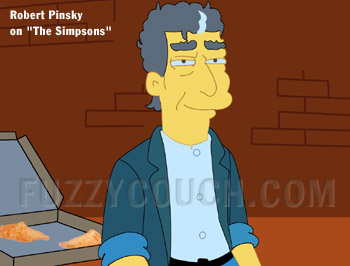
4. I put together a demonstration of this vision in Pinsky's poems, and rounded out the paper with some claims about Pinsky's rise to national prominence having a lot to do with offering this vision. And don't go doubting his prominence in the 1990s, folks. Not only was he a three-time poet laureate: he was the only living poet ever to appear as a character on The Simpsons.


So that's the gist of the essay. The assembled scholars weighed in with all kinds of good points, the highlights of which (for me) include the following:


Liesl Olson pointed out that Pinsky's emphasis on a shared national identity had its corollary in his reading style, the affect of which tends to be very regular-guy, and very oriented toward an identification with the audience, or an invitation for them to identify with him. She also pointed out that it was hard to tell if I was advocating Pinsky's view, criticizing it, or had no opinion. This last bit was particularly astute: I'd written the essay as part of a book on the last generation of Yvor Winters' students, and had tried very hard to seem disinterested for two reasons: firstly, Yvor Winters' readers tend to be very partisan, and I didn't want the book to get reduced to a footnote in the little bush war (can a bush war have footnotes?) between Winters' acolytes and his detractors; and secondly, because his students represent a range of poetries (Pinsky to John Peck), and I wanted to treat them all as social phenomena, as actions in a field of possibilities, rather than as teams for which one might root.

Robert Von Hallberg made a host of contributions, not the least of them being his recommendation of a really good soul food restaurant nearby for post-seminar hanging-out. Of more direct pertinence to Pinsky was his demonstration that Pinsky loves surprising juxtapositions for their own sake, and that my paper, if not read carefully, seemed to imply that Pinsky advocated an ironing-out of these differences that he in fact did not advocate.

In response to some comments about how Pinsky's view of American identity didn't address issues such as the redistribution of wealth (I didn't catch this guy's name), Von Hallberg pointed out that there's an interesting class angle on Pinsky, in that Pinsky has made what seems like a very deliberate decision to distance himself from the ideologies most prominent in English departments (variable forms of tenured radicalism) and affiliate himself with the kind of cultured liberalism prevalent among the American professional classes. Pinsky's move away from university presses, Von Hallberg pointed out, could be seen as part and parcel of this distancing. I was instantly convinced: Pinsky's long poem "Essay on Psychologists," for example, is in many ways a poem of affiliation with the liberal, urbane professional classes. The guy who'd grumbled about redistribution argued that Pinsky's views were determined by this class position, and Von Hallberg pointed out that it seemed quite likely that the grumbler's views had also been determined by class position. It was an interesting moment, and handled tactfully by Von Hallberg and deftly by Lee Gidewell, who chaired the discussion.
Oren Izenberg introduced another line of inquiry, in which he raised the crucial question of whether, in Pinsky's view of American identity as a matter of modernity (in Friedman's sense), one could actually go around believing what one believes. That is: if Pinsky postulates that to be American is to be an open parabola of subjectivity, always taking in and accreting new cultural influences, can he accommodate people who have particular beliefs that they don't want to see absorbed into some other tradition.

The question is important, not just for Pinsky but for navigating through a pluralistic culture: while Oren described the problem, I thought of a converation with a Muslim student here at Lake Forest College a few years ago. She was upset because the College's interfaith center, where she'd been invited to pray, had the emblems and icons of many religions on display. While she was a very broad-minded and tolerant person, she didn't want to pray in a room that represented her tradition as a part of some generalized spirituality: she wanted to pray in a space devoted to her particular tradition, in which she belived. Oren made some good points about how one accomodates such things institutionally, and raised some good questions about whether one can accommodate them in poetic enunciation.

This raised all sorts of good questions, and led me to see that I'd failed to make a crucial distinction in Pinsky's treatment of American identity: that between an idealized American Self and particular American selves. What I mean is this: in many of Pinsky's poems, the individuals he presents don't think of themselves as part of an ongoing process of cultural synthesis. They don't experience themeslves as modern selves in Friedman's sense of the word. They may even think in the sort of essentialist terms of Friedman's traditionalist selves. But despite their inability to cognize their modernity, they embody it.

I admit that the second half of that last paragraph was not my most glittering prose, so let's try an example by way of clarification. Consider "Memoir," a poem from Pinsky's book The Want Bone. Here Pinsky gives us an image of traditionalism first as a prison, then as a kind of false-consciousness for those who are actually living through a kind of modernity. The poem begins with an image of religious orthodoxy of the kind Pinsky grew up with as a version of traditionalism, defining one’s place in the cosmos and the significance of all activities. It’s rigidities are presented as confining rather than comforting:

The iron cape of the Law, the gray
Thumb of the Word:
Careless of the mere spirit, careless
Of the body…


The “sealed words” of traditional religion make an unequivocal assertion in the poem: “It was like saying: I am this, and not that.” But the absolutism and exclusivity of traditionalism are, at the end of the poem, doomed to failure, where we return to a synagogue changed beyond recognition:

The sandstone building converted now
To a Puerto Rican Baptist church,
Clerestory and minaret.
A few blocks away, an immense blue
Pagan, an ocean, muttering, swollen:
That, and not this.


Not only has traditionalism been displaced; it has been displaced by the syncretic culture of modernity, where traditions mix and accrete. The building now combines its original synagogue architecture with a Baptist service, a congregation of converted Catholics, and an Islamic minaret. The final line — “That, and not this” — undoes traditionalism’s emphasis on eternal sameness, and revels in modernity’s xenophilia. But the crucial thing is this: the people attending the church aren't going there for some kind of modern Catholic-Protestant-Jewish-Muslim fusion spirituality. They're going there for the Baptist version of traditionalism. So they falsely conceive of themselves as traditionalists, but what their actual experience, lived rather than cognized, is of the kind of accretive, syncretic, open-and-evolving modernity that Pinsky so loves and celebrates. The individual selves they experience cognitively are one thing, but the collective self they embody is another.
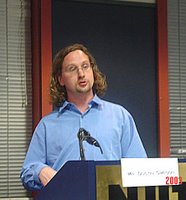
Dustin Simpson, a comp lit guy working on a thesis on modern French poetry, observed that time plays a crucial role here, even a redemptive one. Narrow traditionalisms melt away in the ongoing, fruitful processes of modernity. That they do so at a level beyond the consciousness of those experiencing them is interesting -- that the processes can only be seen by the poet is doubly interesting, at least for me. I mean, I'd always thought of Pinsky as a kind of modern-day Augustan poet, committed to plainspokenness, essayistic verse, and an Augustan reasonableness, all learned from Yvor Winters during Pinsky's grad school years at Stanford. But suddenly here was a Romantic Pinsky, a poet-visionary with a specially disclosed prophetic sense of the nation. I suppose I should have grasped this side of Pinsky earlier, when I read an interview in which he said he “was conscious of Whitman as he wrote every page, sometimes every line, of An Explanation of America."

The guy whose name I didn't catch (he who grumbled about Pinsky not addressing the redistribution of wealth) was a bit upset by this line of discussion. He didn't like the idea of someone proposing a telos to history, and said a few words about the "laughable" historical vision of Karl Marx. Von Hallberg countered by saying that anyone who wants to rise above the level of particular observation to speak of trends has to do something of this kind. Oren Izenberg weighed in by saying some interesting things about the limitations of any line of thought that prohibited positive affirmation or teleological assertion, causing my ears to prick up a bit. It all seemed very much like what Robert Baker had to say about the limits of language poetry in The Extravagant: Crossings of Modern Poetry and Modern Philosophy, a fascinating book of criticism that came out last year and that I'd only just got round to reading. "Have you had a look at Robert Baker's..." I began, but before I could finish, Oren gave a quick nodd, and finished for me: "The Extravagant. Right." He carried on, while I felt the warm glow of connection -- the two of us almost represented a quorum of that book's readers in the Chicago metropolitan region.
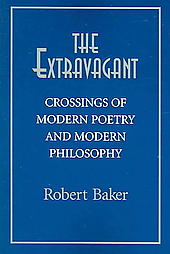
The pertinent business from Baker's book, which Izenberg used as a kind of refutation of the guy whose name I didn't catch's rejection of Pinsky, is probably best encapsulated in this passage (bear with Baker -- the quote is torn a bit roughly out of context but comes around in the end):

...the feature of this history [of modern poetry and philosophy and their critiques of instrumental reason] that I believe has been insufficiently thematized is the emergence over time of an increasing emphasis on the force of a disclosive negativity.... [M]odern poetry and philosophy ... at certain moments come to trace an indirect return to those 'de-ontologizing' discourses developed in the margins of religious orthodoxies. At any rate, many adventures in modern poetry and philosophy, in blowing open wooden conceptual idols and fixed representational schemes, begin to sound like ghostly versions of some vanished negative theology... Indeed, the languages of unmaking and undoing, of dislodging and decentering, of negativity and indeterminacy seem to have become important languages in a broad range of artistic and philosophical discussions over the last century. This is a significant long-term tendency that I would like to thematize and interrogate throughout this book in part because it is my sense that this curiously expanded reverence for the negative may have backed us into a predicament in which we devote our energy to celebrating our fear of our own constructive and transformative powers.


Baker's got a good chapter devoted to these issues, and he gives real depth to the critique of poetic indeterminacy so many people have been interested in lately.

Anyway, the pitting of Pinsky's bardic-romantic-positive-teleological vision against the sort of negative-dialectics vision of the guy-whose-name-I-did-not-catch was particularly interesting, in that it proved to be yet another iteration of a kind of class-oriented difference of opinion, pitting the professional class view (Pinsky's) against the postmodern-professorial class view.

One of Oren Izenberg's questions still haunts me from the seminar: "is Pinsky a serious poet?" He raised this in conjunction with the question of how Pinsky reconciles the syncretic, modern view of culture with the views of those who cling exclusively to particular traditions and beliefs. Inasmuch as Pinsky's poetry raises the issue (which, one could argue, is central to modern culture, from Locke to the whole interest-vs-disinterest debate of the 18th century, to postmodernism), one can at the very least say that Pinsky is a poet deeply concerned with serious things, and that he takes them up from a perspective outside those most readily celebrated in English departments.