Thursday, January 18, 2007

Live! One Night Only!


Live in Chicago! Minneapolis' very own Zach Barocas!

Z. will be reading tonight at Powell's in Chicago, 2850 N. Lincoln Ave, starting at 7:00 pm!

Clayton Eshleman's in town tonight too, but he's giving two readings, so roll over to Powell's with the true cognoscenti and literatti. Come to see and be seen! Mingle and wrangle! Meet the director of The Cultural Society, the drummer from Jawbox, and the man who blogs here!

Sunday, January 07, 2007

Probably the Dumbest Thing Silliman Has Ever Said...


Sometimes — not always, but sometimes — rebutting Ron Silliman's more extreme versions of his characteristic us-vs.-them poetic manichaenism is like playing checkers with a monkey: you can win, but it isn't really worth the trouble (No — Mr. Pickles, no! Don't gnaw on the checkerboard! And for god's sake, don't fling that at the wall! Noo-ooooo-ooooooo!). But this time out I've got to say something, since Ron has committed at least two affronts to intelligence at once. They are as follows:

1. A false assertion that Geoffrey Hill and Gjertrud Schnackenberg have "fascist" aesthetic projects.
2. A false assertion that Hill and Schnackenberg have a shared aesthetic project.

  • Some Background


    So there I was, checking out Reginald Shepherd's brand spanking new blog, when I caught his reference to a new comment by Ron Silliman. I blinked. I did a double take. I resisted, with great effort, doing a spit-take with my Dr. Brown's Diet Cherry Soda. Then I went over to Rantin' Ron's site to make sure this was really what Ron said.

    For the record, here's what I now consider Ron's dumbest comment ever. The context is Ron brooding about Bill Knott. Mid-brood, Ron picks up on Knott's discussion of some other poets, including

    ...the likes of Geoffrey Hill & Gjertrud Schnackenberg (whose aesthetic program Knott characterizes, not incorrectly, as fascist).


    This is the passage that redlined my bullshit detector.

  • Getting to the Source

    To track down the arguments about Hill and Schnackenberg's allegedly fascist aesthetics I surfed over to a post on Knott's blog. There, I found that the ideas came originally from an essay in Magma by Laurie Smith. Since Smith's essay, "Subduing the Reader" is up online, it was easy enough to check out. Smith actually has some interesting things to say about the differences between Anne Carson and Geoffrey Hill, though he's a bit dismissive of Carson. Smith actually seems to admire Hill's chops, but he's actively angry at Hill for reasons that seem to me entirely wrong.

    There are two things about Hill that enrage Smith, and Smith links both of them to what he calls fascism: Hill's allusions to high culture, and Hill's juxtaposition of past and present to the advantage of the former. Let's check these out.

  • Unbelievably Lousy Argument Number One: Dense Allusions Are Fascistic

    Here's Smith taking both Hill and Carson to task for making allusions that most readers wouldn't be able to catch without footnotes:

    ...Carson and Hill share a common aim which is achieved by a common method. It is to interweave their material with such a frequency of cultural reference that the reader loses confidence in her ability to understand, therefore to judge, what she is reading. Faced with a plethora of references to 'high' culture which she feels she ought to know but does not, the reader feels increasingly ignorant and unworthy. She is forced to accept the poem on the poet's terms or not at all; her critical faculty is subdued.

    and later:

    [Hill believes] that 'high' culture should be accessible only to a small educated elite (kept especially small in this case by oblique references and a lack of notes), leaving the majority in vacuous ignorance, strong because obedient.


    There's no ambiguity to Smith's condemnation of this as an aesthetic — at the end of his essay, he comes right out and calls it "fascist."

    There are all kinds of things one could criticize in Smith's contention. For starters, there's the idea that the subduing of the reader to a state of vacuous ignorance is the "aim" of Hill and Carson. Smith does nothing to prove that inducing this state is the goal of either poet. I rather think that including arcane allusions challenges the reader to be active, to seek out some things outside of his or her current range of knowledge. Far from being passive and ignorant, the reader has to be both active and, eventually, informed.

    Smith's argument is so strange I have to put it in capital letters just to fix it in my mind as something someone actually said:

    SMITH (AND KNOTT AND SILLIMAN) ACTUALLY SEEM TO BELIEVE THAT GEOFFREY HILL'S POEMS SOMEHOW BATTER PEOPLE'S MINDS INTO SUBMISSION AND LEAVE THEM SO EMPTY, SO FREE OF THE CRITICAL FACULTY, THAT THEY ARE GOING TO BECOME ZOMBIES OBEDIENT TO AUTHORITARIAN POWER.

    Okay. There it is. But I'm going to need, say, one piece of empirical evidence that Hill's Mercian Hymns has created a group of fascist zombies. Come on, guys, just one?

  • Unbelievably Lousy Argument Number Two: Preferring the Past to the Present is a Fascist Thing

    Here's Smith on Hill's preference for the past over the present:

    Hill's aim is that of Pound of the Cantos, his acknowledged master - to expound a view of culture in which the past is held up as admirable and the present dismissed as worthless. It is a view that brooks no argument, no discussion, and is, in the sense that Pound respectfully used the word, fascist.


    Leaving aside the hyperbole (does Hill really see a "worthless" present?) there are three things that I can think of that are problematic (by which I mean "wrong") here:

    1. To present the past as superior to the present is not to "brook no argument" any more than any other artistic or poetic position does.

    2. To prefer the past isn't always to prefer fascism. It all depends on what version of what past one prefers to what version of what present. Raymond Williams has a really good chapter on this in The Country and the City. The chapter is called "Golden Ages," and its main contention is that there are aristocratic, bourgeois, and radical-worker versions of the past, all of which can be held up as criticisms of the present. The English folk rhyme (recited by the rebel priest John Ball during the peasant's revolt of 1340) "When Adam delve and Eve span / Who was then the gentleman" is just one very brief example of the radical-worker version of preferring past to present.

    3. While Pound may have looked to the past, the poets most clearly identifiable with fascism were the Italian Futurists (Marinetti and company). As the name of their movement implies, they preferred the modern to the ancient — even going so far as to assert that "past-loving Venice" should be destroyed.

  • A Weird Assertion

    Smith's essay concludes with yet another weird assertion: that the problem of fascism in poetry isn't limited to Hill, but extends to Gjertrud Schnackenberg "who is much admired by the New Republican Right."

    Schnackenberg isn't a challenging poet of allusions like Hill (she's a New Formalist, more akin to Dana Gioia than to Hill or anyone in the Poundian tradition). So Smith must mean that a preference for the past to the present alone leads to, or equals, fascism. I think I've already given my reasons for why I think this is a lousy argument.

    I'd also add that I think it is false to say that Schnackenberg is the darling of "New Republican Right." I mean, most of those people don't read poetry. And the Republicans who do read poetry don't tend to come from the wacko wing of that venerable political party. But even granting Smith this point, one could argue that to judge a work of art by the politics of those who like it is a dicey business. Hitler, after all, loved the art of ancient Greece. That's ancient Greece, folks — the culture that gave us democracy (early, flawed, limited, but real democracy).

  • Coda

    Ooosh. That's enough for now. Anyway, my cherry soda's warm, so it's off to the fridge for a fresh one. But first two quick points by way of a coda:

    A. I suppose I'm focusing on Silliman's endorsement of Smith's arguments (rather than on Knott or Smith himself) because Silliman looms larger than the others in the small corner of the poetry world of which this blog is a part. If you're reading this, you're more likely to read Silliman than Knott or Smith.

    B. There's a good article over at Salon on the perils of throwing the word "fascist" around lightly. It is especially worth reading in these our troubled times, when there are real authoritarians out there.

  • Tuesday, January 02, 2007

    Getting Ugly: Adorno, Anti-Pastoral, and the Punk Body


    Forgive me, gentle reader, for the hyper-academic title of this post, utterly, irredeemably formulaic as it is. A punchy little phrase, a colon, a famous theorist's name, a genre, some pop culture and "the body" — half the papers at this year's MLA probably followed that format. But some day a rain will come, a real rain, that will wash all those titles from our works, and we'll go back to calling things "Aspects of the Novel" or "Some Versions of Pastoral."

    But that's not why you dropped by. You wanted to know what was up with the Adorno confab in the works between Scroggins, Park, and the present humble blogger.

    I wish I had my copy of Lipstick Traces handy, but I'm hanging out on the abandoned Lake Forest College campus today (old habits die hard — as the son of a prof I grew up in the university ghetto, and I couldn't wait for the students to head home so I could have the place to myself, scudding around the big concrete campus on my skateboard or, through a little minor-league vandalism, making my way to the rooftop of the chemistry building to read A Moveable Feast) (but I digress). So I'm here, and Greil Marcus' masterpiece repines on the radiator in my front room back at the house, pages yellowing in the late afternoon sun. And I'll have to respond to Park's new post on Adorno without throwing down the big chunks of Marcus' book I'd like to, though I can work with a few photocopies I've got in the office somewhere. Since I'm too jacked on caffeine to wait until I get home, I'll just have to freestyle, and throw in some bits of poetry from the Norton anthology (which is never far from my soft, pale, academic hands).

  • Ugliness and Anti-Pastoralism

    Park has made it to the chapter on beauty and the ugly in Adorno's Aesthetic Theory, a book he and Scroggins and I have been going through more-or-less simultaneously. Park's taken up the bit where Adorno talks about the rise of the ugly in art. Here's what Park says:

    ...Adorno concerns himself with the ugly and the beautiful. He addresses art's relationship to the 'ugly', which he situates as a more or less recent development. "The motive for the admission of the ugly," he claims, "was antifeudal. The peasants became a fit subject for art" (p. 48).


    This is familiar stuff to anyone who's spent time with nineteenth century lit: think of all those peasants in Wordsworth ("Simon Lee," "Michael" and the like). Poems like these deal a heavy blow to the feudal era's pastoral tradition of idealized landscapes and work-shy shephards who seem to spend their days lounging beneath the grape arbor pining languidly for love.

    Or go back earlier than Wordsworth, to the late eighteenth century: George Crabbe's "The Village" gives us a dire landscape of socio-economic ruin and general nastiness where we (as 18th C. readers) may have expected to read of beautiful pastoral comforts. In fact, the poem begins with a good sharp kick to the teeth of the beauties of the pastoral tradition. Check it out:

    Yes, thus the Muses sing of happy swains,
    Because the Muses never knew their pains:
    They boast their peasants' pipes; but peasants now
    Resign their pipes and plod behind the plough;
    And few, amid the rural-tribe, have time
    To number syllables, and play with rhyme;
    Save honest Duck, what son of verse could share
    The poet's rapture, and the peasant's care?


    And no, "Honest Duck" isn't a superhero, or some figure out of a mealy-mouthed Christian cartoon. He's a poet, Stephen Duck, an actual peasant, and remarkable autodidact. Sort of the John Clare of his day.

    Anyway. Oliver Goldsmith, another late 18th C. guy, does something similar to Crabbe in creating an aesthetic of the ugly in his long poem "The Deserted Village." My favorite bit of Goldsmith's antipastoral aesthetic of ugliness comes when he imagines the inhabitants of his ruined village forced to emigrate from England to the banks of the Alatamaha river, somwhere between what are now the cities of Savannah, Georgia and Jacksonville, Florida. What they find isn't pretty:

    Through torrid tracts with fainting steps they go,
    Where wild Altama murmurs to their woe.
    Far different there from all that charm'd before,
    The various terrors of that horrid shore;
    Those blazing suns that dart a downward ray,
    And fiercely shed intolerable day;
    Those matted woods where birds forget to sing,
    But silent bats in drowsy clusters cling;
    Those poisonous fields, with rank luxuriance crown'd,
    Where the dark scorpion gathers death around;
    Where at each step the stranger fears to wake
    The rattling terrors of the vengeful snake...


    Goldsmith's Georgia is so gawdaful the birds actually refuse to sing. Beauty resigns in disgust! (Last time I was in Georgia, the birds were singing full force, but that was in Athens, where the soft patchouli-scent of bohemia gentles the air).

    In one sense, all this Goldsmith/Crabbe business is all in line with what Adorno has to say. Here's a bit of Aesthetic Theory (quoted by Park) in which Adorno spells out the function of the ugly in terms that seem to describe what's happening in Goldsmith and Crabbe:

    Art must take up the cause of what is proscribed as ugly, though no longer in order to integrate or mitigate it or to reconcile it with its own existence through humor that is more offensive than anything repulsive. Rather, in the ugly, art must denounce the world that creates and reproduces the ugly in its own image, even if in this too the possibility persists that sympathy with the degraded will reverse into concurrence with degradation. (p. 49).


    Crabbe and Goldsmith give us a kind of ugly very different from, say, Shakespeare's comic ugliness (Falstaff, Dogberry, etc.). The ugly isn't in their poems for an (inherently classist) comic relief. It's here to throw the crappiness of the unfair and unjust world in our faces. In this, it's of a piece with the whole Zola groove of late nineteenth century Realism and Naturalism: it shows us the suffering people in art in order to condemn the world that creates ugliness and suffering.

  • Antifeudal Ugliness? Not So Fast!

    But in another sense all this evidence points in a slightly different direction than the first passage of Adorno points. I mean, from Goldsmith and Crabbe in the 18th C. through Wordsworth in the early 19th C. on to Zola in the late 19th C., the protest art makes via the rejection of traditional ideas of beauty isn't "antifeudal" at all: it's anti-capitalist. Sure, Wordsworth and Goldsmith explode the pastoral tradition, but in both cases they are protesting against the end of a sort of late feudal world, against the destruction of that world by capitalist developments. In Wordsworth's "Simon Lee," the problem is that the eponymous protagonist has been displaced from his old livery-wearing job as a huntsman in a nobleman's house. The decline of the aristocracy is a bad thing here, not a happy development (after his early revolutionary zeal, Wordsworth became a kind of Burke-reading conservative — for which Shelley never forgave him). And Goldsmith's village has been decimated by the enclosure system — the closing of small tenant farms so that landlords could keep flocks to grow wool for the emerging capitalist-owned textile industry. So the poem can hardly be taken as a protest against the residual feudal order. (Crabbe's another story — I don't think he's nostalgic for anything. He's like the old donkey in Orwell's animal farm, the one who thought that things have always been bad and always will be bad, a general miserablist of the first order, and therefore really very good reading for a bad day, when you want to cast a curse on all houses). And Zola? Fuggetaboutit — there's no nostalgia for feudalism in his work. But there's plenty of anxiety about capitalism — the lead character of Nana is a nightmare of capitalist consumption (of course Adorno has a lot to say about anti-capitalism in art and literature and music too).

  • Adorno Meets Johnny Rotten

    But here's where I want to bring in Greil Marcus' Lipstick Traces and his riffs on punk style. I've got a hunch that had a mischevious God plucked him from his study where he'd repaired to listen to Alban Berg, and plopped the bewildered philosopher down backstage at a Sex Pistols concert, Adorno wouldn't much like what he heard or what he saw. But in a way Punk seems very much in line with the kind of aesthetics of ugliness Adorno goes on about. There's the deliberate crudeness of the music, but there's more, too: think about the late-seventies, King's Row punk body-and-clothing parade.

    "It's hard to remember how ugly the first punks were" — that's one of Greil Marcus' great lines in Lipstick Traces, and he couldn't be more right. I mean, think of it, before it all got cleaned up and domesticated and marketed in that Great All-Consuming Maw of Capitalism way. The unbearable ugliness of Doc Martens, the affrontery of the big-ass safety pin through the face, the ripped up, filthy, S&M-inflected outfits, the penchant for spit and vomit — it's all more or less of a piece with the idea of the ugly as a protest against or refusal of social conditions. For starters, there's the great refusal of instrumentality and use-to-the-system of it all: back in the late 70s, you dressed that way and modified your body that way and talked that way in order to declare (and choose) your unemployability. You felt like a social leftover and you chose and declared that status, throwing it in the face of whoever came your way. Here's a bit from Marcus, not quite the one I wanted, but the best bit I've got with me right now:

    They were ugly. There were no mediations. A ten-inch safety pin cutting through a lower lip into a swastika tatooed onto a cheek was not a fashion statement: a fan forcing a finger down his throat, vomiting into his hands, then hurling the spew at the people on stage was spreading disease. An inch-thick nimbus of black mascara suggested death before it suggested anything else. The punks were not just pretty people, like the Slits or bassist Gaye of the Adverts, they made themselves ugly. They were fat, anorexic, pockmarked, acned, stuttering, crippled, scarred, and damaged, and what their new decorations underlined was the failure already engraved in their faces. The Sex Pistols had somehow permitted them to appear in public as human beings, to parade their afflictions as social facts.


    And that's why we like Greil Marcus more than we like Lester Bangs, boys and girls: the insight that things like punk bodies were a statements, throwings of ugly "social facts" up into public view. (Lester Bangs' freaky homophobia also doesn't help his cause) (but I digress yet again) (but I can't stand it that Bangs couldn't appreciate glam rock, so I beg your indulgence).

  • But Wait...

    But there's a catch:the whole aesthetic of the ugly thing has a tendency to drift away from being a refusal of the existing social world into being something that sophisticated people use to re-enforce their elite class identity.

    I was saying that the ugly as protest becomes something different. I'm thinking of what Pierre Bourdieu points out in another book I don't have with me, Distinction. One of the things Bourdieu's data points to is this: that people without a lot of cultural capital (that is, people who don't have a lot of background in the kind of cultural attitudes and tastes that the society as a whole views as prestigious) don't groove on the ugly. They prefer photos of non-abject subject matter to photos of stuff people think of as abject. I think the examples were pictures of first communions vs. pictures of potatos — I could be wrong, but it was something like that. There was a kind of inverse relation between cultural capital and the kind of subject matter people preferred in their art. If you're one of the culturatti, you're more likely to appreciate a photo of rotting potatos ("such fantastic contrast between the deep blacks and the pale highlights!" "what texture!") than you are to appreciate the overtly beautiful aesthetic ("girls in their pretty communion dresses — so banal!"). And the other way around, too. So in a weird and ironic way, the anti-social aesthetic of ugliness that we see from Crabbe and Goldsmith down to Sid Vicious and Johnny Rotten can turn into a sign of one's relatively high social status: only the rubes shudder at the ugly, so embracing it becomes a sign of savoir-faire.

    So, here's my question: how does Adorno respond to this kind of irony? I'm sure he does, somewhere. Let me know, Adornonauts...

  • In Other News

    Brian Campbell and R.J. McCaffery have some interesting posts up on the ever-ongoing absorptive/antiabsorptive art debate.

  • Friday, December 29, 2006

    The Heresy of Paraphrasing Adorno


    This is kind of a belated response to some email I got about an Adorno post many weeks ago, in which I was accused semi-accurately of defiling Adorno's dearest truths by trying to explain a very few of his ideas as clearly as I could, and giving examples in the process. It's true Adorno wouldn't like the kinds of things I attempted, but then again, I don't think we need to treat his desires and beliefs as absolute truths. It might not even be the best way to respect him — as someone once said to me in a bar in Indiana, reading against the grain is the sincerest form of flattery.

    Anyway:

    We (I am embarrassed to see that I mean "we, the professoriate and/or literati" here, or something similarly mandarin) tend to sneer, nowadays, at Cleanth Brooks' notion of "the heresy of paraphrase": it is, after all, just another New Critical cliche that once hampered the adventurous reader. But we cower before the Inquisitor Adorno when he pronounces the same edict, and labels as heretics those who would say positively what he by negation. One midcentury view of the ineffabilty of the text is treated as outmoded, the other is treated as TRVTH.

    But isn't paraphrase like translation? I mean, aren't both of these like the performance of a musical score? They can be well done or poorly (the Chicago Symphony Orchestra under Solti vs., say, the least-successful youth orchestra you've heard) — but the fact that no performance exhausts the totality of the score's potentials doesn't make it wrong to perform the score in the first place.

    Adorno as the deaf Beethoven who hears the music only in his thoughts.

    And isn't there an irony in Adorno saying of Heidegger, in The Jargon of Authenticity "he lays about him the taboo that any understanding of him would also be a falsification." (Martin Jay pointed this out in Adorno — though weirdly Jay didn't say anything about the other parallel between Heidegger and Adorno: both came to the conclusion that German was somehow a special language, with unique affinities for philosophy — creepy moment of Deutsche sprache über alles).

    I know Adorno wants the kind of truth he wants to get at to be transcendent, above any commodification or reification. But I believe in the need to try to incarnate the transcendent — with the proviso that we make it plain to ourselves and others that these attempts will be innacurate — almost as innacurate as reverant silence.

    Tuesday, December 26, 2006

    Samizdat Notes to Alt-Poetry: A Potentially Good Idea Upon Which I Probably Will Not Act


    So there I was, going over my notebook of annotations to Maurice Scully's two new books, Sonata and Tig for the review I was writing, when a small, buzzing lightbulb appeared over my head. At first it gave off no more than thirty or forty watts, and was more of an annoyance than anything else. But as its light grew and grew, and I was able to switch off my reading lamp and contine to work by the light of my idea alone, I finally came to the conclusion that I may be on to something.

    And that something was this: if I were to post my reading notes to the various relatively unsung books of poetry I teach, review, or otherwise get into with some degree of seriousness, and make those notes available to the public, then I might have the basis for a substantial critical treatment of each book. If I were to put those comments into a wiki, then those who were interested could add their notes and observations Wikipedia-style, and pretty soon we'd have something like a "reader's guide" to each of the books. And if I were to create a format that kind of echoes the Cliffs Notes or SparkNotes format (though, you know, not so thoroughly as to get myself sued), the whole thing could be kind of cool. I mean, I'd love to be able to go to the "Study Questions and Essay Topics" section and see what people had put up -- I imagine at least 50% of the attempts to be funny would work, and there may even be some serious, worthwhile areas for futher inquiry outlined there.

    I admit, I owe many of the watts coming from my lightbulb to the Bill Allegrezza Electrical Company -- Bill's recentlys set up some kind of Wiki for poetry discussion, which I've been meaning to check out.

    So. Whaddaya think? Is this something you could get behind? Is it something to which you'd contribute? Would it be instantly vandalized by haters, oddballs and highly partisan freaks (who are, after all, our people, here on the fringes of alt-poetry land)? Drop me a line (my email is on my profile page) before the new semester starts and my zeal wanes and, if there's an overwhelming outpouring of support, odds are even that I'll actually make it happen.

    Friday, December 22, 2006

    Not a Good Sign


    So we now live in a country where this happens. One could say something about the irony of an administration that says it fights against those who "hate freedom" turning around and censoring the news. One could point out how this latest action is of a piece with the creeping authoritarianism of an administration that has gutted habeas corpus, sanctioned torture, run secret prisons, and continually lied to a public for which it clearly has contempt. One could point out how censorship of the press is perfectly in line with the general outlook of an administration that maintains the president is in effect above the law. One could look toward the future with trepidation.

    But right now I'm too sad for any of that. This has happenend, here.

    Thursday, December 07, 2006

    Difficult Pleasures


    Josh Corey, Eric Selinger and Mark Scroggins have been blogging up a storm about difficulty and pleasure in poetry (and, as always seems to be the case when difficult art comes up, ethics and politics have reared their sober heads). There's some interesting stuff going on, but I'm not at all sure there's a conclusion available, and some of the terms of the debate seem a bit squishy. For what it's worth, here's my take...

  • The Story So Far

    Josh began by writing about the different kinds of pleasure he gets from reading different kinds of texts. Long story short, he makes a distinction between the relatively easy and, to his mind, somewhat passive pleasures to be had from reading mainstream fiction (Richard Russo's novel Straight Man being his primary example) and the thorny, effortful pleasures to be had from reading experimental poetry. From the way he talks about this second class of texts, he seems to be thinking mostly of Language Poetry. And he uses one Language Poet's categories for his discussion, taking Ron Silliman's terms "absorptive" and "antiabsorptive" to describe the experience of reading mainstream fiction and alt-poetry, respectively. (For those of you who've gone a little foggy on Silliman's terms, the breakdown is like this: for Silliman, absorptive texts give you language that you don't notice as such, and allow you to settle back and watch a mental movie. In contrast, the anti-absorptive text throws a bit of a linguistic monkey wrench into the movie machinery, stopping the show — we have to confront the language in its unassimilability to our ordinary reading processes). Josh says he likes both kinds of reading for different reasons (the absorptive text, he says, will get you through a long flight better than the anti-absorptive text, and as a guy who suffered through a long wait in the Rejkjavic airport with nothing but Gulliver's Travels, a Toblerone and a bottle of duty-free scotch to sustain me, I feel Josh on this one). But Josh sort of worries about the non-hierarchical nature of his pleasures. Aren't the difficult texts somehow better for us, he wonders?

    Eric Selinger jumps in with his answer to this last question: a resounding No. In Eric's view, it's all good: straightforward texts, difficult texts, what have ya. He rejects the kind of moral hierarchy that Josh raises as a possibility. He rejects the dichotomy of purely-absorptive and purely-antiabsorptive texts (yet another one of Silliman's dichotomies crumbles under scrutiny). Eric also points out that the difficulty of a text is subjective, not objective: the mainstream fiction that Josh breezes through with ease is easy to him beacuse he understands the conventions well. Other people might struggle with it (the way I do when reading French or Swedish, where my skills are taxed by Le Monde and the Sydsvenska Dagbladet, let alone the poetry of Mallarme or Jesper Svenbro). This last point raises another idea (one Eric doesn't explore much): that something like Language Poetry isn't necessarily "difficult" to its primary readership: other language poets and the profs who swarm around them. (I try to follow this idea up a bit in a review of Allen Fisher's Gravity, among other books, in a soon-to-be-released issue of Pleiades: check the lit-journal section of your local supermarket for copies).

    Enter Mark Scroggins. After giving a summary of the debate much like the one I'm giving now, he takes sides, saying that he, like Josh, feels that there is a sense in which the difficult, anti-absoprtive text is better for us — if not in terms of pleasure, then morally or ethically or politically. Mark presents this as a gut feeling, rather than an argument, and admits that the various arguments for this position that he's encountered don't ever satisfy him for long. But he does give us some sense of what lies behind his gut reaction (and no, it isn't the volcanic south Florida hot sauce he uses as a metaphor for challenging reading): he tells us that the difficult, anti-absorptive text is connected to our ability to recognize the Other as Other (with all Lacanian capitalizations intact). The otherness of unabsorbable language becomes a kind of homology for the otherness of the Other, and our recognition of it somehow makes us, you know, better.

  • Some Problematic Equations


    Here are some assumptions that creep in here and there at the edges of this (interesting, stimulating, end-of-semester brightening) discussion. They are, I think, questionable, if by questionable we mean wrong.

    Difficult = Anti-Absorptive = Ethical

    Both of the equals signs in the above equation are problematic.

    1. Difficult = Anti-Absorptive

    Okay, so this is problematic in two ways. Firstly, there's the point (implicit, I think, in Eric's piece) that difficulty is something experienced by the reading subject, rather than inherent in the textual object. What's difficult for me may be easy for you, and vice-versa. This goes for all schools of "difficult" poetry. I mean, the formidably difficult works of Modernism have become pretty straightforward to thousands and thousands of readers over time, as we (I fear that is the professorial "we") have internalized the linguistic conventions with which they were written.

    Secondly, the equation of "difficult text" and "text that defies ordinary conventions of usage" leaves out a whole range of difficulties, from allusions to matters of sympathy-with-the-devil (I've harped on about this so much before, I feel I ought to leave it alone for a while). (It is also a part of the Pleiades piece I mentioned).

    2. Anti-Absorptive = Ethical

    Man, this idea just won't die. I mean, the idea is better than a century old, in one version or another (not to keep pointing to my own stuff, but I've got an essay on this coming out next year sometime). There have been all kinds of versions of it, from the Surrealist notion that their particular form of strangeness was fundamental to any true political revolution, through Brecht's revolutionary hopes for the baring of the device, and on to the more modest claims of the Langpo and post-langpo types, who so often to equate linguistic rupture and the like either with resistance to commodification (see Charles Bernstein's "The Value of Sulfur for a brief and distilled version of this argument) to the notion that it defamiliarizes our habitual perceptions of the world and therefore opens us up to the Other (the position dear to Mark's heart).

    I can see two problems with this equation. Eric points to the first when he says, a propos Mark's statement that his instincts point in the direction of this position, "show me the money." We'd need actual evidence that this stuff works, and such evidence is on the threadbare side.

    The second problem is this: it is wrong to imply that only the defamiliarizations of anti-absorptive art can truly bring us into relation with the Other. I mean, Mark's protestations that the Russian Formalists had a stake in the avant-garde notwithstanding, we would do well to remember that Victor Schlovsky (the man who gave us the concept of defamiliarization in his essay "Art as Technique") used Tolstoy for all (or was it almost all? I'd have to check, and the book is way over there, behind the stack of essays I'm supposedly grading right now) of his examples of defamiliarization. And one could point to plenty of entirely absorptive, formally conventional works that have gone a long way toward bringing people like me into contact with cultural otherness. Chinua Achebe's Things Fall Apart, for example, gave me rich sense of the otherness of Nigerian history. Ditto Thomas Hardy for English country life of the last century. Ditto Charlotte Bronte for the contradictions of feminine desire in a patriarchy. I don't think I came away from anything by Lyn Hejinian or Catherine Daly with this much of a sense of otherness. (Josh points to a sharp essay on science fiction and experimental poetry with some bearing on all this). Which is not to say I don't find a huge value in anti-absorptive texts: I just don't think the window-to-otherness argument is very tenable.

  • Other Stuff to Consider

    1. Hierarchy and telos. I can't quite be down with Eric's "it's all good, to hell with the hierarchies" position (if that is in fact where he's at). I think it is inevitable that we have hierarchies for different kinds of pleasure -- every time we put one thing rather than another in our Netflix queue, we make an implicitly hierarchical decision. The trick is not to seperate hierarchy from telos: when we ask "is this better than that?" we're really asking "is this better than that for some particular end or purpose." Josh began with a kind of acknowledgement of this when he praised the "it will get through a long flight better than a bucket of Bernstein" virtues of the Aubrey/Maturin novels of Patrick O'Brian. But by the end of his post he'd been consumed by doubts, and seemed to wonder if there wasn't an absolute (rather than telos-driven) hierarchy, in which the anti-absorptive was absolutely (rather than relatively-with-regard-to-a-particular-telos) better. Gotta have the telos if you have the hierarchy.

    2. We aren't really talking much about pleasure any more. We've gone into ethics. What kind of pleasure does anti-absorptive writing actually give, and how is it distinctive from other kinds of reading pleasure (if, in fact, it is different) is a question we haven't done much to answer, although Eric gestures toward this kind of thing when he starts asking about Aristotelian eudaimonia in contradistinction to sensory pleasure (though the sensory, bodily pleasure of reading is generally minimal — way, way, way below neck massage, say, and not anywhere near the cold beer/hot day nexus).

    3. We need some actual data. I know all of the soulfull-eyed, soft-handed humanists of the world blanche at the those two syllables, for I am of that tribe myself, and nurtured in its non-empirical ways. But while my heart yearns for the kind of humanistic interrogation of pleasure Eric outlines (he calls for a discussion invoking "Barthes, Adorno, Freud, Lacan, even Aristotle"), my head tells me we'd do better to have some new information to work with, of a kind that can be measured with actual scientific instruments. You may snicker, oh my fellow humanists, but researchers have been doing interesting things with neural imaging and the humanities — there's been, for example, some interesting work on what happens in various parts of the brain during meditation and what the subjects of the experiments describe as religious experiences (long story short: when people report feeling a mystical union with the universe during Bhuddist meditation, it seems that they've managed to reduce the flow of blood to the part of the brain responsible for showing us our location in time and space). I know the Archambeau Institute for the Neurobiology of Aesthetic Experience isn't going to come into being in my neck of the liberal arts, but I think some serious research into what actually happens in the brains of different readers as they have different kinds of textual and aesthetic experiences would be an important beginning to getting beyond the "my favortie kind of art happens to be good for you and will open your mind to the Other" assertion as a justification for experimental art and writing. Go Big Science!


    4. I'm not through reading it yet, but it looks like Simon DeDeo's new essay on anarchist poetics may have some bearing on all of this. So I'm off to read the rest of it now — what better way to put off reading that pile of essays?

  • Tuesday, December 05, 2006

    Glam Rock: The Poem


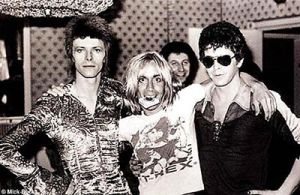
    Hot off the internet, the first issue of Absent is up and running! Check it out for Simon DeDeo's new essay "Towards an Anarchist Poetics," as well as for translations of Mandelstam, for poems by Pierre Joris, and much else besides, including my own "Glam Rock: The Poem," which is about the famous image of David Bowie, Iggy Pop, Lou Reed and Tony Defries (pictued above). There's also a sharp new image, with text, by Johanna Drucker. Dig it!

    Monday, November 27, 2006

    The Liberation of Postmodern Theory


    This is great! I mean, you might not think so, on the surface of it. The event itself is one that may seem like a bit of a downer, or at least an inconvenience: the theft of two copies of Avant-Post: The Postmodern Under Avant-Garde Conditions, right out of the envelope, while they were in transit from Prague (where they were published) to Lake Forest College, where I'd hoped to carry them around under my arm until someone asked about them, at which point I'd casually respond "Oh, these? Another book to which I've added a modest contribution..."

    But think about what this means! An international ring of theory thieves, hungry for the latest international postmodern avant-garde ruminations! A market we can't saturate no matter how many copies we print! A yearning by the penniless oppressed subalterns for the books of theory they can't afford to buy! An anarcho-punk coalition that refuses to pay The Man for its theory fix! Oh yes, my people, the Joyous Revolution of Love can't be too far off, now that bank heists have been replaced by the mail-snatching of avant-gardist fulminations! Utopia is at hand! Or, you know, maybe someone thought the envelope contained DVDs or a video game. But I'm sticking to my theory.

    Tuesday, November 21, 2006

    Archambeau World Tour Winter 2006 Update


    I know you've probably parked the VW microbus you were using to follow me on my world tour this fall, but hold off on fumigating the hippie-funk out of that sucker for a few more days -- I'm adding another gig, and you and your hacky-sack playing, tree-hugging buddies will no doubt want to show up and make a bootleg tape of the rare event. And it's for a cause! Admittedly, "Poets for Human Rights" is about as surprising a cause as "Bankers for Money," or "Fox News Pundits for the Distortion of America's Highest Ideals" but roll with it, peeps. It'll be a good show, featuring a bunch of Chicago's Finest Poets. Here's the press release:

    Poets for Human Rights
    Speak Out Against Systemic Injustice!

    On December 10, 1948, in response to the tragedies of World War II, the United Nations adopted the Universal Declaration of Human Rights. Fifty eight years later, on May 18, 2006, a resolution was submitted in support of a national day and week honoring human rights—this, to the same congress that legalized torture and immunized torturers against prosecution for war crimes.

    Speak out against the injustice committed in our name with Poets for Human Rights: an evening of social engagement featuring the poetry of Robert Archambeau, Emily Calvo, Nina Corwin, Teneice Delgado, Maureen Tolman Flannery, Francesco Levato, Christina E. Lovin, Brent Mesick, Erika Mikkalo, Simone Muench, Charlie Newman, Kristy Odelius, Steven Schroeder, Rachel Webster (and more to come).

    For more information visit Poets for Human Rights.

    Date: December 9th, 2006
    Time: 7:00 PM to 9:00 PM
    Location: Acme Art Works, 1741 North Western Avenue, Chicago, IL

    Tuesday, November 14, 2006

    The Adorno Files: Hideous Progeny of the Culture Industry


    Park has some new notes on Adorno's Aesthetic Theory, including this interesting observation:

    Adorno seems to argue that art in general is losing its autonomy because of the encroachment of the culture industry (significantly, a term he uses for the first time in this book just before this quote I'm dealing with). He does not allow that there may be some differences between different media in this. It's like some master switch has tied the essence of all art together, and ruined it all at once. I suggest that the process he describes--to the extent that it can be said to exist--is almost certainly more messy.


    Park goes on to mull over the differences between music, visual art, poetry etc., in their capacity as things appropriated by the culture industry. But the interesting thing for me is this: the universality of Adorno's claim about the absorptive power of the culture industry (at the early point in Aesthetic Theory Park's talking about -- the second section). On the one hand, I want to point at all manner of exceptions, all of those kinds of art that work resolutely to remain uncommercial and unquantifiable — everything from Dada to Language Poetry to Punk. Then again, I can see how in some clever dialectical way Adorno is probably right about these forms being influenced by the prescence of the culture industry. I mean, you don't find many seventeenth-century poets or painters or composers working delieberately to distance themselves from, or immunize themselves against, a relentlessly commercial culture industry. The culture market just isn't developed enough to seem like a threat to artistic integrity (whatever that may mean). So Dada or Langpo or Punk can be seen as conditioned by the culture industry by virtue of their reactive rejection of it. By virtue of their attempted negation of the culture industry, they are its dissident offspring (long may they wave). One imagines a personification of the culture industry looking on them with a horrified recognition, seeing them as one's own yet horrified at their altierity, their otherness, and saying, like Mary Shelley a propos her Frankenstein, "behold my hideous progeny!"

    Saturday, November 11, 2006

    Is There a There There? The Idea of Chicago Poetry


    So I'm back from Iceland, which I'm defining as "the country with the landscape that tries too hard" — as you drive around the countryside, you can almost here it calling out to you, saying "glaciers! glaciers here! get your glaciers! What? Not into glaciers? Not a problem. How about a geyser? Would a geyser be something you'd be interested in? No? How about if I throw in a waterfall? Make that two waterfalls! And a gorge! With steam coming out of it! And a lava field! How about some hot springs? Could I interest you in some hot springs, with maybe a bubbling mud field thrown in for free, eh? Eh?" Extrordinary, really.

    Anyway. In a couple of hours I'm going to be giving a paper at the Midwest Modern Language Association, which is being held here in Chicago this year. I'm on a panel on Chicago poetry, run by the redoubtable Bill Allegrezza, and here's my paper in its current, slightly rough-around-the-edges state (I haven't proofed it, because I thought I'd only be delivering it out loud, but when someone suggested I throw it onto the blog, I couldn't think of any reason not to, so here it is, replete with whatever stylistic errors remain). It's called "Is There a There There? The Idea of Chicago Poetry." Some of you may recognize a few of the quotations from Paul Hoover, and a stray comment or two, from other posts on this blog. Auto-plagiarism is okay on the internet though, right?

    A shout-out goes to Michael Anania for talking through some of this with me from Austin, and another shout-out to Dave Park for listening to me run all this by him while he was trying to eat a Monte Christo sandwhich.

    **

    It was 1937 when Gertrude Stein, ensconced in Paris, said of her native Oakland that “there is no there there.” It was her way of justifying a move from the provinces to the glittering literary metropolis. Since Chicago is paradoxically both province and metropolis, with all the anxieties and complexes appertaining thereunto, I suppose the question “is there a there there?” is pertinent to our city as a center of literary — and, more particularly, of poetic — production. Certainly there are poets in Chicago, of both innovative and conservative stripes, and there have been for generations. But is there something we could call Chicago poetry, and is it in some way innovative? Is there, poetically speaking, a there here?

    The answer seems to be yes, according to the city’s poetic movers and shakers. But the yes is a very strange one, for this reason: at almost any point in Chicago’s literary history, you can find someone claiming that there was no distinctive, innovative Chicago poetic scene until that very moment. I exaggerate, of course, but you get the general point: over and over again, for just shy of a century we find people willing to say that the natives were without any authentic poetic culture until a great pioneer came along and made the heroic effort to civilize the wilderness.

    What I’d like to do today is to root around a little in the documents of our city’s poetic history, with an eye to the way certain myths of origin crop up again and again. I’d like to focus on three in particular, which I’m calling the myth of the aboriginal as missionary; the myth of benevolent eclecticism; and the myth of a poetic freedom that resides in having nothing to lose. By myth here I don’t necessarily mean “falsehood” — although you have to be more postmodern than I am to believe that all of these origin stories (in which the tabula rasa of Chicago suddenly becomes a city with a distinct poetic life) can be true. I suppose I mean “myth” in something like an archetypal sense, as a story that different generations seem to come to again and again, consciously or (more likely) unconsciously imitating their predecessors.

  • The Myth of the Aboriginal as Missionary

    Before the twentieth century, Chicago’s image of itself as a poetic city was humble enough. To judge from these words of Chicago poet Eugene Field, taken from his 1887 collection of literary journalism, Culture’s Garland, Chicago was a culturally self-hating backwater, almost unworthy of the Missionaries of Culture and Poetry sent to its embarrassingly commercial streets from the east coast: “The presence of [the visiting Bostonian poet] Mr. James Russell Lowell,” writes Field,

    …Has given Chicago a tremendous boom as a literary center…. This impetus first became apparent last Saturday afternoon, when one of the distinguished members of the Chicago Literary Club — a manufacturer of linseed oil — happened to call at the office of another distinguished member of the club, a wholesale dealer in hides and pelts. “I see by the papers,” said the first litterateur, “that James Russell Lowell is going to be in town next week.” “Lowell? Lowell? Oh yes, I remember, the author of ‘The One-Hoss Shay’” “Yes, he’s going to read a poem in the Central Music Hall next Tuesday” explained the first litterateur and it occurred to me that we ought to elect him an honorary member of the club.” “Well,” said the second litterateur, “we’ll think about that…. Here, you, Jim, go up on the back roof, and drag in them calf-pelts out of the rain!”


    The eastern missionary comes among us and we are, it seems, not worthy, being mere hewers of wood and haulers of calf-pelts. But this nineteenth century poetic abjection all comes to an end in 1912, with Harriet Monroe’s founding of Poetry magazine. From this point on we Chicagoans won’t be mere aboriginals craving guidance from eastern missionaries. Now we will generate our own missionaries to ourselves, local literati able to spread up-to-date ideas about poetry to the locals. Monroe saw herself as bringing, to a poetic scene that could only with great charity be described as mediocre, indeed non-existent except in embarrassingly provincial form, a beacon of the innovative and modern. Where there was nothing, suddenly there was something not only substantial, but advanced, innovative, world-leading, right here in Chicago.

    But there’s curious combination, in Harriet Monroe’s writing, of two seemingly contradictory views of Chicago. On the one hand, it appears as a provincial place to which her magazine is bringing the innovative poetic light from the distant cities where Real Art happened. “We women of the staff and our visitors used to have lively discussions…and each new letter from Ezra Pound sharpened the edge of them,” she writes in her memoir A Poet’s Life, thinking of the glamour of “Ezra’s and Hueffer’s [that is, Ford Madox Ford’s] groups in London.” On the other hand, Chicago appears as a metropolitan place, creating a new poetry that is in some sense both distinctive and shockingly cutting-edge. We get a good sense of this from her account of publishing what was to become the signature poem of the city, Carl Sandburg’s “Chicago”: “Alice [that’s Alice Corbin, a poet and also a reader of manuscripts for the magazine] had handed over to me a group of poems in very individual free verse, beginning with ‘Chicago’ as the ‘hog butcher of the world.’ This line was a shock at first, but I tool a long breath and swallowed it, and was laughed at scornfully by critics and columnists when we gave it the lead in March 1914.” So on the one hand Chicago is a mere backwater, a knitting circle awaiting letters from the spectacular elsewhere of London. On the other hand it is an advanced place, an envelope-pushing center of innovation happy to epater les litterateurs.

    It’s not just Monroe who feels this: the provincial/metropolitan tension (in which Chicago seems to be both an innovative leader with its own distinctive style and a provincial follower of developments in London and Paris) is epidemic in the Chicago poets of the period. Floyd Dell, for example, wrote of the early years of Poetry magazine as a time when Chicago fostered “a growing youthful body of [distinctly] American literary taste … nourished … upon the very best European literature and the civilized modern standards.” Which is it — an authentic, advanced Chicagoan American poetic, or the reflection of the real action taking place elsewhere? For him, it seems to be both at the same time.

    The persistence of the pattern of thinking we find in Monroe and her circle in the nineteen-teens is remarkably persistent. Again and again, we find Chicagoans describing themselves as coming of age in a city without a significant past in innovative poetry, then making their own innovative scene. And just as persistently, we find descriptions of that new scene to contain a strange tension between the idea that Chicago has some distinction of its own, some aboriginal virtue, and the idea that the poet in question is a kind of missionary bringing us up to date with New York or London or Paris of San Francisco. Such discussions aren’t exclusive to poetry, by the way: discussions of these kinds take place among prose writers like the Chicago realists and naturalists, from Dreiser through Algren – but these discussions take place perennially in poetry, notably in the 1960s with poets like Paul Carroll and Michael Anania.

    Perhaps the most notable recent instance of the pattern I’m describing came about in 2004, at the AWP convention held (if memory serves) at the Palmer Hilton. This is where Paul Hoover gave the talk “My Kind of Town: Local Literary Community,” later reprinted in the Chicago Review. Echoing Harriet Monroe some 92 years before him, he sees his city as having been something of a dire poetic backwater before his arrival. “For years,” he tells us, “Chicago was a fly-over city.”

    The real world of literature existed on the coasts. Chicago's main poetry event used to be Poetry Day, sponsored by Poetry. In 1972, at the suggestion of Paul Carroll, a few of us, including Lisel Mueller, Mark Perlberg, and Martha Friedberg founded the Poetry Center at the Museum of Contemporary Art. The idea was to bring poets to Chicago to read their work. For the same reason, to leap high enough to connect with what was not local, Maxine [Chernoff] and I published New American Writing, which sponsored a reading series at Links Hall, and served on the board of the Poetry Center. San Francisco comes ready-made. Someone else did the work of building (Kenneth Rexroth, the Duncan and Spicer circles, and so on). Chicago remained to be built.


    And that building, it seems, fell to Paul and his comrades in the art. His description of his own tasks comes across as somewhat Herculean, in a professorial kind of way:”I taught a double load in the fall semester of each year (five classes), ran a reading series with eight to ten annual events, took responsibility for two poetry magazines, and coordinated a growing undergraduate poetry program.”

    The result of all this building was, in Hoover’s narrative, a distinctly Chicago-inflected innovative poetry and a set of institutions to support it. “…In Chicago, my role as a teacher, editor, organizer of poetry readings, and poet was to encourage openness to the ‘new’,” he writes. And his efforts stand, in this version of the origin myth, behind the current framework for innovative poetry in Chicago, a network of institutions that prove that the city has finally become pure metropolis, leaving its provincial past behind. Here’s how Hoover puts it:

    I have a printout from the website chicagpostmodernpoetry.com. It shows the incredible growth of experimental poetry in Chicago in recent years: The Discreet Series, the Danny’s Tavern Series, the Chicago Poetry Project, the Myopic Poetry Series, Chicago Review, and Conundrum. To that list I would add Flood Editions, edited by Devin Johnston and Michael O’Leary, Peter O’Leary’s magazine LVNG, Columbia Poetry Review as formerly constituted, Another Chicago Magazine at its most Beat, the recent arrivals of Margy Sloan and Bin Ramke, among others, and a new openness to such writing at the School of the Art Institute and the University of Chicago….One can now say “Lisa Jarnot is in town” or “Ron Silliman is reading at the Chicago Poetry Project.” In this respect, the city has finally grown up.


    So that’s that. No longer a wilderness of calf-pelt dragging rubes hypnotized by the coastal elites, we are a shining city on a hill — or at least on a stretch of lakeside prairie. But not so fast. Just like Monroe before him, Hoover seems haunted (even in these moments of local pride) by the sense that the real cutting edge is elsewhere. Some of the highest praise he can offer to the poetic city that he helped found is this: “there’s almost as much experimental activity in Chicago as in San Francisco!” If you want to judge where the real metropolis of innovation is, you’ve got to ask whether the New Yorkers or San Franciscans are making comparisons of themselves to us, here in the second city. One rather suspects not. Moreover, even in an essay in which he claims Chicago has “finally grown up,” we see that true poetic validation still comes from other (mostly coastal) places. When Hoover describes the ascent of Chicago-born innovative poets, for example, he does it by telling us the glamorous places to which they have escaped: “My students,” he says, “were being accepted into the country’s leading MFA programs: Brown, Bard, Columbia University, the University of Iowa [and] Bennington.” If his other students went on for further study in our own city, it was study of a sort to humbly local to mention.

  • The Myth of Benevolent Eclecticism

    So the persistent myth of origin — the recurring sense that we as Chicagoans have to establish something up-to-date in what we secretly fear is our backwater town — remains with us. But I’d like to turn now to another recurring theme of Chicago poetry: the idea that our true innovative nature lies in an aversion to orthodoxy, in a benevolent eclecticism of experiment. Here, as always, Harriet Monroe anticipates all who will follow. Describing the Poetry magazine circle’s discussions of poetics circa 1913, she tells us that “poetic technique was an open forum, in which everyone’s theories differed from everyone else’s, and the poems we accepted were a battleground for widely varying opinions.” Indeed, Monroe saw the milieu she was creating as “the scene and center of all controversial action in the art” and a haven for those rejecting the schools and orthodoxies found elsewhere.

    We find this idea of Chicago as a place gloriously free of restrictive aesthetic orthodoxy again and again. In the eighties, for example, Another Chicago Magazine editor Barry Silesky states that while the city of Chicago has a definite literary distinction, and has “an influence on individual writers, there is no school, no genre” and nothing constrictingly “unitary.” More than a decade later I myself repeated the myth, in my editorial for the inaugural issue of the journal Samizdat. Here, I tried to explain the heavily-Chicago oriented table of contents by claiming that it reflected the particularly fertile nature of our local soil for innovative writing, saying that the preponderance of locals was:

    ...reflective of the way that the cultural climate of Chicago has fostered poets without pressuring them to conform too closely to the establishment or the counter-establishment. It is in the interstices between orthodoxies that poetry finds innovation and life, and this is why Chicago has become one of the good places for poetry.


    Paul Hoover played this note too, offering himself as an example of the kind of innovative eclecticism that comes about when one emerges as a poet in a city without a dominant innovative traditon (“New York School,” say):

    The most important turn in my reading may have come when a classmate dropped Ron Padgett's Great Balls of Fire on a conference table in Adams Hall at UIC....I didn't plunge completely into the New York School, nor did I remain where I was. I'm thankfully still in passage, within and among a number of heavy planets: Deep Image, Surrealism, the English Metaphysicals as well as the American (Dickinson), Williams and Stevens, Cesar Vallejo and Pablo Neruda, Language Poetry, Ashbery and Schuyler, Lorine Niedecker, Thomas Trahearne, Robert Creeley, Zukofsky's "A-14," Elizabeth Bishop, Marianne Moore's "The Fish," and Gwendolyn Brooks' amazing vocalizations and close rhymes...


    I’m sure all this is true, and in Hoover’s case the eclectic mix has certainly helped to make for an interesting body of work. I mean, had Paul started out in San Francisco, One wonders how different Hoover would be had he started out in, say, San Francisco. Perhaps his magazine New American Writing would have been a more narrowly Duncany-Spicery kind of journal. And what if Paul had first seen that Padgett book in New York? The powerful gravity of the New York School's levity could well have pulled him in, I think, and left the Trahearne and Brooks and Vallejo sides of his poetry less well developed.

    But if one takes an uncharitable view — not of Paul’s particular case, but of the persistent myth of a benevolent Chicago eclecticism in innovative poetry — one could wonder if we aren’t really just making a virtue of necessity. One could take the tack that we’re simply justifying our failure to create something truly distinctive by calling it a commitment to openness. It wouldn’t be the first time a myth transmuted failure into virtue.

  • The Myth of Freedom in Nothing to Lose

    Connected with this myth of benevolent eclecticism is another cherished myth of Chicago poetry, one dating back at least as far as the nineteen teens. Since I’ve babbled on too long already, I’ll keep my comments here brief, and cite just one source, although my sense of the anecdotal evidence leads me to believe that the view is still fairly widespread. It is the belief that the lack of any serious, tangible reward system allows Chicago poets a freedom not to be found in a place like New York. Out here by Lake Michigan, says this myth, we can’t get too worried about whether or not we’ll be invited to the Paris Review party, where we may well have met and inadvertently charmed one of those mysterious fellows who hands out the MacArthur “genius awards.” Unburdened by such worries, we are free to act and write as we will, without an eye to impressing the powers that be. I hear this view from time to time, and we can find it in print as far back as 1920, when H.L. Mencken (writing from Baltimore) wrote his essay on Chicago writers, called “The Literary Capital of the United States.” New York can’t be such a capital, despite appearances, says Mencken, because in New York there are “great rewards” but “also inviolable taboos.” The new poet arrived in New York senses the existing hierarchy, and sees that those who play by the rules may win the very tangible prizes, so that poet’s “ideas are deliberately flattened out. He learns to do things as they should be done.” “New York, when it lures such a recruit eastward, makes a plaint conformist of him, and so ruins him out of hand. But Chicago … leaves him irrevocably his own man.”

    Two questions spring to mind immediately: firstly, is this really just a “sour grapes” moment for Chicago poets? And secondly, can such a freedom-in-having-nothing-to-lose survive such a catastrophe as the hundred million dollar Lilly bequest to Poetry magazine?

    My best guess on this last question is that the answer is “yes,” given the decreasing importance of geography to culture in general. In the age of blogging and frequent flier miles no province is as provincial, and no metropolis as metropolitan, as it once was. If this means that the future of innovative poetry will take place in locations that are simultaneously kind of provincial and kind of metropolitan, then it means that the future of innovative poetry will look, in some sense, like Chicago. There will be a there there, and it will look like here.