A genuine, unironic embrace of pop culture, especially music. Politics, on the left, and not just in the poems. Charm, pitched a bit more toward the young than the old. A facility with form. Critical comments every bit as good as the poetry. A poem about homeownership. The ability to use the word "messagiorno" offhandedly and convincingly. These qualities belonged to W.H. Auden, but the belong, equally, to Stephen Burt, or did on his recent triumph here at Lake Forest, where he read to a packed house in Carnegie Hall. And like the young Auden, Burt gives the unmistakable impression that he's Going Places. More impressively, you find that you Really Want Him to Get There. (I think he knows all of this about himself — as a line from one poem, which I'll almost get right, testifies: "it isn't enough that a few people who don't know me like me").
Steve came down from Minneapolis for a reading Tuesday, and seems to have made quite an impression on the students who were there. File part of this under Boyish Charm (the Rough Trade Records T-shirt, the glasses that one of my wittier students dubbed "emo goggles"). File more of it under Polished Reading Style (the best part of which is a kind of full-body shrug at the end of certain poems, a gesture that seems to say, rather disarmingly, "yeah, I know you may have reservations, but, you know, I really believe this"). More of the appeal has to do with what I, not unbiased after a decade teaching at Lake Forest and some experience with big university teaching in the U.S. and Europe, think of as the liberal arts style of addressing an audience. Steve asks the audience questions, finds out and uses their names, forms an immediate bond with them more or less as equals, and takes requests. Like a really good liberal arts college prof (which he is, at Macalester) he plants the seeds of the questions he wants his audience to end up asking him, and when they ask those questions, he comes across with real answers. He also deals with big issues in a very clear and jargon-free language, which we can attribute in part to the liberal arts background, and in part to what seems like a generational shift. Where once it was a badge of honor to speak in hazy terms that seemed (to you, and perhaps to your friends) sophisticated, European, theoretical, that vile phase seems to be on the wane, and the bright people in their thirties seem to want you to understand what they mean, even — indeed, especially — when it is complicated.
Steve also scored a hit with the crowd when he talked about politics and art in unpretentious, deeply practical terms. You make political art to make art, not to influence politics, at least not if you've got any sense of the relative influence a poem is going to have on the electorate, he said. Steve's a guy who's done his share of knocking on doors during political campaigns, and this, he said, is the kind of thing that's going to help your cause. Give money if you have money, make calls, use some shoe-leather. Disrupting syntax can be good for your poem (or not), but it isn't going to disrupt the political system. For a generation that seems to be casting a concerned eye at the Hummer-driving, creationism-teaching, McMansion-building, war-waging, propaganda-eating America presided over by our current leaders, this hit home (even at Lake Forest, which was onced listed as one of America's preppiest colleges in The Official Preppy Handbook ). Maybe politics just doesn't seem as abstract to them as it did to those of us who argued about Deleuze and Guattari in the campus coffeehouses of the early Clinton years.
As is often the case, I left the room feeling good about the poetry crowds we've been turning out at the college for the last few years. Full auditoriums and good questions from young people warmeth the professorial heart. I'd hoped to see more of the same two nights later when Raymond Federman came to town, but was too ill (long story, involving shellfish and campari) to make it. Still, it was a good week for literature in our particular corner of the groves of academe. When Burt's new book Parallel Play drops in February, I'll want to get my hands on it right away, and so, I think, will a few of his new fans from Tuesday night.
Sunday, October 02, 2005
The Audacity of Stephen Burt


Wednesday, September 14, 2005
Rue Hazard: Rejoice

John Latta's new blog, Rue Hazard is up and running, and everyone is required to go there immediately to read the excerpt from Patrik Ouředník's Europeana: a Brief History of the Twentieth Century, which presents us with a kind of intentionally banal, poker-faced history of the 20th century. The narrative style reminds me of Edward Sanders' historical poems, although with a bit more cynical edge: Sanders plays a kind of faux-naif role, while Ouředník speaks in the banalities of whatever historical moment he is describing -- a trick as old as parts of Joyce's Ulysses, but absolutely right for our times, where scraping the barnacles of received public opinion off the interior of one's cranium has become a daily necessity.
The more I look around, the more I see poets and other writers turning to history. For example, a few days ago I sent off an article on Kevin Prufer and Albert Goldbarth to the Notre Dame Review, for which I recently wrote a review of Kevin Ducey and Joe Francis Doerr — all poets deeply concerned with history. And I'm at work on a piece for Pleiades on the new prose book by Geoffrey Hill, for whom history and reformation theology have been major muses. Maybe it's just me gravitating to this stuff, or maybe I've become a kind of muse-of-history-go-to-guy for journal editors, but I think there's more to it than that that: something new is happening with the past.
Monday, September 12, 2005
The Public Sphere, the Market, and Books by their Covers
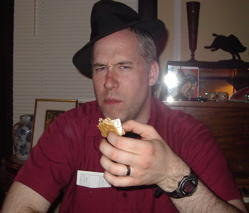
Late yesterday I found this message in my email inbox regarding l'affair Fence (see post below). It came from David Park, a professor of communications at Lake Forest whose mighty brain throbs with the very juices of genius (Park is pictured here enjoying S'mores in my dining room, as is his wont). Says Park:
The whole thing is fascinating. I should do a study of how journal/mag covers signify intellectual content. If your initial argument were taken to its fullest extent, we might see the Atlantic's next issue feature a cover with a porn star.... I don't think your foes are likely to come up with any solid philosophy of the magazine cover that will tell us why the front of a poetry journal should look like the front of a poetry journal.
Dave's up on his Habermasian public sphere theory, so I pestered him for a while via late-night email and, in the end, arrived at the following conclusion: many of the reservations literary types have about the cover come out of an affront to their inherited assumption that intellectual journals are public sphere stuff, not commodities in the market.
You know the classical public sphere model, as articulated by Habermas, right? The ideal of the public sphere is one in which there's a place where we all communicate as equals, where the status of our opinions comes from the merit of our arguments, and where we're removed from concerns of commerce or hierarchical authority. Intellectual journals often have an aura of this ideal. "My disinterested thoughts are here communicated to you, my fellow discussant, for your consideration and possible reply," sayeth the intellectual journal, sotto voce, on every page, "consider these ideas, and talk back, oh reasonable and capable reader." We like to feel, when we grab a literary journal from the rack where it is shelved between Art in America and Conde Naste Traveller, that we're part of a conversation, that we're not so much consumers as we are discussants, members of the public sphere.
When Rebecca Wolff put the topless model Quinne on the cover of Fence to get some sales action going, she committed a sin against these cherished assumptions. She reminded us that, whether we're members of a (real or hypothetical) public sphere or not, we're also part of a market. People out there on the other side of the editorial office door see us not only as subjects of the public sphere, but as consumers. And so she's suffered the fate of most people who bring unwelcome knowledge, and been chided for her actions.
I'm not quite willing to ditch the idea that there really are elements of the public sphere in the little world of literary magazines, though Dave seems to be, sort of. Here's his take:
It's an old question: is there such a thing as disinterested art/ideas/experience/anything? My answer: no, not ever. The more it matters to you, the more interested you are. Tautology ahoy! But still. The attempt to experience art/ideas/experience/anything as disinterested (even if it is accepted that interest is always in there) is what's in play here, and that's much more interesting. So, art and ideas aren't disinterested, and any attempt to experience them as disinterested is doomed to involve a great degree of misrecognition. In some different world, that insight might apply to only a portion of art/ideas. Instead, it applies to almost all that we could call the 'dominant discourse' in art and ideas in contemporary Western society. The presumption that we all give up our interests as we enter the game is a major part of what defines the systems of art/ideas. This is upset by what you call 'catchy packaging,' and what almost anyone else would call a cute topless girl.... I agree that it's a good way to sell magazines and journals, and it's good to be comfortable about selling journals, especially when those journals have reasonably good literature in them. Also, it's good to see someone take on the pompous asceticism common to the world of journals.
So: public sphere or no public sphere, Dave Park's behind the new issue of Fence. Maybe he'll even run out to Barnes and Noble to buy a copy. He'd better move fast, though: I hear they're selling quicker than usual.
Saturday, September 03, 2005
My Anxiety of Influence

Ooosh. Semester has started early for me this fall, in part because of some administrative hoodoo that has moved the term up by a week, and in part because I'm teaching a freshman seminar, and these always start a week earlier than everything else at Lake Forest. So rather than blogging I've been running around prepping two brand new courses and humming one of the numbers from the unpublishable musical comedy about a former college official I've been writing for the delectation of my friends:
Teachin' at the college,
Passin' on the knowledge,
Teach them all the things they ought to know,
Teachin' at the college,
Passin' on the knowledge,
Their tuition is the source of my cash flow...
But that's not why you tuned in. No indeed. No doubt you were wondering when the next appearance of Archambeau secondary literature would hit the newsstands. Well, wait no more: there's a new review of Home and Variations out in issue 165 of my favorite English poetry magazine, PN Review. David C. Ward, the reviewer, says some nice things about the poems, and then claims that "Archambeau is an ambitious (sometimes self-consciously so) and intellectual poet; in the family tree of poetry he would be of the branch of Geoffrey Hill." Ambitious? Got me, at least on good days. Self-conscious? Oh yeah. Influenced by Geoffrey Hill? Yes, but honest to God I thought I'd hidden it so well that no one would ever know.
I mean, old weird Harold Bloom's theory of the anxiety of influence has a lot wrong with it, but one thing he gets right is the way many of us want to hide our influences, lest we be held up to some pretty intimidating comparisons. Hill has been a favorite poet of mine since my first year of grad school, but he makes me nervous in the way that only those you admire fully can make you nervous. I was once invited to a dinner where he was the guest of honor and didn't say a word at the time, so awe-stricken was I (when Keith Tuma argued with Hill over some minor point, I half-expected death rays to shoot out of Hill's eyes and vaporize him). Since Hill's always garnering praise along the lines of "Let us make one thing clear: Geoffrey Hill is the greatest living poet in the English language" (Nicholas Lezard, in a review in The Guardian), being compared to him is a bit like being a guitar player and being compared to Jimi Hendryx. On the one hand, you're grateful. On the other, you rather wish you'd covered your tracks a bit better.
So here's a game for you: which of Bloom's six "revisionary ratios" can you find in Home and Variations' Hill-influenced poems? Play as often as you want, but please don't tell me about it — I'm self-conscious enough as it is.
Tuesday, August 09, 2005
A Monkey on a String, or: the Heart of Dutchness
Back in the eighties and nineties, when the world was young and English departments awash with French cultural theory, a good friend of mine invented the term "Eurojive." He knew we needed a word to describe a genre of writing launched by a thousand "naturally the foundation will bear your expenses" junkets to the USA by visiting European intellectuals. Such intellectuals, wild-eyed at what passed as their newfound American celebrity, would typically walk off the jetway into the arms of a waiting, star-struck grad student. They would then be driven around for a few days, giving talks, meeting the local professorial fauna or tame literati, dine out a little, demand to see a shopping mall or perhaps a casino, and fly back to the École Normale Supérieur or, more likely, one of the many Écoles Normale Inférieures. They would then churn out on essay or, if ambitious (and these were ambitious times) a slim book purporting to explain America. Remember Jean Baudrillard's America? Either we must believe the man was a genius beyond all measure, able to hit the tarmac in Vegas, sniff the air, and grasp The American Soul in All its Complexity and Contradiction, or we must believe the man was something of a jackass. Take your pick. And Eurojive lives on even unto the present day, recently embodied in Bernard Henri-Levi's series of essays for The Atlantic, in which he is driven around more-or-less in the path of Tocqueville (ancestor of all Eurojive), and tells us all about who we are and what we mean. (I nearly knocked HBL over once, but it wasn't a critical comment on his work: I was late to meet my wife at a cafe near the Sorbonne and wheeled my bulky American self around the corner at great speed, having to pull up short lest I knock over the man as he opined into an adoring TV reporter's microphone).
Undeterred by my own skepticism about the general veracity of Eurojive, I've decided to lay down an inverse version of the discourse, and define the nature of Dutch culture on the basis of no more than my own recent experience hanging out in Amsterdam this summer. Having never left the city, having learned no Dutch, having met approxinately 16 of the country's sixteen million inhabitants, I nevertheless hazard this assertion: I have seen into the heart of Dutchness, and it is like a monkey on a string.
Let me explain.
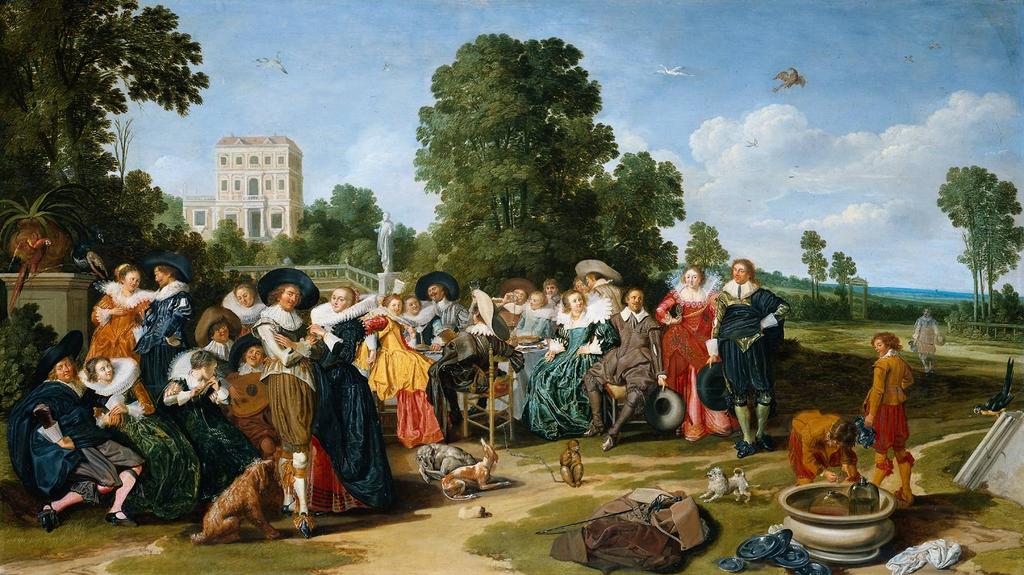
The key to the Mysteries of the Dutch lies in plain view in the Rijksmuseum. It is Dirk Hals' painting "The Fête Champêtre," or, more specifically, the figure at the front of the painting. Like a lot of seventeenth century Dutch paintings, it presents us with a group of people. I'm sure there's nothing particularly new or even interesting about the observation that the Dutch emphasis on the group portrait, or "conversation piece," is closely connected to the nature of power in the Netherlands of the seventeenth-century: oligarchic in an age of absolute monarchs. It was a way of examining group dynamics and group power. (Many paintings of the period, especially Vermeer's, give us private spaces punctuating, or being punctuated by, public spaces, and I'm sure this was a way of thinking about the new relations of personal and public power in a mercantile society).
But here's the interesting thing about Hals' piece: it embodies one of the central concerns of capitalist societies, right at the moment when the Dutch are inventing modern capitalism. On the one hand, the painting is all about the rich clothes, conspicuous consumption, and general full-on yeee-hawness of the laughing, drinking, flirting partiers. On the other hand, front and center is the monkey on a leash. What's that? How'd he get there? And who let the leash go? Is the monkey going to wreck the party? Will he soon hurl his feces hither and yon among the seventeenth-century glitteratti? Irrelevant questions, all, class. The import of this particular simian is symbolic: he is part of a old tradition of monkey iconography in European art, dating back at least to the middle ages, in which the monkey is used as a cautionary figure of appetitive excess. Sex, food, drink, fun: all, all will make a monkey out of you, and the little guy makes his appearance in many artworks to drive the point home. Here, though, the monkey is sort of leashed and sort of unleashed: no one holds the end of the leash, which is draped or perhaps tied to a chair. Moreover, while the monkey is positioned in the front and near the center, the sheer bulk and brightness of the partiers makes for a real tension. Who has the power? Is consumption grand and fun and free, or must we remember that icon of medieval contemptus mundi, the monkey? The painting catches the moment when both Protestant-ethic self-denial andconspicuous consumption were coming into being as two sides of the same coin (a coin clutched in the fist of an Amsterdam merchant driving a hard bargain, or perhaps being flung easily down on the counter of a haberdasher by his spendthrift son). This tension seems central to Dutchness, not only because it finds its way into so many pantings from the great age of art in the Netherlands, but because it explains how Amsterdam can be simultaneously Europe's hash-bar crowded New Orleans and a city of bourgeois comfort, smugness, and propriety. Holland, a Dutch guy on the flight back to the States said to me, was too conformist for him — he'd moved to the Bay Area to get away from all that. Who am I not to believe him? But at the same time, I'd just taken a photo of a coffeehouse adorned with images of Gilbert Shelton's hippie icons, the Fabulous Furry Freak Brothers, which gave me a hunch as to what would be going on inside. So there it is: the Heart of Dutchness is the ambivalence between desire and restraint expressed through the image of a monkey on a string. You heard it here first, kids, Ameri-jive style.
Saturday, August 06, 2005
New Review of Home and Variations
Jeffrey Roessner knows more about my poetry than I do. Read his review of Home and Variations and you will, too. Roessner is one of those readers who seems to have some kind of X-Ray vision.
Also, a decade or so ago Roessner played guitar in a band that had what I think may have been one of the best names ever, "I Buried Paul." It took me weeks to catch the reference.
Friday, August 05, 2005
Back in the USA and Griping About Silliman
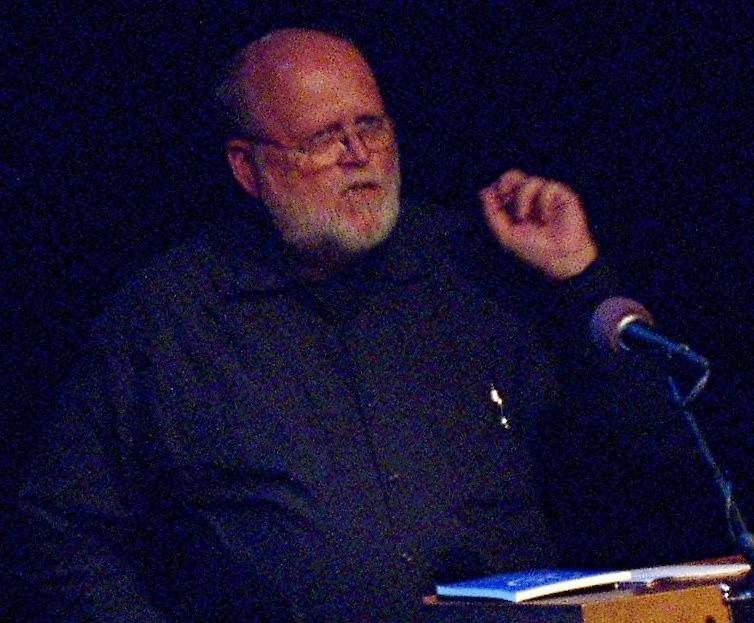
I'm back, I'm groggy, and I'm ticked off at Ron Silliman.
Ron's been blogging away about Christopher Middleton, at one point quoting a Middleton poem and saying "my take on this piece is that it reminds me of what Auden might have been had he actually been a good writer." He seems especially irked by what he calls the "absolutely normative narrative figuration" he imagines in Auden. I am tempted to put "[sic]" after the word "normative," since I don't think Silliman means that the "narrative figuration" prescribes anything, but rather that it follows forms that have been used by many others, and that one could argue are already implicitly prescribed by others. But this sort of half-assed throwing around of terms doesn't bother me too much, or I wouldn't be reading Silliman's blog at all. No, indeed.
The most irritating thing about this dismissal of Auden isn't just the wrongness of it. Nor is it the ideologically blinkered nature of the comment. The really irritating thing is the ignorance. I mean, the young Auden was working experimental veins of a kind that Silliman is generally sympathetic to. If one of Silliman's friends had written The Orators, he'd almost certainly have praised it extravagantly. I'd bet my whole collection of Hejinian first editions on it. (If you want to read an essay demonstrating that The Orators does not follow "absolutely normative narrative figuration [sic]", I suggest this one by Chris Jones, which is more interesting and far-reaching than the synopsis might lead you to believe).
One way to file Silliman's snark is as a generational matter. This easy dismissal, one could say, is old school langpo stuff, the product of a mind still dividing the world into absolute friend and absolute foe based on stlylistic shibboleths. Another way, though, would be to put it down to ignorance of British poetry, especially of British modernism, of which the young Auden was very much a part. A third way to file this is under irony: guys like Silliman have been dismissed out of hand because of what people who don't really know the range of their work imagine to be their limitations. I even did this once, years ago, on the Poetics list, and Ron quite rightly tore into me about it. But here's Ron, being just as unfair to Auden for reasons as illegitimate as those of his own knee-jerk detractors.
Lee Glidewell takes Silliman down for this at greater length than I, a hung-over, jet-lagged, cold-having derelict can just now.
Monday, July 25, 2005
Blog Hiatus

Sorry, folks, but I'll be taking a blog-hiatus until sometime in early or mid August, when I & my crew return to Chicago from Amsterdam.
Houd het echt!
Wednesday, July 20, 2005
Poetry Journals: Punk Attitude, Phone Books & Pulpits

TiVo picked up IFC's new Punk: Attitude documentary for me a week or two ago, and I finally got to it this weekend. Maybe it's the wave of Gabba Gabba Hey nostalgia gently lapping over me that's got me thinking about starting another poetry magazine. I've always had a soft spot for the do-it-yourself attitude of punk, and it has informed my attitude toward the institutions of poetry, if not my aesthetics (sorry, Henry Rollins, but I can't get down with your poems, even though I like your film reviews on IFC).
The big stars for the kids into punk were never the same as the big stars for the square community, so the punk fans, brilliantly, decided to act as if the big stars didn't rate, and their own heroes were the real headliners. Sure, not many people were on board for their projects, but in a society as high-tech and prosperous as ours all you need is the will to do things on your own terms and you can get pretty far: your own zine was easy if you snuck into the photocopy room of your high school or had a pal who'd let you sneak into Kinko's; by the time you got to college you and your pals could let the band crash at your apartment as incentive to let them come to your town on what was somewhat grandiously called their national tour; for a surprisingly small outlay of cash you could just about have your own record label, or at least dub tapes by the dozen. The bulk of people would never care, but all you had to do was not care right back. Which left you more energy to care about unjamming the photocopier in your high school office quietly, so the janitor wouldn't notice you were in there making issue #1 of Prairie Hardcore: the World's Finest Guide to Manitoba's Punk-Rock Scene. (I know, I know, history and the internet have not been kind to the word "hardcore," but back in the day, children, it refered to a kind of music, a special, magical music that could blow the top off of your adolescent head with its ability to channel your rage and skepticism toward vaguely-defined authority figures. Sort of like rap but, you know, not about money). And all you had to give up for this degree of freedom was any chance that any significant number of people would be paying attention — but didn't some guy once give some encouraging words about the relative merit of gaining the whole world and losing your soul?
Anyway. I was in a you-should-get-off-your-ass-and-start-editing-again-because-it-matters-even-though-you-said-you-wanted-to-write-more-instead frame of mind (do the Germans have a word for this?) when I stumbled across Tony Tost's discussion of poetry journals. It's worth a look, but for a summary I'll just crib from Josh Corey's comments. He tells us that Tost sees only two kinds of journals in the poetry world, and that Tost years for something more. Tost, says Corey, defines the two types of journals as:
...the omnibus of "arrival" (here comes the omnibus!) and the mag that seeks to advance a particular aesthetic or communitarian position. I'm sympathetic to his desire for something new, something more self-interrogative, than either existing model seems able to provide. More like a diary in which the entries are written by other people; an unrefereed blog (or e-mail list) will obviously fail to achieve this. What is the guiding principle of such a diarist? Something beyond the merely personal, as Tony says: something more about knowledge and investigation. Investigation of a particular theme or topic would be one way.
I've used slightly different terms when talking to myself about poetry journals (don't worry, peeps, I don't do this out loud, except on the El, late at night, while leaning too close over well-dressed people coming back from the opera). What Tost calls the "arrival" I've called the phone book, simply because such journals show about as much personality as the white pages. The aesthetic/communitarian journal is the one I call the pulpit, although surprisingly few of these journals actually make the position they're advocating explicit in any kind of preachy statement.  Mostly they rely on presenting work from a fairly well defined coterie to make their point. Michael Anania, in one of the brilliant essays in In Plain Sight, points out that while many of these mags have called themselves avant-garde, most are actually more concerned with one or two seminal figures from an older generation, and with their aesthetic progeny, than they are with anything wholly new. They are champions of other-streams, not necessarily of the radically new.
So. I like Josh & Tony's ideas about what a worthwhile journal would look like, but I still have a hard time thinking about how such a thing would be put together. "Self-interrogatory" and "investigative" are great ideals: they propose the journal as a specific conversation about something in particular among people who all want to get their angle on the topic clear. This is like the pulpit in being focussed, but it is more open-ended, it has no answers in mind, just a few urgent questions to the bottom of which it actually wants to get. To that end, a few (debatable) notions on what would have to go into such a journal. Inevitably, I'll end up saying a few things about my last journal, Samizdat, which ran for ten issues, had some hits and some misses, and has a partially completed website archive of the first seven issues online.
1. Mission.
What does The Iowa Review want to talk about? You really can't tell in this kind of phone-book/omnibus journal. Some of these skew a little more toward the scenic or the indeterminate aesthetic, but in the end they simply aren't meant to be there for the exploration of certain possibilities. Mission doesn't mean party-line, here, but an area to investigate. A topic.
2. Editorial.
Someone — an editor or a group of editors — should take responsibility for the issue, and say something specific about what was chosen and why it is important. (Imagine what the editorials for most phone-book style journals would look like if written honestly: "Billy Collins is in here because he's a big name, we deliberately added some women because we realized that, left to our own devices, we'd have stuck to old white guys, and we took a chance on some of this stuff we don't really understand because we're afraid of appearing unhip. Enjoy!"). I mean, it's a good excercise for the editor, who has to think through his own choices for 700 words or so (Tony and Josh's "self-interrogotory" ideal), and it's good for the readers, who can see whether theory and practice add up, who can agree or disagree, who can get into the conversation. Writing these was my favorite part of editing Samizdat, and the part of the magazine that generated the most mail (fan, hate, and deranged, in roughly equal proportion).
3. Reviews.
I'm stunned at how many journals don't run these. I'm also stunned at how many of the reviews that do get printed are kind of empty, giving little more than a sensibility reacting to a stimulus (like too many poems in this regard). The best reviews, I think, are those that try to put the book into one or another big picture (not necessarily a totalizing picture -- nowadays you'd have to have serious cojones and a good dose of delusion to try that). Group reviews are a good, and underutilized, form for going at this: you get a chance to pull a bunch of strands together, to say "Poet X is good but when you read Poet Y's new book you start to wonder about the task X set for himself. Poet Y does something so much more ambitious, you think of Poet X's work as less interesting somehow." Also, the review that pairs unlikely poets is good, and allows the reviewer to reflect on the nature of the poets' different projects (one of the first reviews we ran in Samizdat paired Reginald Gibbons and Rosemary Waldrop). You need reviews, I think, and you need them to be more than "here are some passages that played over my exquisite sensibilities like a gentle breeze on the strings of an aeolian harp.
4. Probably not a lot of special issues on particular poets.
We ran a few specials for Samizdat: one on Scandinavian poetry (I was living in Sweden), one on John Matthias, and a popular one on Pierre Joris and Jerome Rothenberg. I'm proud of all of these, and I think they're useful resources for people who want to check out the topic, but now I think that this sort of thing is best served through books, archival web sites and that sort of thing. They interupt the flow of discourse, and if a journal is to be a conversation or investigation, it would be a rare special issue that played a big role in that. Maybe one could run a notice or summary of the issue, and then direct people on how to get to it. Don't get me wrong: there are some special issues I really love. But they seem more like books to me, and their focus is often on commemoration more than on the following-up of particular questions.
5. Selection of poems
There should probably be a place for long poems, or whole sequences, serialized if they have to be (we did this with Michael Barrett's "Babylons" in Samizdat because I was such a rookie when I accepted it I didn't realize that it would have maxed out the whole first issue). Also groups of poems that make sense together, or that interrogate one another (as in the reviews of multiple poets above) would be good. And more poems by fewer poets would help to give a journal shape and avoid the "here comes everyone" feel of the journal-as-phonebook.
6. Frequency
This is the tough part. Monthly would be good, or a short journal every two weeks. If people are going to participate in an investigation together, the fat quarterly is less useful than the slim, somewhat casual set of documents that shows up every few weeks. The old French notion of cahiers (workbooks) is a possible inspiration.
7. Independence from institutions
You need this if you aren't going to end up looking over your shoulder at the powers that be, worrying about your funding. Institutional affiliation leads, eventually and almost inevitably, to the occasional or perhaps not so occasional worship of false gods like circulation, respectability and being in step with the norms of "the field." I mean, look at what's become of university presses: designed to publish books that aren't commercial, their editors find themselves worrying about what the university suits will say about low sales.
8. Gemeinschaft
Gemeinschaft, or the idea of a community linked by bonds other than the institutional or administrative, is hugely important for a poetry journal. Phone-book style journals tend not to have it, while Pulpit-style journals sometimes do (sometimes, though, they become too in-groupish, and the jockeying for position becomes something a field biologist specializing in chimpanzees or wolf packs couldn't even unravel). About the worst possible way to staff a journal is to recruit people who have some kind of institutional connection to the mag but very little personal connection or enthusiasm for the journal itself. Too many (but not all) university-based journals end up with a staff of grad students who share only the vaguest of common interests. They're usually given little power and, consequently, don't invest much more in the job than the average convenience store clerk does in his — that is, they may be able to steal some candy (networking with people at similar journals in the hopes of getting some play for what they do care about: their poetry), but by and large they'd rather be elsewhere. About the only journal I know of that is guided by grad students and is really first rate is the Chicago Review,, and I imagine there's a connection between the quality of the magazine and the fact that the powers that be actually let the grad students run the whole show. Given responsibility, they make a real investment in the job. (Oh yeah, there's also the fact that they tend to be PhD students, and have a different set of agendas and concerns than the inhabitants of the ordinary MFA mill).
9. Cultivating a sense that something is going on out there
We've all seen journals that seem to exist in some kind of weird vacuum, as if poems were written in a kind of no-place, as if there weren't a field of poetry (let alone a field of power) with which those poems interact. Back in the eighteenth century, when journals were just getting started, Addison and Steele decided that The Spectator should have regular departments named after the various coffeehouses around London. Each department would cover the kinds of topics you'd find discussed in the hangout for which it was named (one for stock news, one for literary talk, one for "gallantry," etc.). I'm not saying a journal should try to cover the whole world, or even try to cover literature and politics together (as The Potomac has tried to do recently, with mixed results). A column on gallantry among poets would be kind of fun — I've even got a piece I could write on seeing Christian Bok try to pick up women at several readings — but this isn't really what I've got in mind. Rather, part of the "self-interrogating" and "investigative" element of a journal could involve articles and poems that address the situation of poetry in the field as a whole, and in the larger field of power in the world.
So.
How much of this could be accomplished, and what kind of effort it would take, are questions I'm not prepared to answer. Whether a substantial number of people would care is not a question that interests me much, but others might have interesting things to say about that. One question that seems particularly important here is that of just how much of all this the poetry blogs are already accomplishing. Blogs can be updated frequently, are good places for editorials and for reviews (though fewer people than you'd think seem to use them for this), and they're great for carrying on mutual investigations of topics. That's something, and it has got me wondering whether the journal is really the form we need right now. The kid who snuck into the copier room to make his zine loved ink on paper, but hey, when the alternative was a Commodore 64 with a 300 baud modem, who wouldn't?
And as a practical demonstration of the idea of blogs as a good way to carry on self-interrogating investigations of poetry, let me point out some remarks of July 14 by Henry Gould, in which he takes terms from the contingent poetry discussion on this and other blogs and applies them to his own poetry.
Monday, July 18, 2005
Then is Now is There is Here is Falling Fallen Yet To Fall

Fallen from a Chariot, Kevin Prufer's new book, is one of those collections of poems that is written as a book: the four parts hold together. The first section is all elegy for a woman who died in a car wreck, and the section serves as a kind of overture, giving us most of the images that will recur throughout the collection: falling gods, death, birds, a crashed car. I imagine the car wreck to have been something real in Prufer's experience, in part because the elegaic note rings very true, and in part because Prufer has looked at cars as emblems of mortality before (as in his earlier poem "Death Comes in the Form of a Pontiac Trans Am"). Subsequent sections pick up the theme of death as a fall, but take it elsewhere (notably to ancient Rome in the second). He embroiders more and more symbols into the fabric of the book as he goes along: doomed airplanes, a ship reminiscent of The Titanic, poisonings, fallen empires, more birds, more fallen gods, more wrecked cars.
The point of comparison for me is Eavan Boland. Like Boland (especially in her collection In a Time of Violence), Prufer writes a poetry that works best by accumulation: themes and images recur, and they take on more significance as the variations pile up. Prufer used to write a fairly formal line sometimes, with a fairly strong sense of meter, but this book gives us a flatter, more prosaic line, also like much of Boland. There are two respects in which Prufer's got it all over Boland, though: incantation and interpretability. He's got more of the first and less of the second and good for him, I say.
We find his incantation here and there, where the language of elegaic longing becomes prayer-like, and this gives the lines an intensity and slight formality that raises them above the level of chopped-up prose. No one will ever say of him (as my students have repeatedly said of Boland) that reading the poet's essays and reading the poet's poems amounts to pretty much the same thing. This is nice, but less interesting than the matter of interpretability. Don't get me wrong, here: Prufer is no indeterminist, no post-avant or Jorie-Graham style spinner of faux-sophisticated fashionable nonsense verse. In fact, he writes in very clear sentences. But it is at the level of intersecting images that his book becomes something quite subtle. The variations on consistently repeated images make them quite nuanced and polyvalent, and hard to paraphrase. This is symbolism in the classic sense of the word, and it is wonderful to trace the patterns as they evolve though the book (which is, symbolically if not syntactically, a bit of a rhizome). Boland always seems to me to be very programmatic, to have decided where she wants to go and what she wants to mean, and in the end this is a limitation. Prufer seems more guided by a set of images the full import of which is not entirely disclosed, even to him. When I write a proper review of the book I may spend some time tracing them out, although my editor would have to be generous with space for me to do them justice (my copy of the book is pretty much scrawled over now, with notes and letter-codes for symbols).
The thing that interests me the most, though, is the way that Prufer decides to treat something quite immediate and intimate (elegy for someone he loved) through the long ago and far away. He loves to play with the idea of a past and a present that are oddly simultaneous, or with a large-scale historical moment that is somehow also something much more local. I'm saving all my best examples for the real review, but here's one I don't think I'll use there, because the two moments that seem simultaneous are more literally related than in the ones I most admire. Here, the death of the Emperor Augustus and the (much later) fall of the Roman Empire seem simultaneous (by the way: Prufer's lines are indented at places, but my html skills just aren't up to showing how, sorry):
Finally the great must — all of them —
So Augustus
put the poison fig to his lips to taste and fell
back in his bed so his soul was lifted away
A hand from the blue squall of sky The sea
crying over its beach A flower
each petal twisting
from the branch The empire slipped with a cough then a gasp
Fell loose jawed Fell slack
alone and asleep
The personification of the empire in immediate juxtaposition to the image of the dying Augustus gives us a sense of the empire and the man as somehow the same, or at least as oddly commingled. There's a lot of this sort of thing (a kind of verbal double-exposure) in the book, and it unites the historical (Rome's fall) with the personal (the death of a woman in a car wreck) and the mythological (the fall of a god to earth) as well as the natural (birds fallen from the sky, or swooping down to feed from the water) and the technological (airplanes and ships doomed to crash or sink). It is one way for a poet to get away from the cliches of the personal scenic mode, and to make something as old as an elegy new.
Now that I've lived with Fallen from a Chariot for a few days, though, I don't think it is really a book of contingent difficulties, of the sort of thing you have to look up. For one, the history it gives us is familiar, coming as it does from territory well explored in I, CLAVDIVS and on The History Channel. For another, there's very little sense of the alienness of the past. It exists, here, as a way of adding emotional heft (even sublimity, through scale of tragedy) to the present. The Romans don't seem that different from us — in fact, if that were Prufer's goal, he wouldn't have them walking around on the decks of cruise ships or playing cards. Prufer conflates past and present in order to better serve his descriptions of the present. There's nothing wrong with this, although my preference is for poems that give us the past in all its alienness, and, when they bring the present into the equation, do so by showing us how we are the guests of the past, interpolated into something that is in many ways remote and poorly understood, but that is nevertheless constitutive of who we are. (Geraldine Monk, Susan Howe, John Peck, Geoffrey Hill, Ammiel Alcalay, John Matthias, Peter Riley, Allen Fischer are the poets I think of when I think of this approach to the past). I've been trying to understand the nature of my preference for such an approach (what I'm calling Contingent Poetry), and my sense that it is somehow an important approach. I suppose it is because it doesn't just assert that "then is now is there is here," (which is Prufer's admirable task, and a great bursting of the narcissistic bubble of much contemporary poetry). It makes us see the alienness of our sources, and the alienness within ourselves, until they become familiar, and then we become what we already were, but with a new degree of consciousness.
Anyway — Prufer's book is moving as elegy and adventurous in its scope. He's prolific and not prone to repetition, so I'm looking forward to where he may take us next.
Friday, July 15, 2005
Another Chicago Magazine Hides Out

Last night Another Chicago Magazine held its launch party and reading for the new double-issue at Hideout. The aptly-named bar is hidden among warehouses in an unotherwise unpopulated sidetreet, and if you're not on the lookout you'll miss their little fenced sandlot and their much-battered Old Style Beer sign. The decor consists of old Christmas lights and the kind of wood paneling you see, for the most part, in super-8 movies shot in teenagers' basement rooms in the seventies. They've got Pabst Blue Ribbon in cans and Summit on tap. It is my new favorite bar on this earth.
Arriving with the lovely and talented Valerie from the leafy 'burbs of the north shore, I wasn't even sure if I was in the right place at first, but when Valerie suggested we park behind a group of hipsters disembarking from their car, I felt my hipness quotient go from zero to sixty in no time flat: said hipsters turned out to be Health & Beauty, a band the Valerie books for U. of Chicago gigs. Later I noticed that members of the Passerines had also turned up. So Another Chicago Magazine seems to rate with the Hyde Park bands.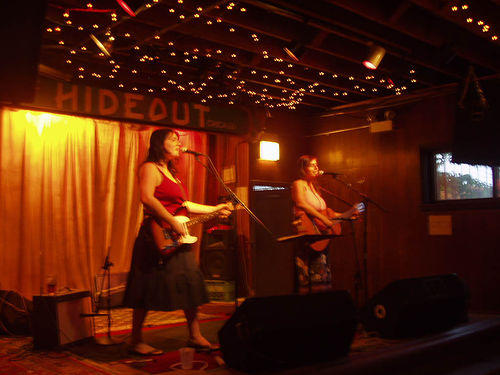 Royalchord, a two-woman band from Australia opened up. They were great, but had me a bit worried: Simone Muench told me I'd be reading first, and the band played very down-tempo, Cowboy Junkies alt-country style songs. Fortunately DJ Birdy Num Num raised the energy level before the readings started, and Jacob Knabb worked his mojo as manic MC. I read short (nobody ever complained that a poetry reading wasn't long enough), and was followed by Kristy Bowen, Matt "if I'm shaking its because I have ricketts" Guenette (in town from Madison), Jason Bredle and many others. Sadly, my ride got an urgent phone call and I had to bail before the end,
  missing Kristy Odelius' reading, although I can say she was sparkling in both shirt and conversation beforehand. I was also glad to run into an old student (and new poet) Steve Halle, who turned me on to this article — sadly, he caught me as I had to rush, since my ride had already left the building. The article is both right enough and wrong enough to merit some thinking, by the way. So I'll add it to the to-be-blogged queue, along with my forthcoming Kevin Prufer post and (probably) a mulling-over of Mark Scroggins' new post on Adorno and style.
But I digress. I was impressed by the standing-room only crowd, liberally dishing out applause (I refer you to the cans of Pabst Blue Ribbon for an explanation — and to jello shots, one of which was forced down my throat by a sparkling poet). ACM seems to be flourishing, and, despite the absence of Mary Biddinger, who's too busy becoming an Ohio homeowner and tenure-track professor to make it into town, the event was a hit. It is encouraging to see this kind of enthusiastic, big, smart poetry crowd miles away from a university. And I think I'm setting up base-camp in Hideout for the rest of the summer.
By the way — those of you following the Contingent Poetry conversation might be interested in Ton Van't Hof's comments at 1hundred1. You'll have to be able to read Dutch, or go to the always-off-base Altavista Babelfish for a semi-useful translation.
Wednesday, July 13, 2005
Contingent Chronicles: Formalism, Modernism & Contingency
Despite wanting to jump into what looks like an interesting discussion about poetry and paraphrasability going on in blogs by K. Silem Mohammed and Henry Gould, and despite having promised to say something about Kevin Prufer, today I've got something else in mind, something that connects, in a sideways manner, with contingent poetry. My unlikely starting point is Adam Kirsch's new book of litcrit, The Wounded Surgeon: Confession and Transformation in Six American Poets. There are no surprises to this book for those of you who've somehow found yourselves browsing through copies of The New Criterion, the unintentionally funny neoconsevative cultural screed journal (there's a great game, by the way, in to picking up a copy, seeing who the article is about, and predicting at the outset exactly what will be said. I've got about an 80% success rate, but a novelist friend of mine who asks not to be named is batting a thousand). Kirsch, in that journal, consistently condemns anything that doesn't fit into the New Formalist paradigm for poetry -- you know: buh-dump-ta-dump-ta-dump-ta-MOON, buh-dump-ta-dump-ta-dump-ta-JUNE -- the sort of thing a really good formalist would wince to hear. In this book, he praises those poets we've come to call confessional for what he sees as their rejection of modernism. In essence, he recruits Lowell, Bishop and company into his little war on modernism.
Wierdly, there are points where I find myself in complete agreement with Kirsch. He lets fly, for example, at Jorie Graham's Swarm for its foggy indeterminacy. But where I've been hoping for a turn away from indeterminacy toward a poetry of contingent difficulties (see the Contingent Manifesto for details), Kirsch plumps for iambics and regular rhyme. Where I see a re-engagement of some ideas that the Modernists sniffed around as a good thing, Kirsch sees Modernism as the treason of the poets.
Reading Kirsch, I sometimes felt like he and I spoke different languages. Then my copy of The Nation clunked into my mailbox (revealing my political differences from Kirsch, I suppose -- I'm a standard quartlerly-magazine-with-no-subscribers leftist, he seems like more of a standard back-pages-of-the-ideological-magazines-with-big-right-wing-money-behind-them neocon). John Palatella reviews Kirsch's book, and makes plain one of Kirsch's main shortcomings: when it comes to modernism, he's myopic.
As Palatella points out, Kisch's Modernism is the narrowed and watery doctrine of the New Critics -- so when Lowell ditches everything he'd learned at Kenyon in Life Studies, that's enough for Kirsch to claim Lowell as a Modernist apostate. There's not much of an excuse for this kind of narrow-minded, shortsighted, historically uninformed error anymore -- not, at any rate, since the publication of volume two of Jerome Rothenberg and Pierre Joris' anthology Poems for the Millenium. In the introduction to that book Rothenberg and Joris describe the period of New Critical hegemony after World War Two as a time in which the poetic energy of the prewar years had been drained away by the institutionalization of a tamed and truncated version of modernism. These years witnessed “an ascendant literary ‘modernism’–hostile to experiment and reduced in consequence to a vapid, often stuffy middle-ground approximation.” There was a willful forgetting of the openness of modernism, and a turn to “a fixed notion of poetry and poem, which might be improved upon but was never questioned at the root.” The task of poets coming of age in the fifties and sixties, argued Rothenberg and Joris, was to find what had been lost, to revive the electrical energy of the force that had crackled through poetry at the beginning of the century. They call the fulfillment of this task “the second great awakening of poetry,” and the second volume of their anthology is an archive of that awakening. (Aha! Cry the surviving subscribers of Samizdat magazine, "Archambeau is quoting himself out of laziness!" a charge to which I offer no more defense than a White House spokesman offers to the charges that Karl Rove must, by Bush's own logic, be fired). Given this woeful misunderstanding of the range of Modernism, where but to New Formalism is a guy like Kirsch to turn for an alternative to the decadence of indeterminacy?
So. Strange bedfellows, on the one hand: Kirsch is as against indeterminacy as I am. But our senses of literary histroy are so different, there's no way we could agree on an aspirational future for poetry.