Wednesday, May 02, 2007

The Battle of Chicago: Peter Riley Emerges from the Rubble


This just in from Peter Riley, regarding my earlier post "British Poetry Wars: The Battle of Chicago.". Riley, whose open letter to John Wilkinson set off what I've thought of as a bit of a dust-up about the claims made for British experimental poetry, weighs in here with a few points about the context of his remarks and, more importantly, his reservations about a phrase of my own, "the Prynne tradition."

Just read Archambeau's excellently cheerful American response and wanted to append a couple of disclaimers.

First is that while I recognise the light tone I don't thing "war" or even "conflict" is the right way to characterise this. It is not a row between me and John Wilkinson, still less between two cultural positions. It is a challenge within a shared framework. I am not ironic in positioning myself within the tradition which I interrogate ("how did we...") . If I speak strongly it is because my worries about my own share in the condition entitle me to, and also put me in a position to shoot out arrows at targets far beyond immediate company.

And I'd essentially like to add for the record that when I sent the letter to Chicago Review I didn't know that the next issue was to be a British poetry issue featuring particularly those four poets. So it's not a response to that content, and John Wilkinson's review of Andrea Brady in it is both prior to and posterior to my remarks, for it indeed confirms that what I say is being said, is being said, but it is also a pre-answer to what I say.

Secondly I can't take this idea of a"Prynne tradition", which I think is an American reading. What I said was "The poetry that developed through Cambridge in the 1960s and 1970s" to which I attach great importance. This isn't a "Prynne tradition" for a number of reasons--

  • 1) Jeremy Prynne was only one of about ten poets strongly involved in that formation. The poetry I'm speaking of emerged from a meeting, confrontation and to some extent conflict, between Prynne and the other poets, who I think affected his writing at that time as much as he did theirs. This contact produced a particular and recognisable way of writing which has emerged sporadically from those poets and others for some ten or twenty years afterwards, including some who were only marginally involved. Anthony Barnett, for instance, is relevant, the only contemporary British poet Prynne has ever devoted a lecture to, but who seems to have vanished from sight in the "Prynne tradition".

  • 2) There are at least two JH Prynne poetries, polarised as early and late, and I for one find them so separated from each other that I don't see how one can be in the tradition of the other, let alone anybody else's.

  • 3) I think Prynne's poetry has always been unique and inimitable. All attempts to write like him have failed. That's because there is a long developed and cultivated aesthetic underneath the affects of his poetry which he has pursued to an extreme condition and if you don't participate in that, and you can't, you don't have a chance of writing in that way. R. F. Langley, alone, knows and participates in this programme, which he turns to his own purposes. I don't think Keston Sutherland's poetry resembles Prynne's, or barely, still less any of the other poets in that issue.


  • I've got to own up to this much, at least: I did invoke Prynne in a broad way, using him as a figurehead for British experimental poetry with a Frankfurt-school inflection from midcentury on — from where Riley sits, this is painting with very coarse strokes indeed. And I can see why I finer brush is needed: as one of the many people who got in touch with me after the initial post pointed out, what's at stake here (in what I still take pleasure in calling the "Battle of Chicago") is Prynne's place in the history of British experimental poetry. Will we end up treating Prynne as the godfather of experimental Britpo, the key figure of the current generation's "useable past"? Or will he recede in importance until he seems like one of ten or so equally important figures? Will we or won't we see some future Hugh Kenner writing The Prynne Era? We don't know the future, but we know where Peter Riley has taken his stand.

    Tuesday, May 01, 2007

    Two Very Different Kinds of Press


    "Hey Archambeau — you made me bite my cereal spoon!" Those were the words with which I was greeted as I walked into my English Lit seminar yesterday. One of my students, it seems, had been sitting down to a perfectly innocent breakfast and, glancing at the local newspaper, had been confronted with my face staring out of the pages. Yeah, I know what you're thinking ("What kind of horrible scandal has Archambeau entangled in himself this time?") but for I change I haven't been caught outing Valerie Plame, conducting illegal wiretapping, firing government lawyers for political purposes, or authorizing torture at secret prison sites in crumbling eastern European republics. Nope. I'd been tapped to say a few words on poetry and the teaching of poetry for a string of Chicagoland suburban papers. What's that? You need to read my comments right now? Aw, gosh, really? Well, okay, if you must. But the online version lacks the spoon-damaging picture of me, aptly described by my student as "sort of creepy."

    Those of you jonesing for a bigger dose of me shamelessly opining about poetry (both of you?) might want to check out the
    latest installment in Adam Fieled's "Waxing Hot: Poetics Dialogue" series over at P.F.S. Post (Adam is pictured here in his best Ezra Pound beard). He and I tossed the poetics football back and forth for a while, jawing about such topics as the real-or-imagined rise of the book-length poetic sequence, transparency vs. opacity, what's up in Chicago poetry, and the secret resemblance of the Norton Anthology of English Literature to a portside bordello. Ahoy!

    Thursday, April 26, 2007

    Albert Goldbarth Talking


    What distinguishes most contemporary poetry from prose isn't meter or rhyme or even line breaks, but a self-conscious spareness and a slightly arch or elevated diction. These are the hallmarks of the poet laboring to achieve intensity, the byproducts of the "language distillation" process.

    An Albert Goldbarth poem, by contrast, is wacky, talky, and fat.


    That, anyway, is what Eric McHenry had to say about Albert Goldbarth's poetry back in 2002, in an article commemorating Goldbarth's second National Book Critics' Circle Award. While I wouldn't bet the mortgage money on the universal validity of McHenry's distinction between poetry and prose, he's dead right about the talkiness of Goldbarth's poetry. I've been a fan of this talkiness ever since I was tapped to review one of Goldbarth's books and, being the obsessive-compulsive book geek that I am, set out to read the whole Goldbarth ouevre (I gave up after seven of his twenty or more books, but only out of human frailty and a looming deadline). So I was looking forward to some fantastic, wide-ranging talk during Goldbarth's visit to Lake Forest earlier this month. Man, did he deliver.

    Favorite topics, as I squired Goldbarth around campus, drank coffee with him in the student center, or sat next to him in Lake Forest's best-because-only bar, included:

  • How we both used to get the Columbian drug-mule treatment at the U.S.-Canada border on a consistent basis during our respective years of disreputable hair (I was a sad victim of the 1990s guys-with-grungy-ponytails phenomenon; Goldbarth had a truly regal mane in the seventies, and still carries a shot of it in his wallet).

  • The sad similarity in format among poetry journals (digest-size paperback with an often bland gesture toward artiness on the cover), a state of affairs Goldbarth attributes to that ambiguous blessing, the patronage of Dame Academe.

  • Whether or not Wordsworth gets away with all of the digressive padding in his poems. I remember going upside Wordsworth's head about the hazy middle bit of the otherwise amazing "Tintern Abbey," and Goldbarth in turn going upside my head, saying that a poem can't be all muscle and no ligament (I think he cited Richard Howard as the source of this comment, but since this was one of the in-bar conversations, I'm not sure about that).

  • The superiority of Buck-Rogers era tailfin-having spaceships to Star Wars X-Wing fighter figurines. I warn you: do not cross Goldbarth on this issue. He knows all about it.

  • The decline of D.H. Lawrence's status in the canon. Goldbarth and I both fear Lawrence will hardly be read in a hundred years, and that his examination of gender will end up being treated just like Hemingway's: that is, it will be described as if it were a how-to book for the masculinity of John Wayne in The Ballad of the Green Berets.

    Goldbarth also talked about his reticence to talk publicly, which struck me as odd at first, until I remembered a quote in an old Another Chicago Magazine interview I'd read, in which he complained about the expectation that poets would speak on panels, take part in Q&A sessions, and be endlessly interviewed about their work. He dismissed all of this as "breadloafing" that detracts from the appreciation of the work itself. I've gotta say, this made me nervous, seeing as how I'd booked Goldbarth onto a panel and as the speaker for a faculty luncheon event. But my fear was for naught. Though I couldn't make the panel (I was running around campus like a super-caffinated bigfoot, trying to find a missing poet who shall remain nameless), Goldbarth's talk for the faculty was prime stuff.

    Playing to the mixed-specialization group of faculty (graybearded humanists, hipster-dufus social scientists, chino-wearing science guys), Goldbarth talked about the relation of poetry to scientific knowlege, speaking of a time, a kind of lost Eden, when such knowledge and poetic methods were not mutually exclusive (an Eden already lost when John Donne wrote his famous lines about the "trepidation of the spheres" in "A Valediction Forbidding Mourning"). One sad moment in the history of the divorce of poetry from scientific forms of knowledge, said Goldbarth, is encapsulated in Walt Whitman's poem "When I Heard the Learn'd Astonomer," in which the poet-speaker walks out of a scientific lecture:

    When I heard the learn'd astronomer,
    When the proofs, the figures, were ranged in columns before me,
    When I was shown the charts and diagrams, to add, divide, and measure them,
    When I sitting heard the astronomer where he lectured with much applause in the lecture-room,
    How soon unaccountable I became tired and sick,
    Till rising and gliding out I wander'd off by myself,
    In the mystical moist night-air, and from time to time,
    Look'd up in perfect silence at the stars.


    "Enough with objective and abstract knowledge!" we can imagine Whitman yawping, "Give me experience! Give me subjectivity, proved on the pulses, not this objective dreariness!" For Goldbarth this is a lamentable moment: the poet is walking out on a boundless source of inspiration (Goldbarth mentioned Stephanie Strickland as a poet who has gotten some serious mileage out of science and mathematics; I thought of Randolph Healy).

    The faculty kicked all this around for a while, with Dave Park unfurling the banner of his communication-theory erudition and making some good points about how this Whitmanic emphasis on subjective experience has contributed to a climate where poetry is granted almost no authority in public discourse (as opposed to science and social science).

    If, with Whitman, poetry storms out of the astronomer's lecture hall, Goldbarth grabs it by the arm and steers it back in. I don't just say this because I saw an issue of Scientific American poking out of Goldbarth's bag: his poetry is always based on facts, information, and reports from out there in the objective, material world. If this doesn't exactly give him the authority of science, it certainly seems to provide people with something they hunger for in poetry: Goldbarth's reading to a packed house that evening may have been better-received than any I've seen at the college — certainly the applause thundered louder than it had at any reading since the late Michael Donaghy brought down the house during what turned out to be one of his last readings back in 2004. So here's to Albert Goldbarth, long may he keep talking about the world.

  • Monday, April 23, 2007

    Archambeau World Tour: This Week


    Come one, come all, to the antiseptic white bauhaus moderne yet somehow charming space that is Series A's venue at the Hyde Park Art Center in Chicago! Thrill to the literary stylings of Kass Fleisher! Groove on award-winning writer Matt Briggs! Observe the Billy Dee Williams-like smoothness of Bill Allegrezza's slick MC moves! See if there's any free beer, or perhaps a cookie or two, on the refreshment table! Endure my own poetic ramblings!

    Live! Free! One Night Only!

    Tuesday April 24, 7:00 PM, Hyde Park Art Center
    5020 S Cornell Ave, Chicago, IL

    directions

    Sunday, April 22, 2007

    British Poetry Wars: The Battle of Chicago


    It shouldn't surprise us that the latest round of internecine British cultural warfare has occurred on American soil. I mean, this country was founded by a bunch of disgruntled refugee British cultural dissidents with funny hats and a lot to learn about growing corn and trading beads for turkeys and real estate. So the Brits have a distinguished tradition of exporting their squabbles. They also have another distinguished tradition: one of arguing bitterly about the nature and value of avant-garde poetry over the last three decades or so (if you want to read about a particularly savage episode, check out Peter Barry's new book Poetry Wars: British Poetry of the 1970s and the Battle of Earls Court, out last summer from the good people at Salt Publishing). And the last few weeks have seen the two traditions collide, with the carnage splattered across the pages of the Chicago Review, and on the walls of Chicago's Elastic Arts Center.

    Let me explain.

    It all started quietly enough, with a review of a new book by the younger British poet Simon Jarvis by John Wilkinson, a fellow Brit recently transplanted to (God help him) South Bend, Indiana. The review itself begins with the not-all-that-hyperbolic assertion that Jarvis is an odd kind of poet. "It would defeat rhetoric to overstate the peculiarity of Simon Jarivis' book The Unconditional: A Lyric," writes Wilkinson, claiming that it "must be among the most unusual books ever published." How's that, you ask? Well, Wilkinson continues: "imagine if you can... a continuous poem of 237 pages mainly in iambic pentameter, in which whole pages pass without a full stop," a poem "dedicated to a high level of discourse on prosody, critical theory, and phenomenology; all this conducted in a philosophical language drawing on Adorno's negative dialectics" and "a narrative language that is the unnatural offspring of Wyndham Lewis and P.B. Shelley." Moreover, the book is filled with a particularly unusual cast of characters, a group resembling nothing so much as "refugees from an Iain Sinclair novel finally fed up with walking" with names like "=x" "Agramant" "Qnuxmuxkyl" and "Jobless," a group who start out on a Canturbury Tales-like trip, but wind up in a dingy pub displaying unlikely degrees of alienation and erudition.

    (I can't be the only one to rush to Amazon.com immediately after reading that description, can I? Amazon's note on the status of the book, then and now — "currently unavailable" — indicates that Jarvis' American fan base is either so large that the book flies off the shelves like the latest Harry Potter, or so small that Amazon can't be bothered to keep the book around. I dream of a world where the former case prevails, but suspect otherwise...).

    Anyway, after outlining the oddball parameters of Jarvis' book, Wilkinson lays down some heady lines about the goals of Jarvis' project, saying that Jarvis wants to invoke Adorno's notion of a negative utopianism, that is, "a redemptive utopianism that is understood to be impossible" but is nevertheless "the necessary horizon for art, philosophy, and political struggle." What Jarvis fears, says Wilkinson, is that "the extinction of a utopian horizon for the left leads necessarily to the installation of capitalism as an historical terminus." Instead of getting his Thomas More mojo on and laying out a specific utopia, though, Jarvis (in the story Wilkinson tells about him) refuses such a temptation (which could only lead to violence and dystopia). Instead, says Wilkinson, Jarvis wants to use difficult form, full of things that can't be glossed over or assimilated to our usual patterns of understanding, to set the reader "on edge" so he or she will not "float into a complacent sphere beyond all struggle." You know, the usual Frankfurt School, Langpo-ish stuff you learned from the local school marm while working on your M.F.A. Ah, how fondly I look back on those days, taking a crayon to the image of Max Horkheimer in my coloring book, and nervously standing before the class, my hair slicked down, my Hush Puppies freshly shined, as I recited Charles Bernstein's poems at prize day in the quaint old chapel by the soccer pitch. Oh, the fun we had in those salad days! But I digress.
    So. When I first read Wilkinson's review, I admired his specific and clear description of Jarvis' book, which sounds unlike anything I've read. But I sort of blew off the big ideological claims Wilkinson made, since claims of that kind I have read before, in, I think, about every third review of experimental poetry I've come by over the past 15 years.


    But Peter Riley did not stand by so idly and complacently in the face of these familiar claims for the political value of experimental poetry. Gird, did he, his loins for serious battle. Tap, did he, most vehemently into his laptop. Publish, did he, an open letter, in the next issue of the Chicago Review. And, judging by Wilkinson's response, wound, did Riley, his formidable foe. Check it out.

    Riley begins with a genteel moment, praising the Cambridge/Prynne tradition embodied by Jarvis and polemically upheld by Wilkinson. But this feels sort of like the moment when two boxers "shake hands" by thumping their gloves together at the start of a match, and soon the blows begin to fall heavily. Riley's main target is the identification of formal innovation with political utopianism. As the first sentence in this paragraph of Riley's makes plain, he's going after Wilkinson here, for sure, but he's also going after all those other Frankfurterized reviews of avant-poetry:

    For Wilkinson as for most other commentators on the forward side of things, to speak of poetical virtue is to speak of political virtue, there is no distinction. Poems and poetical thinking are politically good or they have no good in them. I guess we are used to that these days. The one big claim left to the poem, that it (rather “somehow”) holds the answer or counter to political harm by occulted inference. It’s more alarming to notice that in this particularly fervent British version the contrary also holds: political virtue can only be poetical virtue. “Aesthetically-founded politics” (which involves more than poetry of course, but): only the (poet) is qualified to be a politician. It is not just that the poet “knows better” than the working politician, indeed I don’t think that claim is made, but that only the poet has the spirit to inhabit the sphere of total oppositional negation which is the only political register to be tolerated. Doesn’t this mean that in a sense there is actually a withdrawal from politics, from the politics that happens and can happen into one that can’t possibly? An understanding of how politics works and how amelioration can be wrought through the science of it, of what the mechanisms are and so of what could be done – all this would be beneath us? To assume that you can go straight from aesthetics to ethics is worrying enough, but aren’t the two here fused into one substance?


    Yow. Didja see where Riley landed that blow? Right smack on two of the Big Assumptions of avant-poetry: that formal radicalism is special because it is political radicalism; and that the total negation of current political reality is the only responsible position, and the rest is all complicity, all the time. Such assumptions, says Riley, leave "the entire non-poet population of the world (and most of the poets), condemned as criminals." Come on, admit it: you've encountered the very thing Riley's on about: the insistence that only a certain kind of poetry can be ethical, and the rest of the poets may as well all run off in their giant SUVs on their way to Dick Cheney fundraising events, spouting clouds of carcinogens from their tailpipes and tossing non-biodegradable burger wrappers out the window as they go.

    Anyway, after this comes my favorite part of the piece, Riley's powerful cri de coeur directed toward the avant-garde community in which he himself has much standing: "How do we get to be so haughty?" It kind of hits home, really. I think of some of the haughty-ass theoretico-jive that's come out of my mouth at various conferences and coffeehouse readings over the years, and I shudder.

    I think Wilkinson must have shuddered a bit, too, judging by his (not yet published) response. He begins with what seems like a kind of conciliatory statement, saying that he didn't mean to imply that Prynnite, Langpo-ish avant-postery was the only good or ethical kind of writing:

    I reject the idea in Peter Riley’s letter that referring to a relatively small number of poets must imply an exclusivity in taste or could be used to impute an aesthetic or political programme. It is a mistake to assume that anyone necessarily worries away publicly at what he most loves; and this is especially misleading where writers rather than scholars are concerned, since generally writers write about two kinds of writer – those whom they feel fail to receive their due, to some extent a covert special pleading for their own work; and those whose work seems whether successfully or not to tackle ideas or technical problems which trouble them. But we all have different ways of reading in different circumstances, as musicians do of listening and painters of looking; what need to argue why merely to glance at certain poems by John Donne or Thomas Hardy or James Schuyler can bring tears to my eyes, any more than I have to justify to myself a preference for Lee Konitz over John Coltrane or for sea pinks over daffodils. It is typical that working life has left me too dependent on early-established taste, but teaching now shows me much to enjoy and admire in writers I once dismissed with youth’s arbitrariness.


    (Many thanks to Wilkinson for letting me quote from this — you've got to admire I guy who'll let you quote unpublished material that you find intelligent but not always entirely convincing).

    I'm not too keen on the "don't expect me to be fair, I'm a writer" argument. And I'm not sure how to feel about the "hey, I didn't get the chance to read around enough to have a broad taste because I had to work at a real job" line (Wilkinson was a mental health professional for many years). Had he directed the comment at me, I'd have assessed my career path so far in life (brief and inglorious military service, used bookstore clerk while a student, and standard-issue academic since), felt some kind of prof-caste guilt, and cut Wilkinson some slack. But he's directing this at Peter Riley, who scrambled to make a living as a rare book dealer for years (and may so scramble still, for all I know). So the ethical high ground falls away from beneath the Wilkinsonian sandals. That said, the embrace of ecumenical pluralism is encouraging.

    Wilkinson goes on for a few pages, and, being both bright and combative, lands a few good blows of his own. But as I was watching the critical fisticuffs fly, I couldn't help thinking that what gets lost in his exchange with Riley about exclusive taste and pseudo-political haughtiness is the poetry itself. Then, as if on cue from whatever goddess reigns on Parnassus these days, a group of stangers appeared at the edge of town. They were Keston Sutherland, Andrea Brady, and Peter Manson, and if you wanted an actual exhibit of the kind of post-Prynne, Jarvis-y poetry Riley and Wilkinson were arguing about, you couldn't have asked for anything better. All three poets have work in the Spring '07 issue of the Chicago Review. But the poets themselves were making a Chicago stop on their trans-continental American tour, courtesy of Kerri Sonnenberg and her ever-amazing Discrete Reading Series at the Elastic Arts Center, so I hightailed it down to the city, disgracefully wolfed down enchilladas at El Cid with Kristy Odelius, Bill Allegrezza, and Jennifer & Chris Glomski, then made the scene. Which was really two scenes in one, since the usual Discreet crowd had been joined by tout le monde du Hyde Park, especially the Chicago Review crowd. I ran into Josh Kotin, Bobby Baird, Eirik Steinhoff, as well as Dustin Simpson and Josh Adams (who seem to be engaged in a Surrealism-versus-Oulipo debate of the sort that can only rage with such intensity in the rarified air of Hyde Park). Also Joel Craig. And I saw Chicu Reddy and Suzanne Buffam from across a much-crowded room of black turtlenecks and Amstel Light bottles. If Ray Bianchi hadn't been in Istanbul, and if Albert Goldbarth had descended upon us from his secret mountain fortress, we'd have had almost all of the main speakers from this year's Lake Forest Literary Festival on hand.

    But I digress. I wanted to talk about the poetry, not the audience. For my money Keston Sutherland gave the strongest performance, and I've got to say this about his work: it was all the things Wilkinson said Jarvis' work was: formally strange, intriguingly metrical, and very much in the Prynne tradition. It even had a strong social component, addressing anxieties about capitalism (particularly incipient Chinese capitalism) and the ways it enters into our most intimate psychic spaces. Sutherland's work tries to get a handle on these anxieties not through making a statement about them (the mimetic and statement-oriented elements of language are only intermittently in operation in his work), but by casting them in oddly familiar forms (his work is strangely ode-like, and intriguingly metered — formalist, I want to say, but nothing at all like Dana Gioia). He registers all kinds of things that are going on out there politically. But there's nothing messianic about it. There's nothing in the work (at least in what I saw that night) that claims "because I do this, my politics are pure" or "because I do this, the Empire of Media-Saturated Capitalism quakes" or even "because I do this, Philip Larkin was a bad poet." And it was a hell of a show, too.

    In the end, I'm inclined to agree with a comment Eirik Steinhoff made between readers at the Elastic Arts Center that night: "the problem isn't the Prynne tradition — the problem is the messianism attached to it." If Keston Sutherland represents the Prynne tradition in its current iteration, I'm inclined to think it's the most vital part of British poetry today. If we could only find some way of talking about it that didn't imply it was a way — no, the way — to save the world...


    *****
    LATE-BREAKING NEWS: THE SENTIMENTALITY OF EXEMPTION

    This just in from Eirik Steinhoff:

    Did I really say that about Prynne the Messiah? ....Can we correct that quote to read "print" for "Prynne" and "Masala Dosai" for "Messianism"? That sounds more like something I might have said that exciting evening.

    That sd, the Wilkinson/Riley colloquy does usefully illuminate the issues that crop up when promises are made that poetry is often hard pressed to keep. Keston's keenly alive to this problem, speaking of the "sentimentality of exemption" avant-gardes fall prey to.


    *****
    MORE LATE-BREAKING NEWS: HENRY GOULD WEIGHS IN

    I'm not sure how to feel about being called "chipper." Then again, I've been called a lot worse, generally with justification.

    Saturday, April 14, 2007

    They Come In All Colors, One Size Fits All...


    Remember the ending lines of Allen Ginsberg's "A Supermarket in California"? Ginsberg imagines turning to Walt Whitman, and asking:

        Will we stroll dreaming of the lost America of love
    past blue automobiles in driveways, home to our silent cottage?
        Ah, dear father, graybeard, lonely old courage-teacher,
    what America did you have when Charon quit poling his ferry and
    you got out on a smoking bank and stood watching the boat
    disappear on the black waters of Lethe?

    If you're listening to Ginsberg read these lines on your iPod as you stroll down, say, Michigan Avenue's glitzy shopping zone, and find yourself thinking of the America we have now, and what Walt Whitman would think of it, you may catch yourself mentally rewriting the opening of "Song of Myself" thusly:

    I celebrate my wealth, and sing my wealth;
    And what I consume you can't consume;
    For every item belonging to me cannot belong to you...


    Trust me. It could happen.

    Tuesday, April 10, 2007

    Lake Forest Lit Fest / John Matthias Early Warning


    I find myself, dear reader, in the middle of a chickenshit monsoon related to next week's Lake Forest Literary Festival (clicking on the picture above will give you the official poster with all the info you need for three days of literary bliss). But all the guano-storms are going to be worth it: the theme this year is Chicago Poetry, and we're bringing in former Chicagoan Albert Goldbarth to headline an event featuring Srikanth Reddy, Ray Bianchi, Joel Craig, and Kristy Odelius, among others. The web site is (after much stuggle) up and running. Everything is free, fabuous, and open to the public! Here's how you get to campus, and here's a map of our leafy acerage, suitable for printing, if not exactly for framing.

    Also, this just in from the good people at Salt: John Matthias' new book of poems, Kedging is coming out soon. Here's their press info:

    Kedging is John Matthias’s first book of poems since his long New Selected Poems of 2004. The volume is divided into five parts: “Post-Anecdotal” includes short poems on autobiographical and elegiac themes; “The Memoirists” engages the lives and writings of Lorenzo Da Ponte, Edward John Trelawney, Frederick Rolfe, Céleste Albert, and Vernon Duke; “The Co-translator’s Dilemmas” deals with Swedish poets, Swedish poems, and issues of translation; “Laundry Lists and Manifestoes” ranges from Homer and the Old Testament to Internet technology; “Kedging in Time” deals with the lives of several families in the context of British naval history; and “The Back of the Book” prints an essay called “Kedging in Kedging in Time,” which was commissioned by Chicago Review as a commentary on the final poem in the volume. The three extended sequences in the book underline the observations of Mark Scroggins in a review of New Selected Poems – that Matthias, working in the tradition of late modernism, but in middle-length poems that are not open-ended, has “written one Briggflatts after another.” Robert Archambeau has said that Matthias writes “successfully in a wider range of styles than any other contemporary poet.” John Kinsella has said simply that Matthias is “a great poet.”

    “One of the best poets in the USA.” —Guy Davenport


    And here's an advance peek at the contents of Matthias' book:

    Kedging


    ’s all you’re good for
    someone said. Is what? Your good

    and for it. Not to fear: O all your
    goods so far. Your good 4.

    Your goods 5 and 6. With a little tug
    at warp. So by a hawser winde

    your head about. Thirty nine
    among the sands your steps or

    riddle there. Who may have
    sailed the Alde is old now, olde

    and addled, angling still for some
    good luck. So labor, lad: when other

    moiety of men, tugging hard at kedge
    and hawser, drew us from

    the sand? Brisk and lively in the
    dialect East Anglian. Ain’t so well

    as I was yesterday, for I was then
    quite kedge. Even though I pull and

    pole and persevere I’m blown to
    windward. Winding still. Warping so

    as not to weep, cadging as I can.


    Okay, back into the monsoon. I did take shelter from it a few days ago, at an amazing British experimental poetry roadshow featuring Keston Sutherland and various post-Prynne types. More on that when the storm lets up and I scrape the chickenshit residue off my longsuffering shoes...

    Friday, March 23, 2007

    The Kafka Sutra, Live!


    We're just past the middle of the spring semester in my leafy corner of academe, and you know what that means, don't you, class? Yep, that's right: this is the time of semester that devours my soul and crushes my spirit. One side effect of all this is that my blog has been reduced to a string of short entries and announcements, and today's entry is no different — but if you're in Chicago, I really do urge you to check out the event I'm annoucing: a show at the Chicago Printmakers' Collaborative that runs from tommorrow through late May. It features work from a host of young, hip printmaker types, including Sarah Conner, who has worked with me on a series of prose poems/prints called The Kafka Sutra. The prose poems are kind of what you'd guess they might be from the title: Kafka's parables rewritten as if they were the Kama Sutra. Conner's prints go beyond being mere illustrations to the writing, I think, and can stand on their own without the text — but booklets featuring some of the prose poems will be available at the show, so come on down and get your neo-Kafka on for free. The show is at:

    4642 N Western Ave
    Chicago, IL 60625
    (773) 293-2070

    Thursday, March 15, 2007

    Notre Dame Review #23: Rejoice!


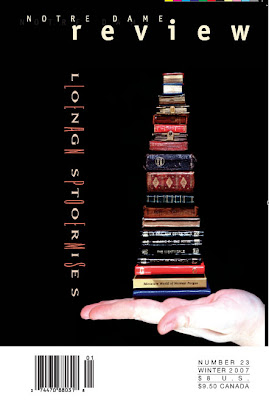
    Rejoice! The latest Notre Dame Review is out, and there's almost too much to love. From the very cool cover photo by Catherine Gass (whom I met when she came up to the &NOW Festival to hear her dad, William Gass, read), to the reviews in the back (lots of good stuff, including Christopher Merrill on Merwin, and Igor Webb on the ever-amazing John Peck), it's a rock-solid issue, and admirably diverse. Poems by W.S. Merwin, William Logan, Michael Anania, John Peck, and Jesper Svenbro, among many others (if you read only one Swedish poet, it should be Svenbro, so give your transations of Tomas Tranströmer one last, yearning look, and set them afloat on the icy blue breakers of the Baltic). The issue also contains new work by Chicago's own Kristy Odelius, whom we've just convinced and cajoled and arm-twisted into coming up to Lake Forest for the Lit Fest this April (she'll read on the 17th). And, for those of you who've had enough excitement, there's my essay "The Protestant Ethic and the Spirit of Poetry," perhaps an anomaly in this (ahem) most catholic of journals (it's probably for the best if you wince at that).

    Wednesday, March 14, 2007

    We Interrupt this Broadcast for a Bulletin from Ancient Sparta


    So there I was, at the age of ten or eleven, sitting on the floor of my parents' weekend place in the Canadian wilderness. I had a perfectly functional tree fort outside, I had a canoe and fishing gear at my disposal. These being delightfully unenlightened years, I had an air rifle in my arsenal. I had a couple of Cree Indian kids as friends, causing much envy among my city pals, who imagined me in mocassins, creeping like a miniature Hiawatha through the underbrush. There was even an abandoned gold mine nearby, entirely verboten but easily accessible if you knew where to squeeze through the fence. But was I going to take advantage of any of these things? Not a chance, ace. I had a brand new book of world history, and I wanted to see if its illustrations of the battle of Thermopylae were going to be as mad-ass, awe-inspiringly cool as those of my other big book of world history, a book I'd pretty much destroyed through excessive and overzealous reading and rereading.

    I say this to establish my credibility as an ancient history geek of many, many years standing. This goes deep with me, muchachos, deep.

    So I know what you're thinking. You're thinking I'm going to rain on the big, fabulous, over the top parade that is 300, the new movie about Leonidas and his 300 Spartans at the battle of Thermopylae. You're thinking I'm going to list a thousand historical innacuracies of interest to no one but the most dire literalist. But seriously: I don't mind most of the liberties the filmmakers took with the story. You want to ditch the armor to go all-out with the chiselled Spartan abs? No problem. You want to make Xerxes into an actual giant? Sure, why not. Go nuts. No harm no foul. You want to cash in on Warholian Minute 14 of the whole body-piercing thing and make the Persian leaders look like they got drunk in the West Village on a Friday night and woke up looking like punked-out pin cushions? Hey, I'm down with it. I mean, you've gotta make the Persians look exotic, as they would have to the Greeks. (Of course the Persians looked exotic to the Greeks in no small measure due to their curious and foreign habit of wearing pants, but that's just not going to look weird to the avergae chino-wearing soccer dad at the multiplex, so the whole piercings-for-pants substitution can be seen as a legitimate act of translation).

    What gets all up in my ancient-history-lovin' grill is this: the movie lies about the nature of Spartan society in ways that come too close to the kind of lies we hear about our own country in contemporary America. I just can't get past this in the name of fun & games the way I can get past Giant Xerxes or the Abdominizer Army. Let me explain.

    You might wonder why a military powerhouse like Sparta could only field a paltry 300 soldiers. With so much at stake, why would the Spartans send the equivalent of about two infantry companies? There's a movie answer, and there's a real answer, and between the two lies a giant gulf.

    The movie answer is this: the Persians bribed Greek priests in order to get the Oracle to say that the no army should be sent during the sacred Karneia festival. Despite these weak-willed, treacherous, peacenik enemies-at-home, 300 heroic Spartans are willing to defy the Oracle and Fight the Good Fight for Freedom.

    The historical answer is this: Sparta was a brutal slave-state, and the ruling warrior class was in more-or-less constant fear that the Helot slave-class would rebel and win their freedom. Sparta couldn't spare many troops, becuase their own society was fraught with inequity.

    So the movie masks a real class struggle and national disunity with — well, with what? With unthinking nationalism, and repeated (and unintentonally ironic) cries of "freedom!"

    You, there, with the Dell laptop — I can hear you mumbling "You can handle a giant Xerxes, but you can't handle this?"

    Yeah, I suppose that's true. I guess it's because I don't live in a country with a heavily pierced giant as president (which, you've got to admit, would probaby be an improvement). The things that bother us — unthinking nationalism, a complex, tragic war justified with too-simple shouts of "freedom" — have to be closer to home.

    Friday, March 02, 2007

    World Premiere of "Two Sonnets for Music" March 6


    Last summer Lake Forest College's composer-in-residence Rami Levin and I worked together on "Two Sonnets for Music," which will be performed with full choir and orchestra Tuesday night at the Lily Reid Holt Chapel. It was a miracle of long-distance collaboration, given that she was in Brazil and I in Chicago. Anyway, here's the press release — hope you can make it.

    I kind of wish they'd used the (entirely accurate) phrase "LIVE! FREE! ONE NIGHT ONLY!"

    On Tuesday, March 6 the Lake Forest College Chamber Orchestra and Chorus will perform a special work created in honor of the 150th anniversary of Lake Forest College titled "Two Sonnets for Music." The performance will be held in the Lily Reid Holt Memorial Chapel at 7:30 p.m. The public is welcome to attend free of charge.

    "Two Sonnets for Music" was written by Associate Professor of English Robert Archambeau (text) and Composer-in-Residence Rami Levin (music), and will be performed under the direction of David Amrein, a member of the College's music faculty. The program also includes a performance of Schubert’s Fifth Symphony by the Chamber Orchestra and music of Purcell performed by the Chorus.

    Robert Archambeau's books include Citation Suite (1997), Word Play Place (1998), Home and Variations (2004), and Laureates and Heretics (2007). His critical essays, poetry and translations have appeared in numerous journals in Europe and America, and he has been a visiting professor at Lund University, Sweden. From 1998-2004 he was the editor of the international poetry journal Samizdat. He has received prizes for his poetry from the Illinois Arts Council and the Academy of American Poets.

    Rami Levin’s works include pieces for orchestra, chorus, chamber ensembles, and solo instruments. They have been performed in the U.S., Britain, Canada, Spain, Norway, Italy, Israel, and the Slovak Republic. Her orchestra piece, Anima / breath of life, recorded by the Warsaw Philharmonic Orchestra was recently released on the Master Musicians Collective label. The piece was premiered by the Slovak Radio Orchestra in May 2003. In June 2003 clarinetist Richard Stoltzman recorded her Concerto for Clarinet and Orchestra with the Slovak Radio Orchestra. That recording was released on the Master Musicians Collective label in August 2006. Levin has received consecutive annual awards from ASCAP (American Society of Composers, Authors and Publishers) since 1994. She has served as president of American Women Composers, Midwest and has been active in the Chicago music scene both as a composer, and as the founding director of Lake Forest Lyrica.

    Saturday, February 24, 2007

    Situationism: The Smackdown


    Imagine if you will your humble blogger seated at his study table, surrounded by ghostly spirits. As they swirl in their disembodied way about his head, each calls out in thin-voiced dismay, urging the seated man to a course of necessary action. "Revise your old manuscript! The press wants it reformatted, and cannot wait!" urges one wispy and ectoplasmic entity. "Heed not those words," urges another "for you owe the editor of a book some notes on your contribution!" A third spirit whirls feverishly through the air, gibbering insistently about an omnibus review of an under-appreciated poet for which the immutable deadline looms. Then another ghastly apparition arises, sending the previous speakers off to cower in the corners of the room, by the unread stacks NYRBs. "Grade your students' papers!" it commands, its hollow eyes offering vistas of the abyss. What to do when confronted with such poltergeists? The humble blogger rolls up his sleeves, and, turning to his age-old strategies of semi-industrious avoidance, undertakes some research for a new book, a project for which no deadline exists.


    No doubt this will lead to terrible regrets later. But I gotta tell ya, I'm glad I did things this way today, because the research involved reading an exchange between two scholars of Situationism, and watching the first scholar smack down the second was at least as exciting as watching Roger Federer crush the will of yet another hapless opponent. (I was actually watching both smackdowns at once, reading with tennis on in the background. God knows how I stood the excitement).

    The exchange on Situationism took place in the pages of Social Justice's special issue on "Art, Power and Social Change" (that's vol. 33 #2, 2006, for those of you running to your archives or rooting around on the coffee table to find it under the remote control and that bag of Funyuns on which you've been secretly gorging). It began with a piece by Mikkel Bolt Rasmussen of Copenhagen University, to which Simeon Hunter of Loyala (New Orleans) replied. It ended with the resounding thud, as Rasmussen threw Hunter down in a devastating-yet-politely-professional riposte.

    Before filling you in on the specifics, a few words on Why This Matters, beyond the base thrills of the gladiatorial arena. What's important about the exchange, I think, is this: it shows us two important things that can happen when we equate aesthetic actions with political actions (as so many on the avant and post-avant tracks seem to do). Firstly, the exchange shows us how this can lead to the overt subordination of aesthetics to politics, which can be deadly to art (this is one of the conclusions Rasmussen draws about Situationism); secondly, the exchange shows us how easy it is for those of us immersed in aesthetic activity to think of aesthetic gestures toward politics as much more grand and powerfully subversive than they actually are (this is the conclusion I draw from watching Hunter try to form a coherent reply to Rasmussen).

  • Mikkel Bolt Rasmussen on the Situationists

    The story Rasmussen tells about Situationism comes, for the most parts, from his thinking about Guy Debord. If I had to paraphrase it in narrative form, I'd say it goes something like this:

    Back in 1957 Guy Debord and his crew looked around and saw nothing but the ruins of old avant-garde movements. The old avant-garde had been killed off, or suppressed, or marginalized, or had their radicalism domesticated and commodified and reduced to mere style. But Guy and the others were young enough and idealistic enough to think they could revive all that was best about the interwar avant-garde. They told themselves that, like the heroes of Dada, they could mock and undermine bourgeois norms and art and values; and like the heroes of Dada, they could liberate art from the institutions that had separated it from life, reducing it to useless decor and toothless aestheticism. They also told themselves that, like the heroes of Surrealism, they could break down the barriers between life and art and revolution. They turned for inspiration to the Surrealist notion that the unleashing of the unconscious and the repressed would bring us freedom, since the unconscious is not controlled by the social powers that be.

    But soon enough Guy Debord and his crew looked around again and saw that they hadn't managed to accomplish much, and they decided that art was not the solution they had hoped it would be. Debord came to the conclusion that our social order had evolved to the point where it was dominated by spectacle — by a system of images that colonize our minds and reduce us to passive consumers and obedient producers, and that dissolve all social associations that don't serve the dominant order. Art was simply appropriated by this system, and the spectacle even managed to colonize our unconscious. Debord looked down at the two six-guns he held in his hands, the one called Dada and the one called Surrealism, then looked up at the towering Godzilla that was the spectacle, then he looked over his shoulder to his companions shouting "our weapons are useless against it!" and ran for cover. [Rasmussen, who looks like a very serious man with serious glasses, didn't put it this way, and might not be too happy with me for so doing, but I believe I'm not too far off, really, in paraphrasing his position].

    When Guy and his band of outlaws reassembled in their secret caves, they gathererd round the fire they'd built from the only available materials (a couple of old chair legs and a dozen copies of Dialectic of Enlightenment, if I remember correctly), and asked themselves a question: in a situation like this, with Dadaist and Surrealist techniques rendered useless, how can we remain true to the spirit of the avant-garde? The answer came from Guy himself, from where he'd ensconced himself behind a protective wall of film-canisters containing the complete cinematic works of Jean Cocteau. In a voice not untinged with sorrow (indeed, in a voice not unlike that of Milton's Satan, as he addressed the defeated army of rebel angels), Guy told his companions that the only way to stay true to the revolutionary ideals of the avant-garde in an age when art was co-opted by the spectacle was to abandon art. Hear the voiceover to this sad scene, as narrated by Rasmussen himself:

    There was no doubt in Debord's mind: it was time to affirm the historical necessity and transcend the obsolete pseudo-communication of art.... Art had to be negated and realized in revolutionary practice even if that meant losing art. The Situationists had to abandon art; historical development necessitated this dramatic move.


    And so the Situationists were through, theoretically, with the production and criticism of such obsolete entities as literature and visual art per se, and set about a path of radical refusal: they "restained themselves from making artworks out of fear of commercial integration and institutional cooptation." The attempt to form a politics fused with aesthetics led, in the end, to the abandonment of aesthetic activity. Art died, that ideology could live.

  • Simeon Hunter's Reply

    Simeon Hunter's attempt at rebuttal begins promisingly enough: he asks us to look not at Debord's philosophical positions, but at the actual practice of a multitude of artists who follow in the Situationists' footsteps:

    I do not propose to object to Rasmussen's exposition. Rather, I wish to suggest that his account is overly pessimistic and that the value of Debord's text lies less in its argument and more in the possibilities that it opens despite itself. If we are to measure these possibilities, we need to focus our attention on those tangential visual practices and evidences that Debord seeks to close off, but which his thinking nevertheless propagated and indeed continues to propagate.


    What's that? Yes, I know, I know, Hunter's verb tense choices are a bit iffy, but quit being such a language nerd, why don'tcha, and listen to what the man has to say. Jeez! What Hunter means is that, despite Debord's sense that art could not significantly contribute to the big historical revolution of which Debord and his cronies collectively dreamed, there is still a lot of art that came out of the Situationist tradition, and such art is in fact politically efficacious. Debord may have thought such art futile, but, according to Hunter, it came into being anyway.

    Most of what follows in Hunter's essay is a list of various Situationist-inflected art projects (I say "inflected" rather than "influenced" because it isn't always clear that there is a direct line of influence). The examples include, among others, works by Andy Warhol and the Guerrilla Girls. I'd like to look at these in particular, because I think the distance between Hunter's claims for what the works accomplish politically, and the actual effects of the works, is huge. And the vastness of that gulf between claim and effect speaks stongly about the sentimentality of those whose interest in the aesthetic is justified by politics.

    1. Warhol. Hunter tells us that Warhol's work was, among other things, an example of art that worked to subvert the spectacle-driven social order Debord described. "The really clever part," says Hunter, "was that [Warhol] managed to make his critique so close to its subject that the system unquestioningly distributed the work for him.... It was reproduced, celebrated, and distributed by a commercial media unable to spot the subversion." Sigh. I mean, do I really have to say this? Well, okay: a subversion so subtle that it goes unnoticed as a subversion doesn't subvert much at all. It is reasoning of this kind that maketh one shudder when one hears one's fellow poets and professors speak blithely of the subversive nature of their favorite art. The question of tangible results has to be swept under the faculty-lounge carpet (probably by non-unionized immigrant labor, too).

    Several of Hunter's examples are roughly analogous to the Warhol example in terms of the question of tangible results. My favorite is that of the Lettrists, text artists who, according to Hunter, "sought to unify sign systems into a single politico-poetic voice designed to ameliorate the conditions of living for all by disrupting those specializations that the Enlightenment had imposed..." One yearns to grab a Lettrist by the lapel and ask "Say, that project of ameliorating the living conditions of all by getting jiggy with fonts? How's that, you know, working out for you?" Round the colossal lack of impact of such projects the lone and level sands stretch far away...

    2. The Guerrilla Girls

    Some of Hunter's examples involve work that does, in fact, have plausible claims to having had tangible effects. But a look at the most convincing of these examples, the Guerrilla Girls, shows us the limits of the kind of effect they have, and the overblown nature of the claim that they fulfill the Situationists' massive goals of social transformation. [Full disclosure: I think I was in some weak way connected to the committee that brought the Guerrilla Girls to visit Lake Forest College a few years back, but memory fades...]. I mean, consider the following statement, drawn from a Guerrilla Girls' piece consisting of a parodic recreation of the Ten Commandments:

    Thou Shalt Admit to the Public that words such as Genius, Masterpiece, Seminal, Potent, Tough, Gritty, and Powerful are used Solely to Prop Up the Myth and Inflate the Market Value of White Male Artists.


    The politics of the piece are pretty typical of the GGs. I actually think they've got valid points, and I think they've had an impact on the art world. But these are very limited politics — the politics of art institutions. While such things do have an eventual broader impact, this isn't exactly the revolutionary liberation of society for which the Situationists longed. It isn't revolution at all: it is an urging of the reform of some institutions that serve the privileged classes. And it is first and foremost about modifying the way we talk about art. If this is Situationism, it is a greatly diminished thing, in terms of social goals. (Was it Dwight MacDonald of the old Partisan Review crowd who used to look at the shrinking goals of his radical friends, and speak of an imaginary species of bird that went extinct because it could only fly in smaller and smaller circles, until eventually it disappeared up its own ass? Anatomically dubious, but one takes his point...)

  • Rasmussen's Smackdown of Hunter

    It was at this point that Rasmussen, who had been quietly positioning himself high up on the ropes of the ring, leapt down and slammed Hunter to the mat. And as he took Hunter down, he twisted the poor guy's body in two directions. First, he wrenched Hunter over to the corner to our left, and banged the hapless art-historian's head on the turnbuckle while uttering through gritted teeth that there has been "a widespread effort — visible in Simeon Hunter's reply, too — to turn the Situationist project into an art movement," despite the Situationist rejection of art. Having knocked his opponent around sufficiently at that end of the ring, Rasmussen the Dangerous Dane pulled the staggering Hunter to the center of the ring, cast him down, and delivered the coup de grâce, saying:

    We must still come to terms with the proliferation of images, but without repeating the damned grandiose themes of the Situationists, for whom it is a question of all or nothing, requiring the destruction of images to liberate the imagination.


    It is at this point that the bell rang, and the referee mercifully intervened, raising Rasmussen's arm in a spectaclular display of victory.