Friday, February 03, 2006

Notre Dame Review #21: Rejoice!

The latest issue of the Notre Dame Review has made landfall in the nearby harbor, and from the hold of that mighty vessel come poems and prose both rich and strange. There's a short story by Ihab Hassan (whose Paracriticisms first turned me on to PoMo back when I picked up a copy at a garage sale when I was in high school (dad was an art prof, so I grew up in a university ghetto, and the books of the moving-because-they-didn't-make-tenure crowd were often on sale at a deep discount). Also poems by Albert Goldbarh, Tom Raworth (and yeah, he did the cover too), Joe Francis Doerr (the ND Review and Salt seem to have a lot of overlap lately), and the crazy-good and utterly unknown Jere Odell, who someone's got to put on the radar soon. And John Peck, writing on Christopher Merrill with his usual 400-pound-per-square-inch perspicacity.

My own piece in the issue, "Gravel and Ghosts," treats the historcial poetics of Kevin Prufer and Albert Goldbarth. Since all my thinking about them began on this blog, I'm posting the first two paragraphs of the ND Review piece. They go something like this:

If you catch me on a bad day and ask me about the state of American poetry, you’ll probably get an earful of ill-humored grumbling about the enervating predominance of two kinds of poetry. “On the one hand,” I’ll gruffly opine, “we’re still swamped with the poem of the semi-confessional backyard epiphany.” You’ll probably tune out after ten minutes or so of examples drawn from recent contest-winning books, and your eyes will glaze over during my comparison of Charles Altieri’s notion of the Scenic Mode of Poetry and Ron Silliman’s idea of the School of Quietude. You won’t need to hear the finer points of their theories, because you already know what they’re talking about: poems that focus on the exquisite sensitivity of the speaker, caught in a meditative moment in an ordinary American life. Just as you think you’ll be able to slip out the back door of the campus coffee shop, though, I’ll start in on my other bĂȘte noir. Citing examples from the fat, respectable university quarterlies as well as any number of weird little online magazines, I’ll grumble and gripe about the linguistically hazy, indeterminate, pseudo-sophisticated nonsense verse that has emerged from the wreckage of language poetry. “Post-avant, they call it!” I’ll shout, alarming the people lined up by the cappuccino machine, “but Faux-avant is more like it! Poems about nothing, doing nothing that hasn’t been done before! This emperor has no clothes, and we’re all too cowed by Charles Bernstein-quoting associate professors to say so!” This outburst will leave me a little sheepish, and I’ll no doubt appreciate a few kind words from you before you make your getaway and your mental note never to ask me about the state of poetry again.

If you caught me a few weeks ago, though, when Albert Goldbarth’s Budget Travel Through Space and Time and Kevin Prufer’s Fallen from a Chariot landed on my desk, you’d have found me in a considerably better mood. Both poets find grist for their creative mills outside of those usual stockpiles of contemporary American poetry, sensitive autobiography, and sophomoric wordplay. Both Goldbarth and Prufer turn to the long-ago and the far-away as means of understanding contemporary experience, and their poetry is much the richer for this xenophilia. Both seek out facts, images, and anecdotes from history, and both interrogate contemporary experience through the examination of the exotic historical other. The two poets use the past to interrogate the present differently, though. Goldbarth is an omnivore, devouring anything he sees, hears, or reads, absorbing it, ascribing significance to it, and using it to understand contemporary experience. Historical anecdotes are the chunks of gravel in his gullet, and he uses them to digest the often-difficult world around him. For Prufer, the past is more elusive. While it offers parallels to contemporary experience, those parallels are often mysterious in nature. The past doesn’t explain the present, it haunts the present. Images from poems set in the past recur in poems set in the present, but the full meaning of the images remains undisclosed, as does the meaning of the recurrence. Indeed, the recurrence of these mysterious, melancholy, and beautiful images is, in some sense, their significance: the sublime unknowability of the world endures, the ghosts shimmer into appearance but cannot be grasped.


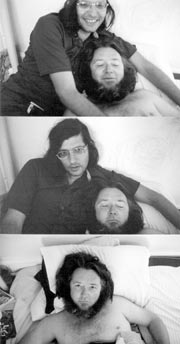
Of course the cartoonishly-caffinated Archambeau depicted above is a bit more of a believer in the avant/quietude dichotomy than is the sedate and mild-mannered Archambeau who reads quietly in his study of an evening, but the real me makes lousy reading. Anyway, some of the issue is up online, along with bits and pieces of bonus material.

Sunday, January 29, 2006

Pastiche as Criticism

Even after all these years, the beginning of a new semester always smacks me upside the head a little more than I expect it will, and I've been away from blogging for a while, unless you count the rerun of a bit of social satire that I ran last week after the original post was quoted in a Chicago newspaper. I've been busy, though, what with teaching, getting the revised manuscript of Laureates and Heretics out the door, and writing an essay for Avant-Post, a book Louis Armand is editing for the very happenin' Litteraria Pragensia in Prague. I keep changing the name of the essay, but most versions include the phrase "Pastiche as Criticism," and today's re-entry into the inner blogosphere is fuelled by some of that project's fallout.

I've noticed several examples, lately, of critics straying into areas of composition where once only poets and fiction-writers dared to go. Specifically, I've noticed criticism being written in the form of pastiche, with the deliberate imitation, by the critic, of a pre-existing source text. This is interesting for all kinds of reasons, not least of which being the way it upsets one of our more established critical/theoretical applecarts: the idea that language is somehow entropic, that it becomes less meaningful the farther it moves from originality, and the closer it hews to the repetition (in style and in content) of earlier ways of talking. Here's Goethe taking this line, back at the end of the 18th century:

All dilettantes are plagiarizers. They sap the life out of and destroy all that is original and beautiful in language and in thought by repeating it, imitating it, and filling up their own void with it. Thus, more and more, language becomes filled up with pillaged phrases and forms that no longer say anything...


Okay. So Goethe tells us that we need linguistic innovation to regenerate cliched ways of writing, talking and thinking. We need heroic individual innovators to keep things fresh. If it all sounds a little avant-gardist, or at least modernist, it should (I actually came across the passage while reading a kickass essay by Jochen Schulte-Sasse, in which he claims that avant-garde ideas of lingusitic entropy and alienation are present much earlier than we tend to expect to find them, and are in fact coincident with the rise of capitalism). This is a way of thinking common to modernist writers (think Ezra Pound's "make it new"), and it persists today (think of Richard Rorty's riffs on Harold Bloom and the redescriptive power of the poet in the "Contingency of Selfhood" chapter of Contingency, Irony, and Solidarity).

But what if repeating, imitating, using pillaged phrases and the like becomes not the means of saying nothing but cliches, but rather the means of creating new insights? This was also a modernist idea, but it was a modernist idea in what we think of as the creative genres (poetry, the novel), not in what we think of as the critical genres (the lit-crit essay, say, or art history). (I know, I know, the dichotomy is false, but it persists in our usual modes of thinking -- bear with me).

This use of pastiche as a form of criticism seems to be the method of a few innovative critical types lately, including Benjamin Friedlander and my man David Kellogg. They deliberately take old bits of language and go about "repeating it, imitating it, and filling up their own void with it." The result isn't the banality Goethe feared, though, but the shaking-up of our received modes of critical thinking. Check it out!

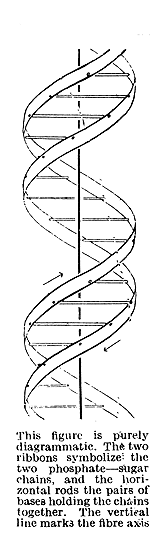
Here's Kellogg, who begins "The Self in the Poetic Field" with a pastiche made up of (in his words) "a line by line rewriting, with a few sentences removed, of J.D. Watson and F.H.C. Crick, 'A Structure for Deoxyribose Nucleic Acid' published in the journal Nature in 1953.". The original essay, as every bio major knows, begins like this:

We wish to suggest a structure for the salt of deoxyribose nucleic acid (D.N.A.).

This structure has novel features which are of considerable biological interest.A structure for nucleic acid has already been proposed by Pauling and Corey (1). They kindly made their manuscript available to us in advance of publication. Their model consists of three intertwined chains, with the phosphates near the fibre axis, and the bases on the outside. In our opinion, this structure is unsatisfactory for two reasons: (1) We believe that the material which gives the X-ray diagrams is the salt, not the free acid. Without the acidic hydrogen atoms it is not clear what forces would hold the structure together, especially as the negatively charged phosphates near the axis will repel each other. (2) Some of the van der Waals distances appear to be too small.


And here's Kellogg:

I wish to suggest a structure for contemporary American poetry (C.A.P.). This structure has novel features which are of considerable critical interest.

A structure for poetry has already been proposed by Eliot. He has kindly made his manuscript available to the world for the last eighty years. His model consists of an enveloping tradition, with the dead near the center, and the individual talent on the outside. In my opinion, this structure is unsatisfactory for two reasons: (1) I believe that the material that provides the poetic structure is the living community of readers, not the dead. Without the stack of coffins, it is not clear in Eliot's model what forces would hold the structure together, especially as the variously interpreted bodies near the center will repel each other. (2) The self of the poem is extinguished along with the poet.


Okay, that last sentence is a pretty big departure. But you get the idea. The original is inhabited the way a hermit crab inhabits another sea-critter's shell. Benjamin Friedlander takes this method to a whole new level in his new book Simulcast: Four Experiments in Criticism. Here's his description of the method of that book:

I describe these works as experiments because all four are based on source texts and thus inaugurate a species of criticism in which the findings only emerge after struggle with predetermined forms. Sometimes this struggle took shape as an exercize in translation, not unlike the re-creation of a sonnet's rhyme-scheme and meter. Often, translation was impossible, and the struggle resolved itself instead in an act of controlled imagination -- not unlike the sonnet's original creation. In each case, the production of my text had less in common with the ordinary practice of writing an essay than it did with the composition of metrical verse....[the book's] somewhat scandalous methodology [involves] the creation of criticism through the strict recreation of an earlier critic's text (or, more precisely, through as strict a re-creation as the discrepancy between my source text and chosen topic would allow). Thus, my "Short History of Language Poetry" follows the arguments (and even wording) of Jean Wahl's A Short History of Existentialism, while "The Literati of San Francisco" takes Edgar Allan Poe's Literati of New York City as its template.... Although I was predisposed in each of these pieces to certain arguments and conclusions, I willingly abandoned these when they became incompatible with the critical approach demanded by my source.


What's interesting to me about Kellogg and Friedlander are the ways they turn the dominant assumptions about language around. We do tend to think like Goethe: repetition of the past seems bad, derivative, weak, and destined to perpetuate cliches. But Kellogg and Friedlander avoid all this. In fact, their use of source-texts as a critical tool takes them away from their own instinctive thoughts about literature, and forces them into new insights, different from their own critical predispositions. This seems a lot like Oulipo to me -- the use of a deliberate, systematic form of writing, carried through with some rigor and against our 'natural' (that is, habitual) modes of composition and thinking, as a means of generating new insights.

What makes this particularly effective, I think, is the turning to source-texts at a bit of a remove from the dominant critical prose norms of our time. Kellogg leaves the humanities behind and seeks out a scientific source-text, while Friedlander turns to remote, belletristic stuff (Poe) or to a philosophy currently deeply out of fashion in the academy (Existentialism). This is different enough to break our usual norms of thinking, but familiar enough to generate insights that are still comprehensible, if not uncontroversial. It reminds me of a comment Vincent Sherry made about John Matthias' poetry and its use of arcane historical source-texts in Word Play Place: "on the one hand, the pedagogue offers from his word-hoard and reference trove the splendid alterity of unfamiliar speech; on the other, this is our familial tongue, our own language in its deeper memory and reference." We get an estrangement of thinking, but it is an estrangement based not on an absolute alienness, but on a revival and reexamination of disused discursive strategies.

The critics are doing it like the poets have been doing it for decades. This is positive, and I hope we can see more of it: nothing is more enervating than the prose-style of our immediate inheritance: the half-assed theoryspeak of the professoriate, 1979-1999. May it rest in peace. Long live pastiche as criticism!

Monday, January 23, 2006

Rich Twits of Chicago's North Shore: An Anthropology (Reposted)

Since I've been getting a lot of hits from subscribers to Crain's Chicago Business, which mentions this old entry, I'm reposting it. Enjoy! (Disclaimer: since this is probably something that looks like ivory tower snobbery about people who actually have or make money, note that I also make fun of academics like myself).


Although I always thought I'd stick to the humanities in this blog (poetry, philosophy, and a bit of art), I find myself morally compelled to sully my soft humanist hands with the rough silt of the social sciences -- let me explain.

The following report was passed to me by Raskolnikov T. Firefly, Ph.D., a former colleague of mine at another university. He seemed nervous, demanding to meet in the middle of the night at the Denny's on route 41. I arrived on time, but he was late, shambling in like a twitchy fiend as I was finishing my Eggs-over-my-Hammy special. He kept looking over his shoulder and trying, fruitlessly, to light cigarettes, which he then discarded. He said I had to help him, that my blog was his only hope now that the agents of his enemies had turned the respectable journals against him. Taking his yellowed, coffee-stained manuscript from his trembling hands, I promised to do what I could. This was all some time ago, and I haven't heard from him for weeks, although my caller ID indicates that the inhabitant of a certain single room in a certain Motel 6 near the Wisconsin border calls and hangs up every couple of hours. Frankly, I'm a little concerned for Rasko, as we used to call him in the grubby little leftwing bookshops in that university town in the mountains by the seashore in another country oh so long ago.

His report follows:

A Socio-Anthropological Typology of the North Shore
by Raskolnikov T. Firefly, PhD


My decade long researches among the inhabitants of Chicago’s North Shore have, at last, yielded results. I and my crack research team (thanks, Kid V, Pravda and Jimmies B and C -- couldn’t have done it without you), have spent the better part of the last ten years lurking in such dangerous and unpalatable locales as artisanal bread shops, high-end cycling centers, national-chain arthouse movie theaters and, in a true show of courage, Starbucks outlets not yet unionized by the I.W.W. Forthwith, our conclusions.

1. Method of Study

Lurking, malingering, and harumphing in lines outside American nouvelle cuisine bistros, sneering from our Hondas and Chevy Cavaliers as we pass the Aston Martin and Land Rover dealerships, looking suspiciously around the room during late night visits to Ben & Jerry’s, drifting aimlessly through Anthropologie or Jos. A Banks, trooping out to Lake Geneva Wisconsin to observe North Shore fauna in its semi-migrational mating-and-antiquing phase, attending community theater and Suburban Fine Arts Center fundraisers, checking the license plate numbers outside Unitarian churches, noting the girlish giggles of septuagenarian matrons in the Marshall Fields’ handbag section and the boorish grunts of Dick Cheney look-alikes from the 16th hole rough. Drinking cosmopolitans and anything ending in -ini, so long as it is from the color palette present in a roll of Jolly Ranchers. Also, a lot of internet surfing and repeated viewings of Ordinary People and Risky Business, for which we have drawn elaborate location charts and alternative storyboards depicting general uprisings of the people and the creation of a service-worker’s Utopia led by Tom Cruise and Rebecca DeMornay. Oyez, oyez. Power to the people.

2. A Typology of North Shore Habitants

A. The North Shore Goof (NSG)

You know this guy. He looks like Chevy Chase, especially the Chevy Chase of Caddyshack. Good-natured, but more of less useless on account of never having had to work a day in his life. Habitats include golf courses, convertibles, east Lake Forest, and restaurants featuring club sandwiches. Harmless, except when seen objectively.

B. Predatory Corporate Status Monkeys (PCSMs)

Think thirtysomething or fortysomething. Think wire-rimmed glasses in sylishly contemporary frames. On the weekends you see him biking like Lance Armstrong and looking at you with a faint disdain for not making as much money and biking as frantically as he, or out with his wife (either a PCSM herself -- 25-30% are women -- or a Subscriber) on a powerwalk, pushing the kid in an ergonomic high performance mountaineering pram, making quality time with the nipper he’s not seen all week and won’t see again until he makes sure the guys in Acquisitions get the WEENUS report in on time. Habitats include west Lake Forest, east Highland Park, and Glencoe, also the Green Bay Trail and Miramar. American Express gave him his Blackberry as a Preferred Customer Premium.

C. The Man

He does not work. You work for him. The PCSMs work for him. In the end, one way or another, we all work for him. He neither toils nor spins: he owns. His markings include great height and a shock of white hair. Habitats include houses that cannot be seen from the road. With stunningly little variation, he looks like George Plimpton.

D. Vic Wilcox

Named after a character from David Lodge’s splendid little novel Nice Work, the Vic Wilcoxes of the world have some cash and won’t be shy about telling you that they’ve earned their pile. They’ve earned it by building up companies that plate things in nickel, or supply Styrofoam coffee cups to office parks in the western suburbs, they’ve earned it by getting the contract to sell tanning beds to Carnival Cruise Lines, they’ve earned it by keeping those union guys out, they’ve earned it and they don’t mind telling you and they almost almost don’t mind that they’ll never be The Man because they’ve earned it and they haven’t had time to get comfortable at Lyric Opera fundraisers and their picture won’t ever be in Chicago Social (sorry, “CS”), they’ve earned it and wonder if they can trade in their first wives for new ones who might have contempt for them but could tell them which charities they could give to so they could go to the parties where they won’t be comfortable -- and wouldn’t they rather watch football and eat a meatball sub anyway. Usual cause of death is angina and a quite despair that knows not how to speak its name.

E. Subscribers

These are, as you guessed, the subscribers to that esteemed and storied magazine, North Shore Bitch. Picture that title, if you will, in the elegantly curving cursives of that journal’s cover. You see them jogging with their iPods, keeping it all in shape. You see them buying tureens at Williams and Sonoma, buying sundresses at Saks, buying stylin' maternity clothes at Bellydance, buying DVDs of Martha Stewart. Basically, you see them buying, often in small gaggles of the likeminded, oblivious to those outside their braying bubble of buy-buy-buy. In their fantasies they are Princess Diana as she marries Charles, or better yet as she has that affair with the dark and brooding Saudi billionaire. “How fun!” they gush, between bites of the roasted tomato and grilled chicken salad at Southgate. Only one fear haunts the manicured lawns and magazine-ad-like, blowing-curtained, wicker-furnished sunrooms of their dreams: becoming DFWs.

F. Discarded First Wives (DFWs)

Little is known about these middle-aged women of the North Shore, seen only buying gin in the Jewel or behind the wheels of slightly aged Volvos. Little is known because one dare not meet their gaze, so bitter it is, so soaked in the tannic fluids of experience and thwarted entitlement. Fear them.

G. Evil Withered Sticks (EWSs)

If you’ve seen Nancy Reagan, you know the type. Her weight never gets into three digits, her skin has, through repeated exposure on tennis courts and seasons in Coral Gables, attained the consistency of fine Corinthian leather. She may once have been a subscriber, fearing DFWhood, but she is now a formidable feature of the landscape, braying with laughter behind her cocktail glass at a lawn party on a sunny afternoon. Try the Onwentsia club if you seek a high concentration of the species.

H. The Good People of Evanston (GPEs)

This is a subspecies of the PCSM, with the following distinction: they’re smug about their virtue. Having once written a $500 check to the Sierra Club, having once attended a book signing by Deepak Chopra or perhaps Dave Eggers, they are secure, indeed ontologically grounded in their sense of superiority to their fellow PCSMs from farther up the shore. Also, since they live near Chicago, they secretly suspect that they’re street, homes, street. Surprisingly, not all GPEs actually live in Evanston. Some live elsewhere but are members of the North Shore Unitarian Congregation.

I. Standard Academic Clowns

Not often found outside of Evanston and a small enclave established in the unlikely and infertile soil of Lake Forest, these hapless sorts are distinguished by rumpled chinos, dented upper-mid-range cars, Steve Earle CDs, good internet access and a wonderful conformity of ideas, consisting of centrist beliefs masquerading as radicalism. Often seen birding, or overheard telling their friends about how little television they watch.

Tuesday, January 17, 2006

Names and the Pity of War: Here, Bullet

I think it was because I've been thinking about war poetry lately that Simone Muench suggested I check out Brian Turner's Here, Bullet, a book that's been getting a lot of high-profile press (New Yorker, New York Times,). I gave it a read during the interstices of the first teaching day of the new semester at Lake Forest, devouring bits between my two seminars, and finishing it on the train home. Although it isn't my usual thing, I can see why she suggested it. It is (pardon the pun) hit-and-miss, but it is a good example of how in war poetry so much of the poetry is, as Wilfred Owen said nearly a century ago, in the pity. And much of the pity, interestingly, comes it the use of proper names.

The poems are generally anecdotal, loosely put together, and usually depend on a kind of scene-setting over which an emotional sheen has been cast. Turner's also not above a few cliched forms of phrase, like ending a poem with the adjective-concrete noun-of-abstract noun formula. What's strong about Here, Bullet, though, is the emotion, which covers a range well outside the usual poem of backyard epiphany. The white-knuckle world of the American soldier in Iraq comes through loud and clear, as does the strangely unreal quality of the soldier's experience over there. As does the all-too-real nature of the violence. As does the existential absurdity of it all, as seemingly inexplicable acts of violence tear through the day, and friend/foe/bystander categories become muddied.

I'm intrigued by the way names come into all this. In contrast to poets like Randall Jarrell and Kevin Prufer, who deal with the dehumanizing nature of war by making their soldiers anonymous, Turner is hell-bent on keeping the people around him real, and making their tragedy specific, through using their proper names (that he does this for both Americans and Iraqis is especially laudible).

This is most effective when a name is incanted over and over, as in "AB Negative (The Surgeon's Poem)." In just over a page, we hear the name of the wounded protagonist five times, twice with both given- and surname: "Thalia Fields lies under a gray ceiling of clouds"; "Thalia / drifts in and out of consciousness"; "a nurse dabs her lips with a moist towel / her palm on Thalia's forehead"; "Thalia / sees shadows of people working / to save her"; "a way of dealing with the fact / that Thalia Fields is gone, long gone." The repeating of the name is redundant, grammatically, but syntactical efficiency isn't the point here, any more than it is in any chant or lament. Repetition is the faith Turner keeps with the dead.

Sunday, January 15, 2006

Naming Names: Corey and Palatella on Ted Berrigan


Lots of interesting responses to the Berrigan/proper names business, including some interesting thoughts by Josh Corey. He tells us that, when it comes to proper names in New York School poetry,

Well, I'm generally for it, as the same principle allows me to refer to a man I've never met as "Bob" in this blogpost. There was a time, though, when I felt that sense of outrage he describes when public sphere expectations are violated by the introduction of private codes: I remember reading an issue of The Germ years ago and reading an interview between Keith Waldrop and Peter Gizzi (long before I knew who either of those gentlemen were) and being irritated by the first-name basis they seemed to enjoy with legions of poets I'd never heard of. I felt deliberately excluded—yet if I were to read the same interview now I'd nod my head with recognition and feel a sense of warmth and inclusion more pervasive, if less intense, than my initial sense of repulsion. And for whatever reason that earlier feeling failed to deter me from my interest in the strange and marvelous world of poetry I discovered in The Germ... But come to think of it, maybe my irritation derived more from the fact that the medium was an interview, which I imagined was meant to be precisely the disclosure of a private sphere unto the public one: isn't that what we read interviews for?


I kind of like the breaking of public sphere/private sphere norms in Berrigan's poetry, where I think it serves a number of interesting roles (not the least of which is drawing our attention to those often-unexamined norms). But I'm not sure how I'd feel about the Waldrop-Gizzi interview. Anyone want to send me a copy?

John Palatella, who didn't get to say everything he's hoped to in his review of Ted Berrigan's Collected Poems for The Nation, has a number of good points to make.

I think readers have been inclined to misunderstand Berrigan’s use of personal names in part because of the way other poets have reduced what Berrigan and O’Hara did into simple name-dropping, a manner of advertising one’s eccentricity and status. Berrigan says in an interview with Anne Waldman and Jim Cohn that one of the many poets he read when he arrived in New York was Ezra Pound, and that he learned from Pound what to put in a poem—everything that’s going on in your life. What you learn from the letters you get, the books you read. What this means is that instead of Browning we get Dick Gallup, instead of Confucius, Ron Padgett, instead of Jefferson, Joe Brainard. I don’t think Berrigan was joking when he said this. I think he meant it, mostly because he was a poet who, not unlike EP, read in order to write.

I also think the names are a way for Berrigan to imagine a listener, to create the conditions necessary for sympathy, or the transmission of a feeling that touches some second figure. In that same Waldman interview Berrigan says “I didn’t want people to come into my poems, but if I could make things come out…” One of the things that comes out is sympathy. (It comes out explicitly, and a little viciously, in "Red Shift"-- "I'm only pronouns, & I am all of them, & I didn't ask for this / You did / I came into your life to change it & it did so & now nothing / will ever change / That, and that's that.") What's more, because the names are a way to invoke a listener, the personal identity attached to the name often doesn’t matter. The name could be mine or yours. Some of Berrigan’s readers have been keen to figure out the identity of the Chris mentioned in The Sonnets. Alice Notley’s notes in the Collected to The Sonnets enable one to do that, but again, I think that the significance of the appearance of the name Chris in the poems, like the appearance of the name Dorothy in “Tintern Abbey,” doesn't hinge on knowing Chris's personal identity and biography. It's very interesting to me that when Berrigan does speak fondly about certain friends, as in "Red Shift," he chooses not to identify them by name.


Although Wordsworth never actually names Dorothy in "Tintern Abbey," I see what Palatella means. In fact, this makes Berrigan's use of names into a way to construct the relational self Ellen Hinsey talks about, and helps to take Berrigan out of the depths of self-obsession that so much of American poetry fell into during the sixties and seventies. Were I not fried from the last-chance-before-teaching-starts-again attempt to go over the manuscript of Laureates and Heretics one last time, I'd opine about it at great length. You may well consider yourselves spared...

Veni Vidi Ambiguity


Steve Burt (who should, as of yesterday, be a new father), writes in with regard to my Robert Hass post made about Robert Lowell calling for a "return to Rome":

Aren't you being a bit unfair to Lowell? He "advocated a return to Rome" in the sense that in the 1940s he was a Roman Catholic, but I think you mean his Juvenal adaptations and other pseudo-neo-Latin work from the Sixties, especially Near the Ocean -- & the point of that work was not that we should become more like ancient Rome, but that we (the US) were too much like Rome and didn't know it, that if we all knew more Roman history and literature we wouldn't be repeating Rome's dreadful mistakes,


in small war after small
war, to police the earth, a ghost
orbiting forever lost
in his monotonous sublime.


(He was right, too!)


You know, I think I let the fact that three of my degrees are from Notre Dame blind me to the fact that "returning to Rome" can mean different things to different people. I was thinking about Lowell's turn to Catholocism in the 40s -- a longing for a more hierarchical/theologically clear religion, in contradistinction to the world of Hass, with its "flexidoxy" in religion.

Wednesday, January 11, 2006

Private Faces in Public Places: The Lower East Side as Public Sphere


Rejoice, oh subscribers to The Nation magazine! Amid the usual depressing/outrage-inducing catalog of the
villainy
, arrogance , venality, and miscellaneous atrocity of Bush's regime, we find full-scale reviews of the collected poems of both Ted Berrigan (by John Palatella) and Kenneth Koch (by Melanie Rehak).

Two things struck me from reading the reviews. First there was a very clear statement of something I'd intuited about Berrigan's sonnets, but never really articulated, even to myself.

Berrigan's sonnets ring serious changes on the traditional sonnet structure of an octave followed by a sestet. Influenced by Tristan Tzara's cut-ups, John Cage's chance compositions and the jarring polyphony of John Ashbery's second book, The Tennis Court Oath, Berrigan assembled his fourteen-liners according to various methods. Lines quarried from Berrigan's unpublished poems are worked into a sonnet according to strict formulas. Lines, phrases and shards of lines from sonnets early in the series reappear later in different permutations. Berrigan's own words are collaged with language snatched from the work of other poets.... If [William Carlos] Williams considered the sonnet a Procrustean box, Berrigan turned it into a Rubik's Cube.


This is Ted Berrigan as a Barthesian scriptor (a role for the poet I've always found compelling, as I mumbled about in my last post). I suppose this is one reason why reading his sonnets en masse is so much more rewarding than reading one of them in isolation. Much of the pleasure comes in watching the same lines change in new contexts.

But the most interesting thing in the Berrigan and Koch reviews is the attention they draw to one the most distinctive stylistic markers of the New York School: the tendency to write publicly as if one were speaking privately, dropping names and making in-group allusions. I kind of like this (maybe because the need to footnote some of it pleaseth my elbow-patched academic soul), but people I know who don't like New York School poetry often single this out as something to grumble about, and even people who like the New York School sometimes dislike it. Palatella quotes Ed Dorn, who felt that Berrigan's greatest shortcoming "was that his subject matter was limited to his friends, or circle."

This sense of New York School parochialism comes up again in Rehak's review of Koch, where she says that Koch, James Schuyler, John Ashbery and Frank O'Hara constituted a "merry band," or a "little cosmos" of their own. You get this in the stories of their lives, but the thing that throws some people for a loop (and delights others) is the way this sense of a little cosmos finds its way into the poems. I mean, it isn't hard to parody this part of NY School poetry, because we've all seen it so often:

The rain was falling on Larry's windows like fog but heavy,
Jane, but I was upstairs where you were painting
and rain doesn't come through the telephone,
except as noise, like you'd get at Ted's but that's downtown
and we're here where it's warm and Willem is on the way


So what's the deal on this, anyway? Here's a hypothesis. I think what bothers Dorn about Berrigan's version of the in-group name-droppery of the New York school is the way it short-circuits our expectations about how published writing communicates.


Ever since the development of subscription-based journals in the eighteenth century (you know, Habermas' classic public sphere), most of us have tended to think of published work as a venue where we, the readers, all encounter the writer on roughly equal terms. None of us are meant to be privileged as readers by virtue, say, our social position -- we read the published word and our ability to assess it is, we assume, meant to be based only on the power of our intellect. Theoretically, we all have access to the word equally. That's why it isn't usually a scandal when, say, a your uncle Ed says he disagrees with you, a PhD-wielding English Prof, about the interpretation of his favorite novel; and why it would be a scandal if you were to try to win the argument by saying "I must be right -- I'm a professor!" In the classical model of the public sphere, you are meant to demonstrate the superiority of your understanding through reason, not an invocation of authority or social positon. (Yeah, I know: the should be qualified in a hundred ways, and when articulated at book-length by Habermas it is. But I'm not out to defend Habermas, just to say that most readers and writers in our society operate on the basis of principles more-or-less like those described by Habermas).

In this context, many readers are going to be scandalized, or at any rate a bit irked, by a published book (an entity belonging to the public sphere) that seems to communicate more like a private letter or even (to use a NY School favorite metaphoe) a phone call. When the poem becomes difficult to read because of what seem like in-group shibboleths, such a reader feels a bit cheated. Even when the poem isn't made cryptic by in-group stuff, it seems at odds with public sphere norms just by virtue of seeming to appeal first to a small group of friends, and only secondly to a big, anonymous audience. This kind of poem is an anomaly in a publishing world whose norms are defined by the public sphere.

My guess is that this is one of the things Berrigan wanted, though of course he never sunk to the language of communications theory. But so much of his life was a deliberate rejection of bourgeois norms, I imagine his rejection of bourgeois published-communications norms was a part of his bohemian ethos. I mean, he rejected bourgeois materialism, bourgeois careerism, the bourgeois division of time into productive day and recreative night, even bourgeois bodily health, in his poete maudite role. He was every inch the bohemian -- modernity's anti-modernity invention -- and he'd enter the public sphere of publication only in order to short out its norms. Those post-card poems from near the end of his life are a real slap to the logic of our dominant publication system.

So, now that the internet has changed everything, do we still have those classical public sphere assumptions? Does it still seem wrong to drop names, as if only a close circle had a privileged status among your readers? What do you think, Josh? Henry? Eric? Kevin? Catherine? Mark? Joshua? Jeffrey? Steve? Simone? Natalia? Brian? The rain is falling on your windows like fog but heavy. But I'm upstairs where I've been writing and rain doesn't come through the internet.

Tuesday, January 10, 2006

The Poet as Scriptor


My "Imitations and Collage: From the Poems of Blas de Otero" is up on Sharkforum.org, a very cool site devoted to the art, music, and literature being made in Chicago.

The piece is a set of loose translations (like Lowell's Imitations, or at least that was the plan), combined with a short coda in the form of a pseudo-cento, which combines elements of the translations into a new poem. When I wrote the piece I was tripping on Roland Barthes' "Death of the Author," (still a favorite of mine), and was very interested in the idea of the poet as a scriptor, someone who doesn't so much invent as recombine existing elements. My largest project of that kind was "Citation Suite," which Randolph Healy published in a very slick Wild Honey Press edition, and which you can read online.

Friday, December 30, 2005

The Trouble with Ron


Back from Philadelphia, where I spent Christmas, and now in deep convalescence from a cold I picked up from my nephew (I don't know what the deal is, exactly, but every time I'm in close proximity to children I get sick). But undeterred by illness I blog doggedly on from behind my half-empty bottle of Nyquil (the only cold medicine to come with its own shot-glass) and an ever-growing haystack of used kleenex.

Today's act of bloggery is prompted by Josh Corey's meditation on Ron Silliman's blog. Silliman has an odd status: since he was the first poet of standing to start blogging, since he does it regularly, and since he plays a kind of manichean game (in which you are invited to feel like one of Ron's heroic good guys, or to feel the equal but opposite pleasure of raging against the Orthodoxies of Ron), he's ubiquitous in the poetry blogosphere. In this little world, he is a condition of discourse, a kind of hegemon (as Jim Behrle has stated, not in words, but in a whole line of "obey Ron" merchandise), but he still works the rhetoric of the aggrieved outsider. Maybe it is this dissonance between his objectively central status and his subjective experience of marginality that mars his model of the shape of the contemporary poetic field. I mean, some of what he says about the way we map poetry makes a lot of sense, but there's a narrowness to it that, in the end, is deeply ironic. Check it out.

One of Ron's big ideas is that those who occupy positions of power tend to think of themselves as normal, and others as deviant. Nothing new to this, really: whenever I tell my students that they all have accents, the majority of them object, since they think only those from American English's linguistic minorities (people from the south, or old school Brooklynites, or rural Wisconsin cheeseheads, or whatever) have accents. They think they speak unnaccented English, because their accent is the dominant one. As it goes with accents, so it goes with poetry, and Ron quite rightly wants to see this come to an end. He is angered by a world in which people act "as if Robert Pinsky and John Hollander wrote poetry, but Kasey Mohammad wrote post-modern or New Brutalist poetry, Geof Huth wrote vispo, Erica Hunt & Harryette Mullen wrote langpo." I owe the discovery of this passage of Ron's to Josh Corey, who goes on to comment on it in a way that nails both the virtues and the vices of Ron's way of thinking about poetry. Ron, says Josh,

wants the word "poetry" always to carry an appropriate socio-historico-communitarian modifier, and if he took the time to distinguish more closely the various differences and strains within what he too often lumps together as a School of Quietude he might encounter a little less resistance to his project. (Not that such resistance seems to faze him even slightly.)


There it is: Ron's got a very worthy desire to see all poetry described precisely, and a desire for everyone to be aware that what they write isn't simply "poetry" but a particular kind of poetry, with a history behind it, with a series of implicit aesthetic decisions always already made. This is the good Ron. But the bad Ron is the guy who is willing to lump everything he doesn't like together in one big mass and give it a kind of derogatory name. This is bad because it is unsubtle, because it masks real differences, and because it is dismissive. I suppose this is where the self-image as aggrieved outsider comes into play: it's okay to dismiss all that stuff, you can tell yourself, because they are powerful and they dismiss you. The irony of this (you're narrow-minded and ignorant of us and think we're all the same, so I'll combat it by being conversely narrow-minded) is so clear it is amazing that a guy as smart as Ron doesn't see through it.

One reason I keep harping on David Kellogg's model of the poetic field (with all its limitations and its need for refinement) is that it could lead us toward two things we need: A) a more subtle system of understanding the varieties of contemporary poetry and B) terms for describing poetry that are not already charged with positive or negative value. That "School of Quietude" is always a negative term is clear enough, the proof being that, like so many other negatively charged terms for groups of people, the people it describes never use it to describe themselves.

In the end, I suppose I want one of the things that Ron wants: a poetry world in which everyone consciously understands something about their own aesthetic position and the sociology that goes with it. I just wish he'd be more fair to people from other traditions than they are to him.

One could make a case that there is more reason to rant against the people who give out the big prizes than there is to rant against Silliman. They are just as dismissive, after all, and they tend to have a bigger immediate impact on the lives of poets. But there are two reasons why it is more important and worthwhile to rant against Silliman than to rant against, say, Helen Vendler:

1. There is an actual chance that someone like Silliman would listen. I peg the odds of Helen Vendler responding to a blog-based critique of her aesthetics about even with the odds of the Green Party winning a seat in congress. (Oddly enough, though, I do get a lot of hits from Harvard whenever I mention her name).

2. Silliman, I think, is actually in a position to give out the bigger, more meaningful prizes. I mean, those who seem powerful are rarely as powerful as we think they are, and I think that is the case in the poetry world now. I'll bet that time will show us that the real reputation makers aren't going to be the Vendlers of the world, but the Sillimans. The Vendler view is dominant for the moment, but the Silliman view is the emergent power, with scads of younger people taking their cues about literary history from him. Some of this surely has to do with the fact that most of the people Ron would call "Quietude" types don't actually write a lot of criticism, for all kinds of complicated reasons. There's more to say here, but for now I'll just assert my conviction that Ron's blog will probably turn out to be the major canon-machine of early Twenty-first Century American poetry, so what he occludes or elides will become the excluded orders that the future will have to find ways to reclaim. The poets who get neither Ron-credit (from the emergent power) nor Helen-credit (from the now dominant, eventually residual power) will be the most excluded of all, and our sense of literature will be the poorer for it.

Of course my crystal ball is no clearer about the future than is yours. If we hit the treadmill to work off the last week's diet of fruitcake, sugarplums, and double-scotches, we may just live long enough to see how things pan out.

*** *** *** ***

Much more movement in blogland during my Philadelphia hiatus, including an interesting post by Eric Selinger, who riffs a bit on the whole business of aesthetic disinterest.

Thursday, December 22, 2005

Cato! No!


I staggered free of the five-blog pile-on (see post below) and limped back up the stairs to my office. Closing the door and leaning against it panting and sweating, I thought I was safe at last. But no! Like a modern-day Inspector Clouseau returning from a world of danger to his Paris apartment only to be bushwhacked by his butler Cato, I found myself assailed even in my sanctum sanctorum. Yes indeed! A hand shot out from under my desk, hauled me down, and drubbed me soundly with an accusation (true, all too true!) of inadequate materialism.

As I dusted myself off and helped my assailant up from behind the desk, I saw that it was none other than Joshua Clover. He explained his position thusly:

There's something frustrating about Samizdat's acccount, even as it seems smart and useful. The frustration lies in the way history is narrated, so that the cause for a bunch of powerful, potentially useful and destructive ideas turns out to be another idea. Locating the appearance of this separation of thought we're calling "disinterest" is useful. But history simply can't be told in such a way that thoughts always come from other thoughts; this approach is literally non-sensical (albeit occasionally convivial to folks who think for a living); effects without causes.


Good point! Indeed, deliberation about taste and disinterest in the eighteenth century come about, in no small measure, as a product of social change. It is a cornerstone, for example, of discourse in The Tatler and The Spectator, journals that play a role in the forming of a new, hybrid elite of landowners and the newly powerful mercantile class. The ideas come out of and feed back into a social movement.

You know, when I typed out more than 2,000 words on disinterest, I thought that A) no one would want to read it and B)no one would wish it longer. But given the level of interest, and the general desire for a subtler account than I was able to give in that space, I'm beginning to think there's a book in this. Which is good news, since I've spent about eight months laying the ground work for something along these lines.

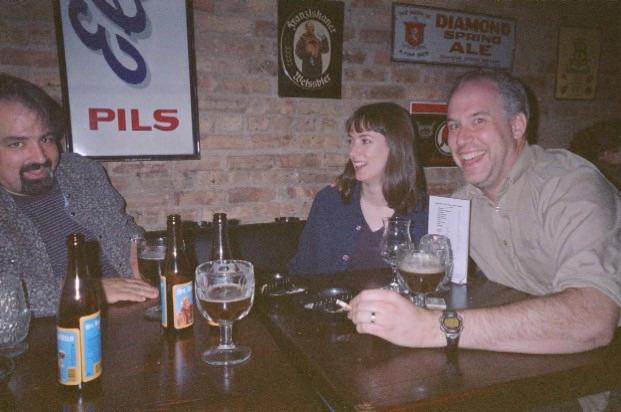
Since everyone else who commented on the disinterest post had their photo posted, here's a shot of Joshua looking pretty badass for an English professor:

Wednesday, December 21, 2005

Much Interest in Disinterest


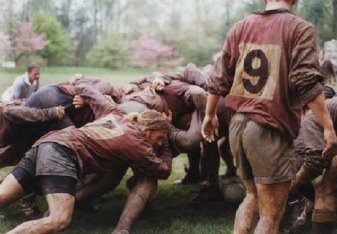
So there I was, a few days back, basking in the warm glow of Josh Corey’s kind words about my post on "Good Taste, Disinterest, and the Divided Self, with a Peroration Concerning the Doom of Iraqi Democracy" as I strolled out the door of my office on my way to lunch. Imagine my surprise when five figures lept out from behind an arbor vitae and wrestled me to the ground. What could it be? Had the Lake Forest rugby team turned against me? Was I to be mugged and have my wallet (contents: sixteen bucks and a Johnny Thunders Fan Club card) taken from me? No! As I wriggled around at the bottom of the scrum I recognized my assailants: Mark Scroggins, Dave Park, Henry Gould, Eric Selinger, and Jeffrey Bahr. They didn’t want my precious Johnny Thunders card, either: they wanted me to know they took issue with my post. Between elbow-jabs and ear-tugs, they explained the nature of their critique. As I understood it from deep inside the scrum, they had two areas of criticism.

1. The Split Self of the West

Eric Selinger maintained that I had taken a political stance against the Enlightenment (and the West in general) when I quoted Lawrence Rosen on the existence of a split in Western self that isn’t present in the Arab self. Rosen maintains that the disinterested self of the Enlightenment west, which divides the professional role from the individual’s values, isn’t strongly present in Arab societies, where the self, lacking this split, is “whole.” Mark Scroggins agreed with Selinger on all this, or so I gathered from their synchonized jabs to the Archambaldian breadbasket.

Since both of these guys came away from the piece with the same impression, I’m going to take responsibility for a lack of clarity, even though I don’t think I did take a political stance for or against this kind of Enlightenment subjectivity. Rosen means his words for the two different kinds of subjectivity (“split” and “whole”) to be merely descriptive and not laden with values, but in the end they are loaded words, and we do tend to equate “wholeness” with “goodness,” so I can see where the trouble started. And I did give only one example of Enlightenment subjectivity, in which it was shown as making some unpalatable behavior impossible. But I don’t think I said that Enlightenment subjectivity was always bad, or that it’s alternatives were always good.

Anyway, Eric was soon willing to acknowledge that the problem may have been with clarity more than with content, saying “Maybe Mark and I did pile up on you, Bob, but my sense is that disinterested aesthetic pleasure, like so many other products of the Enlightenment, is in fact under attack these days, if not necessarily by you.” And right he is about that! I just finished teaching a course on the Enlightenment with my historian colleague Dan LeMahieu, and remember his closing remarks about the continuing radicalism of the Enlightenment, under attack by fundamentalists at home and abroad. (For the record, I’m too much of a Frankfurt School guy to be unaware of some very real and powerful critiques of the Enlightenment, and spent too much time teaching Romanticism not to feel the truth of some of these critiques, but on the whole I think you’ve got to see most of the Enlightenment legacy as tremendously positive).

A different form of critique of these notions of selfhood came from Jeffrey Bahr, Henry Gould, and Dave Park, all of whom made versions of the following point: the Western self/Arab self dichotomy is too simple because both selves are hybrid. This I grant immediately, and not merely because of the head-lock in which Park held me at the bottom of the pile, nor due to the powerful noogies administered by Bahr, nor the savage half-nelson into which Henry repeatedly put me.

Bahr pointed out that Western subjectivity is hybrid, combining elements of the “disinterested”/gesselschaft-oriented Enlightenment self with a more “interested”/gemeinschaft self. He put it this way:


I like Robert's characterization of "separation" that many Americans exhibit in their beliefs and behavior. I wonder, though, if western civilization is really so far along the ethical curve. It hasn't been that long since most police forces had large numbers of the force getting free drinks at bars or accepting a $10 bill in exchange for overlooking a traffic violation. Political machines, patronage, and municipal deals that would be labeled as "corrupt" were also prevalent for most of American history.


Right! I mean, I live in Chicago. You shouldn’t have to tell me how the world of Enlightenment disinterest is mitigated by a very different version of ethics. I’ve even read Mike Royko's excellent biography of the first Mayor Daley, so I’ve got no excuse for missing this point. Noogies merited!


Henry pointed out that all cultures have their different splits in subjectivity (“The divisions & splits between (ethical) self and (social) role seem inherent to moral dilemmas of every kind, in every culture”) and he’s got a point. I (and Rosen) contrasted a Western split in subjectivity with an Arab self that lacked that split. But while there may be no exact counterpart to the post-Enlightenment Western fissure in subjectivity in the Arab world, any culture is sure to be full of its own various splits and fissures. So I’ll wriggle out of Henry’s half-nelson by acknowledging that I threw too many unqualified asserions into the initial post.

Dave Park makes much the same point in greater detail, saying:

You begin with the contention that "modernity is disinterest." Great. I like it. Just the kind of top-heavy and profound statement we readers of Samizdat blog have come to expect from our troubador Bob. You offer a discussion of Randy Cohen's suggestion that someone keep their personal opinions away from their occupational function. You move from this to a ... broader set of assertions, concerning the roots of modernity, and the difficulties that face anyone hoping to introduce democracy in Iraq. Fine. But you say that this notion of disinterest leads one to become a "very split self". Well, maybe. You presume that the interested/non-modern self is somehow more 'whole' than the modern disinterested one. This ignores the tremendous amount of 'splitting' that can occur in the self that exists in a society that does not buy into disinterest. Are Iraqis really so un-split? Do they not interact differently in different situations? This does not wipe you out, but you must concede that, if modernity is to be understood in terms of the introduction (and spread) of the splitting of the self, this splitting is not the only kind of splitting there is.


Let...(gasp)...go...(ow!)...of my...(yow! owie!)...head, Parksie! Damn! Okay, that’s better, man. Whew. Yeah. I get it already. Hey, when are you going to add that blog to your website, anyway?


2. Aesthetic Theory and the Origin of Enlightenment Subjectivity

Okay, I know this subject heading looks like a parody of the kind of paper I used to write in grad school, but it is the best short phrase I can think of to describe the second part of the criticisms leveled at my initial post. These come from Mark Scroggins and Dave Park, mostly (with Eric on board as well).

Mark puts the point in concentrated form, saying that the claim that the Enlightenment subject has its origins in aesthetic theory is unconvincing because

the splitting-up of the Enlightenment and post-Enlightenment Western subject is entirely overdetermined, entertwined and inter-influenced in so many directions that it seems patently reductive to point to this one aspect of division of psychic labor (yes, it all does come down to capitalism, somewhere) and premise another aspect upon it. A disinterested aesthetics is no doubt part and parcel of the ambivalent project of enlightenment ... but I can’t buy it as somehow a “triggering” element.


On the “part and parcel” business Mark and I can agree. And it was both hasty and quite probably inaccurate to make early aesthetic theory out as strictly causal. So Mark’s probably right there. I do think, though, that eighteenth-century aesthetic theory comes early in kind of thinking that forms the basis of the Enlightenment self — a point not too distant (as
Mark points out) from what Terry Eagleton has to say in The Ideology of the Aesthetic.

So, as I crawl from beneath the pile, shaking hands with my worthy assailants, I conclude that there’s still a lot of thinking that needs to be done here.

******************

And in Other News...

Responses to another recent long post, on the varieties of self in contemporary poetry, have been more generally positive, including one by Kevin Andre Elliot that takes the whole notion and runs with it in a two-part post up here and here. Well worth a look!