Saturday, June 18, 2005

Contingent Manifesto 1.0


After all the speculation about the death, or at any rate the decadence, of indeterminacy in American poetry that came out of this week’s (fascinating, exhausting) discussions with Mark Scroggins, Josh Corey, Eric Salinger, and everyone who chimed in via email, I thought I ought to turn away from what I think is moribund in American poetry, and look forward, down one of the paths poetry could take, in fact a path that I very much hope it does take. That path would lead away from a poetics of indeterminacy and toward (to use the terms from George Steiner’s “On Difficulty” that we’ve been playing with in this discussion) a poetry of contingent difficulties -- of facts, reference, and investigation.

The contingent path out of the scenic mode/indeteminacy dilemma is something I’ve been thinking about ever since I ran into what I regard as an essay of real importance for our moment in the history of poetry, Kristin Prevallet’s "Writing Is Never by Itself Alone: Six Mini-Essays on Relational Investigative Poetics.” Prevallet begins with the premise that “the pursuit of knowledge as the basis for critical thinking has been suppressed and mocked for many years in this country, as if being ‘intellectual’ is a threat to being ‘normal.’” But she’s unafraid of seeming abnormal in this context — in fact, she feels obliged to turn to a poetry full of contingent difficulties.

For Prevallet, a vital poetry will combine elements of Investigative Poetics (Ed Sanders’ old project), Olsonian Projective Verse, and the relational poetics of Eduard Glissant. (She’s also interested in salvaging elements of langpo, and has more faith in the rhizome than I do). What’s really interesting and important here, I think, is the interest in historical investigation and elements of Olson’s poetics (was it just me, or did anyone else notice the weak representation of Olson at the various Orono conferences? He and Duncan once seemed like peers, but Duncan’s star seems to have risen in proportion to the decline of Olson’s).

Prevallet’s essay is really worth reading -- here for me are a few key areas of emphasis that would be useful for what I’m calling a contingent poetry:

1. History.

A contingent poetry reacts to the quagmire of ideologically-spun language that makes up the contemorary haze of disinformation by making specific investigations, definite investigations about particular things. Despite all the flaws of The Maximus Poems, they offer a model for this kind of thing. Here’s what Prevallet says:

To Olson, history is a complex organism in which an individual connects to his (her) locale through "what he knows, what he really knows." History is what connects a person to space and time; it is not a force that acts upon the individual from the outside. Rather, it is story, imagination, poetry—it is a verb meaning "to find out for yourself." So, instead of allowing larger power structures and forces to act upon you as a passive, helpless object, you act upon them subjectively by expanding your knowledge and writing the story of the universe as you see it—based on the facts and observations that you have collected. Olson's work emerges from the messy materials of historical accounts, notes, and raw information.


2. Document.

Contingent poetry would work with historical texts and let them into the poem. Prevallet is most interested in this in her discussion of Eduard Glissant (whom she calls, using Glissant’s terms, a “relational poet”):

These questions of Relation extend to the very moment of the creative act. How do poems get written? Where does that flash of creativity come from? What is inspiration? The Relational poet simplifies the first question by discarding the last, and rather than sitting on mountaintops waiting for genius to strike, looks around and begins collecting, accreting, gathering. Glissant writes, "We no longer reveal totality within ourselves by lightning flashes. We approach it through the accumulation of sediments. . . . lightning flashes are the shivers of one who desires or dreams of a totality that is impossible or yet to come." This emphasis on the accumulation of sediments implies an apprehension of the world not as an unshaped bundle of materials waiting to be formed, but rather as a diverse and extensive patterning that is already formed and transforming, already imbued with a logic.


3. Synchronicity.

Synchronicity, says the dear old OED, consists of "two or more contemporaneous events that are linked in a meaningful manner." The goal of a contingent poetry is this kind of synchronicity.

Here are two of Prevallet’s comments on this notion:

Synchronicity, in other words, might be thought of as the opening of the poem to the possibility that poetry can be written from several perspectives at once. When the practice of Investigative/Relational poetics is applied to synchronicity, what results is not the obliteration of the observed moment into the overall assemblage of the poem or collage, but rather an activated field in which the source appears in spite of its rough edges.

Through these practices, poetry is infused with the flow of larger reality, a space occupied with objects in constant motion, and with people—us—who exist in relation to both our personal histories, our political inheritance, and the strata of the land upon which we are standing.


4. Language Working Upon Consequence, Consequence Upon Language.

Coming soon in another post -- this will be long, and I’m not unaware that I’m taking up too much of your time already, gentle reader.


Some Bibliography for Contingent Poetry

Prevallet’s essay is probably the most important document for contingent poetry, although she, unconcerned with Steiner’s categories, never uses the phrase.

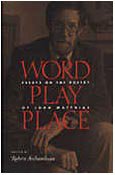
Ameliel Alcalay’s from the warring factions and John Matthias’ New Selected Poems strike me as important texts for an understanding of contingent poetry.

A new look at Charles Olson’s The Special View of History would be useful.

Okay, then: there’s version 1.0 of my thoughts on one possible future for poetry. This doesn’t mean a total break — one could find many elements of contingent poetry in post-avant work, and even in some works of the scenic mode (Prevallet is quite keen, for example, on Muriel Rukeyser). But the question is one of emphasis, of turning away from the primarily ontological difficulties of indeterminacy, and the bad-faith simplicity of the scenic mode, toward a new kind of difficulty, more definite, more documentary, more fully based in history, more investigative. Any thoughts for 2.0?

Wednesday, June 15, 2005

Bleed-Over and Decadence, or: No Bones About It, They're Talking About Language Poetry

“Let’s make no bones about it, what both Bob & Josh are talking about is Language poetry,” writes Mark Scroggins in Culture Industry. The conversation Mark’s referring to, for those of you keeping score at home, has been one in which Josh Corey, in his Cahiers de Corey, and I, in my last two entries here, have both been advancing version of the following thesis: the poetry of indeterminacy has run its course as a vital force in American literature and culture.

Josh’s version of this thesis is subtler and more nuanced than the one I laid down in my last post with all the subtlety of a bull elephant serving afternoon tea. Is the poetry of indeterminacy in its decadence, you ask? “In one respect, the answer is no,” writes Josh, because he feels “the fostering of a capacity for negative capability in readers is an absolute good that poetry can produce.” But in another respect, he maintains, the answer is yes, “because it has been possible for a while to adapt indeterminacy as a style whose detachment from late-capitalist market logic is no longer a meaningful one.”

I think this second part of Josh’s statement is particularly astute, and it helps me in answering Mark’s claim that what we’re talking about here is the future of language poetry. Let me follow Josh’s even-handed formulation and answer Mark by saying yes, in one respect I at least am talking about language poetry when I talk about the poetry of indeterminacy. But in another respect I’m talking about something larger than language poetry. The fact is that indeterminacy has bled over from language poetry (and other sources — but mostly from language poetry) into a great deal of English-language poetry. It is this large body of poetry, a body that includes both language poetry and bleed-over verse, that I call “the poetry of indeterminacy.” The very fact of the bleed-over is, I think, a sign, though not necessarily a cause, of the decadence of indeterminacy.


Before going on to that decadence, I should say that Josh and Mark are both right in noting that despite everything, the most common kind of poetry being written in English remains the sort of thing Charles Altieri has called “the scenic mode.” It’s good to see Altieri’s definition back in play, since it sticks to genre as a way of defining this sort of poetry. I’ve been too willing to define such stuff by what were once its institutions, calling it “MFA” or “APR” poetry. But since so many MFA programs now seem to produce almost as many poets of indeterminacy as they do poets of the psychological moments and narrative interludes that make up the scenic mode, and since so many of those poets find their way into mainstream journals like the American Poetry Review, institutional definitions won’t do the trick anymore. Bleed-over has happened at the level of institutions as well as at the level of composition. Poets of indeterminacy hold a number of the big ivy-league jobs, for example, be they language poets of the purest pedigree (Bob Perelman of Penn, say) or otherwise (take, for example, Jorie Graham of Harvard). Mark Scroggins notes this phenomenon at a less exalted level when he writes “I’m not a regular reader of Poets and Writers, the industry mag, but on my occasional scans through I’m astonished by how many poets of a definitely “non-scenic” bent are getting regular rotation on the visiting writer circuit.”

If, broadly speaking, language poetry’s indeterminacies came about as a way of rejecting the universal commodification of all things — including language — in twentieth-century capitalism, then there’s a real irony at work here. Indeterminacy has become, among other things, a style-marker, even a kind of prestige-brand marker of sorts: in short, a kind of commodity. The scenic mode is certainly the most common kind of poetry, but the poetry of indeterminacy has, in certain limited markets, greater cultural capital. Hence the bleed-over from those most concerned with social issues to those whose concerns have more to do with landing the gigs advertised in the pages of Poets and Writers.

So, if, as Josh says, indeterminacy has long-since “hardened into a style” and more recently “softened into a decadence,” what is to be done? “Whence,” as he puts it, “the new style?” I, too, feel we are on the verge of something new, but the nature of the beast that slouches toward Parnassus to be born has yet to be seen. Theories welcome from all quarters, speculations to follow.

Tuesday, June 14, 2005

The Age of Indeterminacy in American Poetry: 1962-2005


"What!?" you say, "an age is over? Did I miss something?" No, nothing is over, and you didn't miss anything. I've just decided to go big with some further fallout from the recent Salinger-Heller-Finklestein-Scroggins conversation (from Culture Industry, Say Something Wonderful, and Cahiers de Corey) about poetic difficulty, and make a Giant Unsupportable Claim to lay atop a few minor observations about poetic indeterminacy. The Giant Unsupportable Claim is that, for the last forty-some years, the dominant kind of difficulty in American poetry has been indeterminacy -- so much so that in much casual talk about poetry "difficult" and "indeterminate" are virtually synonymous, despite the wide range of other kinds of difficulty outlined by people like Steiner (thanks to Mark Scroggins, by the way, for setting me straight about "ontological" difficulty -- I've changed the term from "metaphysical" to "ontological" in the post below). Poetry that works with this kind of difficulty has become one of the dominant modes of American poetry -- not only among the sorts of poets that Ron Silliman likes to blog, but among many of the poets we see in the American Poetry Review. So, I thought it might be worthwhile to try to parse out some of the different kinds of poetic indeterminacy. To that end, a few preliminary notes:


The Indeterminacy of Negative Capability.

We know one form of this from Keats -- when he ends the "Ode to a Nightingale" with the question "Do I wake or sleep?" there's no for us way to answer that question with any certainty, and he doesn't feel any need to pursue the point. This is a way of enacting or portraying a state where the reaching after determinate certainties is impossible. A more contemporary version of this, though, involves a variation on the old Keatsian model. Instead of dramatizing a moment of negative capability on the part of the author, the poem will create a moment of where the reader is left with an undecidable interpretive choice. We'll see several ways of piecing together the words, but we're left without a basis for choosing one over the other. The poem forces us into a position of hermeneutic negative capability. Bruce Andrews' "Bananas are an example" is (ahem) an example. William Howe, thinking about Andrews' poetry, notices this kind of indeterminacy and finds himself in a position of hemeneutic negative capability, then grumbles about it a bit, writing:

One of the problems with language writing is that it works too well, in that it destabilizes language to the point that it becomes difficult to give a normative critical reading of it. This is particularly true in the case of much of Bruce Andrews's work. So much so that normative reading is problematized to the extent that a close critical reading becomes much more difficult than looking at the work in general and making broad statements about how it fits into a poetics or politics (and there may not be any difference between the two in reality). Part of the reason behind this overt problematization of a close critical reading of language writing is that language writing resists translation . . . in all its forms.


Pity the critic who wants to say something particular and definite about such works. If such a critic really wants to do close readings of long stretches of poems with this kind of indeterminacy, he's going to find himself having what George Steiner calls a "modal difficulty" — he'll be out of sympathy with the project. A lot of kvetching about language poetry probably comes from such modal difficulties with the indeterminacy of negative capability (hermeneutic variety).

Indeterminacy as Determinacy by Other Means

What is often taken for indeterminacy can also be a matter of determinacy by means other than syntactic coherence. That is, a poem can make no sense by the rules of conventional syntax, and present us with a kind of undecidability in those terms, but nevertheless offer a fairly determinate meaning once one catches on to the different rules the poem creates for itself. A lot of work that comes out of Oulipo and Fluxus seems to work in this way. Caroline Bergvall's "More Pets," one of my favorite poems from the most recent Notre Dame Review works this way. I'm too lazy to type in the whole thing (and I'm sure my limited html skills are going to result in some messed-up margins) but here's a stanza and a half:

a more — cat
a more — dog dog
a more — horse
a more — rat
a more — canary
a more — snake
a more — hair
a more — rabbit
a more — turtle

a more — turtle cat
a more — turtle — more — cat dog
a more — dog — more — cat horse
a more — dog — less — horse — less — cat rat
a less — hair — less — horse — more — rat canary

Okay, there's a lot of interesting stuff happening here: "a more" echoes "amore," or love (in a poem about pets, which seems appropriate); "a more" also juxtaposes the singular with the plural, (which is interesting in a poem about pets as representatives of species). But the most interesting thing is this: while the poem lacks even a vestige of the subject-verb-object relation that would make it interpretable in any conventional way, it is not so much indeterminate as determinable by means other than the conventional ones. The first stanza lays out a series of distinct species, and the stanzas that follow start to pair up those species, later on producing weird hybrids like the "rabbitrat" or "rabbitnot," and even seemingly grotesque or diminished variants like the "turtle trtl" we meet near the end of the poem. The rules of assembly here are not syntactical, but a kind of mimicing of genetic manipulation and modification, and the poem is less an indeterminate mystery than it is a use of unusual form to meditate on a topic. It's as if Eduardo Kac, instead of opening an ethical can of worms by creating green rabbits as artworks, had undertaken his investigation in language. I mean, you can comprehend a poem like this, in a way that you can't with poems that traffic in hermeneutic negative capability.

I think that many of the poems Josh Corey's thinking about when he writes that "sometimes post-avant poetry has the sameness of unrestraint" in its emphasis on "phrases meeting cute" have this kind of semi-indeterminacy. While the phrases are syntacticaly disjunctive, there's usually some kind of wordplay that creates a similarity between the phrases, and the actually determinable point of the poem will be that there are more kinds of linguistic coherence than are dreamed of in J.L. Austin's philosophy. Sometimes, in those poetries that take pleasure in skipping from one kind of linguistic connection to another (I love Josh's "phrases meeting cute" as a description of this) that's all there is to the poem. This can seem tremendously clever or stupendously tedious, depending on the poem, or how late into the evening the reading takes place. I've been at group readings where, after six or seven poets working this vein of indeterminacy, no degree of cleverness will overcome my desire to club myself into a stupor with a chair. Thank god the chairs are usually too full of poets and professors for me to get my hands on one and lay into myself.

So why does what I've pretentiously called The Age of Indeterminacy run from 1962 until 2005? '62 was the year of Asbery's Tennis Court Oath, which seems as good a year as any to pick for the time when indeterminacies of various kinds pulled ahead of contingent difficulties (intertextual look-it-up-or-you-won't-get-it stuff) as the leading kind of difficulty in American poetry. '05 is, of course, now -- the year when I realized that indeterminacy (like the rhizome), had started to become a mannerism. This has happenend with indeterminacy before, around a hundred years ago. Then it led to some modernist grumbling about "the exact word," "direct treatment of the thing," and a poetry "austere, direct, and free from emotional slither." I don't see such a puritanical reaction on the horizon right now, but something's afoot when David Orr calls Jorie Graham out for being "strangely bleary" in her "arty vagueness," and plausibly asks (of the beginning of Graham's ''Praying (Attempt of April 19 '04)'') "what are these lines about? Generalized angst? Adobe Acrobat?"

So, by the powers vested in me by...by...what? By my independence from both Helen Vendler and Ron Silliman? Perhaps by the powers vested in me by my own insolence? Whatever. I hereby declare the Age of Indeterminacy in the mid-stages of its decadence. Any comments on my crude schema and/or my unsupportable declaration are welcome.

Sunday, June 12, 2005

Four Fascinations of What's Difficult


Interesting weather fronts have been moving through some of my favorite layers of the blogosphere. Specifically, there's been an exchange between Josh Corey, Eric Selinger, Mark Scroggins, Mike Heller and Norman Finkelstein (these last two via Selinger's blog) about poetic difficulty. For those of you who haven't followed it, the barest of all possible bare bones summaries would look a bit like this -- apologies to the participants for the reductio:

Josh ruminates over Mallarme, Clark Coolidge, and difficult poetry. He finds that while he is often seduced by indeterminacy in poetry, others are repelled. For him, there's a kind of aura of wonder to the indeterminate. Interestingly, though, he speculates as to whether this kind of poetry may be on the verge of being played out. Eric is sympathetic to the idea (articulated by Norman) that difficult poetry can open a space for a kind of religious mystery, but he's also sympathetic to the complaints his students raise about such poetry, and he wonders about a class-bias to this sort of work. Bourdieu, after all, has pointed out that art that distances itself from purpose or from immediate emotional connection is not well liked outside of the more privileged classes. Mike and Mark raise a number of issues, but what I find most interesting in both of their contributions are the way they raise questions about the different kinds of difficulty (Mike asks about the different funcitons of mystery, and Mark mentions "the difference between difficulties").

Since I've been thinking about these last issues a bit -- and since there's been a bit of a tendency over the last few years to equate difficulty with indeterminacy -- I thought I'd drop in a few notes about kinds of poetic difficulty.

George Steiner wrote a useful essay back in the 70s called "On Difficulty," in which he describes four distinct kinds of difficult poety. I don't have it with me, but if memory serves, this is how it goes:

Contingent Difficulty. This is the kind of difficulty that can be resolved through the presence of a good encyclopedia or perhaps a few minutes with Google. It is the difficulty of facts, or dates, or other bits of information. Much Modernist difficulty is like this -- you need an annotated version of The Cantos, and many (not all) of the poem's difficulties are resolved simply through the presence of footnotes. No amount of staring at the page is going to help you understand Social Credit economics, for example, but the difficulty is resolvable with factual information.

Tactical Difficulty. This pertains to texts that resort to various kinds of coding in order to get past censors, or to put subversive messages into works that, were the meaning manifest on the surface, would get the author (and perhaps the audience) into trouble. So certain kinds of Soviet writing fall into this category, and so do things like many Blues lyrics (it took me years to realize what was meant by the squeezing of lemons or the pulling of daisies, for example, oh innocent prairie boy that I was).

Modal Difficulty. Here's where one of Steiner's phrases sticks with me, because it is so completely unlike anything Steiner would normally say: with this kind of difficulty, Steiner says, the reader finds himself saying "I get it, but I don't dig it." Ah, the seventies, when even a tweedy fellow like Steiner could contemplate wearing a medallion. Anyway, this is actually a very common kind of difficulty in classroom situations: the reader understands what's happened in the poem, but is out of sympathy with the project and rejects it as pointless. How many of us have been teaching classes and had a student make a very perceptive observation in the form of a complaint. "It's like James Joyce doesn't think plot is as important as all this other junk," said a student of mine when we were studying Ulysses. "Right!" I said "exactly!" But of course that didn't solve the problem.

Ontological Difficulty. This is the sort of difficulty that Josh was talking about, I think, when he mentioned awe and aura in his post. Here, the poem is made in such a way that it resists interpretation and maintains its indeterminacy. This is probably the most common form of difficulty in poetry today -- so much so that you sometimes see "difficulty" and "indeterminacy" being used interchangably. Steiner hints at religious experience here, the idea being that the elusiveness of meaning in the poem is homologous with the elusiveness of religious mystery. Nowadays you also hear undecidableness and indeterminacy defended as a kind of noncommodifiable resistance to the market, though perhaps unsurprisingly Steiner doesn't take that tack.

There's still a fair bit of contingent difficulty out there -- if you want to write something more ambitious than the poem of the backyard epiphany, it is probably inevitable. But this kind of difficulty can be cleared up with a little effort online or, for the antiquarians out there, with a reference book. I don't imagine there's a really big need in countries like the USA for much overt tactical difficulty in poetry nowadays: repressive tolerance means never having pretend to toe the line. The big issues of the discussion that's been going on seem to have more to do with a combination of ontological and modal difficulty. That is, many people have a modal problem with ontologically difficult poems.

I think it is fair to say that a lot of the class-based rejection of difficult art comes from a kind of modal difficulty, a simple lack of sympathy with the project. One response to this situation is simply to say "So what? you eat your populist apples and I'll see if I can figure out my mandarin oranges over here in Elitist Alley." Another response is to reject difficult art on the grounds of elitism (one would do well to recall the change in Russian art between the vibrant early revolutionary period of experimentation, and the later stultified bullshittery of the Socialist Realist era before leaping to this position). Yet another is to get all Educating Rita and try to be a missionary for the difficult, with all of the ironies, contradictions and condescensions appertaining thereunto. I suppose I oscillate between the first and the third alternative, without a lot of coherence, and without as much self-reflection as I could have.

Wednesday, June 08, 2005

Some New Publications and a Reading in July

Three new publications from yours truly are now available:

"Rhymes with History: Joe Francis Doerr and Kevin Ducey" an article on two first books of poems, Doerr's Order of the Ordinary and Ducey's Rhinoceros, in issue 19 of The Notre Dame Review. Ducey and Doerr are, for my money, two of the most interesting new poets around.

"Black Dog's Bedside Manner" and "Poem for a War Poet, Poem for a War," two poems, in issue number 44/45 of Another Chicago Magazine. "Black Dog's Bedside Manner" is dedicated to John Matthias, and I had the pleasure of reading it at the Matthias gathering at Notre Dame a few weeks ago (the event is blogged below).

And the Big Publication of the month, "Identity Politics and the Modern Self: Robert Pinsky's An Explanation of America". This is a shorter version of the Pinsky essay from the forthcoming book Laureates and Heretics. It appears in Mantis number four, a newish journal out of Stanford. Their site needs an update, but has ordering information. The issue itself is a special number devoted to poetry and politics, and is packed with good stuff.

There will be a poetry reading to celebrate the new issue of Another Chicago Magazine at Hideout in Chicago on July 14th at 9:00 pm. I'll read, as well as a few other poets including the incredibly cool Simone Muench. Admission is a paltry five bucks, and that includes the post-reading dance party (Simone can dance, I can't, which doesn't always stop me) with DJ Birdy Num Num, whose name comes from the funniest movie of 1968.

Since this is the Me Me Me post, let me add a link to the new page my publisher has put up for my book: they've got good designers at Salt, I think.

Friday, June 03, 2005

Red Strawberry Leaf

John Peck's Red Strawberry Leaf: Selected Poems 1994-2001 arrived in the mail a couple of days ago, and while I've yet to give it the attention it deserves, I can already tell this much: this will be a book that matters to me. It is also a selection that puts Peck's work in a new light.

I've had a running argument with Peck ever since I started writing about his work with a review of his Collected Shorter Poems six years ago. At that time I'd maintained that Peck, despite what he'd told me, was essentially a Poundian modernist. Several years of reading and re-reading have led me to reverse my position and admit that Peck knew more about his poetry than I did. I also maintained, in that article and elsewhere, that Peck was a poet whose importance was matched only by his inacessibility. Red Strawberry Leaf leads me to believe I was wrong there too, as far as inacessibility ws concerned -- wrong enough to merit a bit of a recantation.

The poems of Peck's new book pick up on a tendency I'd noticed in the poems that closed his previous collection of new work, M and Other Poems: they do away with some of the more obscure and arcane intertextualities, or at any rate they present their erudition in a manner that allows you to pick up what you need from context, rather than from a nearby copy of the Encyclopedia Britannica. This is not to say that Peck is writing Life Studies. Rather, he's writing in a mode that melds the personal and the intertextual, that shows hiss erudition for what it is: something so internalized that it is lived on the pulses of his own experience.

In one poem, "Walter Benjamin's Hope for the Best," I catch what I think may be a barb aimed at the kind of critic who has labeled Peck a retro-modernist (as I've done at least twice, with the somewhat lamentable phrase "modernist after modernism"). Peck writes:

Stamped arriere-garde? Display the date of franking and say,
Lapsed address.

Whether Peck was once more of a Poundian than he is now (as these lines imply), or whether, as I'm coming to suspect, the more accessible, more personal Peck was there all along, remains to be seen. But I'm done with second-guessing John Peck's self-assessments, at least for now.

His book, which makes an excellent introduction for readers who don't yet know his work, is available here.

Thursday, June 02, 2005

John Matthias as Eminence Gris


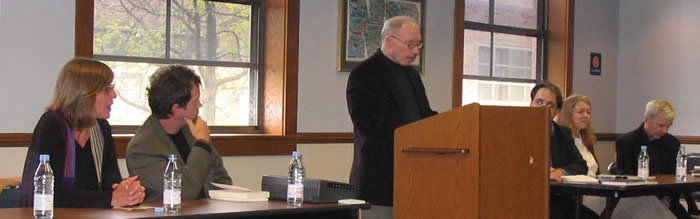
Here at last is the long-awaited blogging of the John Matthias retirement festival at Notre Dame some weeks ago. I was invited to speak on a panel and give a reading at what turned out to be a very well-attended event to mark the retirement not only of John Matthias, but of poet/fiction-writer Sonia Gernes as well. The day marks quite a changing of the guard at Notre Dame, where Cornelius Eady will be the new resident poet come the fall (along with John Wilkinson).

Coming in from Chicago on the South Shore railroad, I remembered three years of commuting in from my then-haunts in Wrigleyville/Boy's town. Back then I could count on a daily encounter with one or another version of derangement on the train: the guy who'd stand in the aisle and read from the Bible in Spanish, say, or the two south-side sisters who'd inevitably start arguing and, about every other week, break into a low-grade catfight, or the man who wore a pocket calculator like a badge on his jumpsuit, wrote mysterious numbers on a cash-register roll all the way from Gary to Michigan City, muttered about how he'd live in the woods "like an angel" if it wasn't for how strung out he was on "Juan Valdez Coffee." But no such luck: either the early morning trains have a different clientele from the later ones I used to take, or the city's sothward gentrification has increased social order at the expense of the ragtag alienation of old. The big industrial sprawl and decay was still there, though, through Hammond and Gary and the far south side. I'd forgotten how much those scenes had gotten to me, and how they'd found their way into a number of the poems I wrote for Home and Variations, a book I shamelessly flogged later that day, and which I'll shamelessly flog now: check it out here

The event turned out to the the best sort of literary gathering: an assembly of people who know about many things, care about the same things, and want to listen to each other. This is rare, really. Most gatherings fail either by lacking any focus, or by being too parochial. The big academic conferences (the MLA and its variants) are scattered and somewhat arbitrary -- who hasn't found themselves placed on a panel that should really have been called "Papers that We Couldn't Fit Anywhere Else"? They lack any real community feeling, and a shared professional affiliation can't quite make up for it. Too much gesselschaft and not enough gemeinschaft makes for a dull day. At the other end of the spectrum are those gatherings where the usual suspects get together to talk about the same short-list of poets. What can you say about these get-togethers?

All shuffle there; all cough in ink;
All wear the carpet with their shoes;
All think what tenured people think;
All know the text their neighbour knows.
Lord, what would they say
Did Frank O'Hara walk that way?

The best conferences I've attended have been things like Romana Huk's "Assembling Alternatives" conference on experimental poetry (almost a decade ago now), where everyone shared interests but where the parochialism was countered by a series of truly different perspectives (it was the first time I met Billy Mills and Trevor Joyce and Catherine Walsh and the other alternative Irish poetry crowd, and their take on Bernstein & Co. was new to me, and worth a hundred evenings spent listening to Ron Silliman's friends introduce one another at the group reading, hoping to have their membership in the tribe noticed and prominently blogged). Being there in Belgium when Maxine Chernoff, Paul Hoover, Joe Amato and Kass Fleisher got together with Antoine Caze and Michel Delville was just as good: everyone knew something different, everyone cared about some of the same things, and everyone cared a little differently. (Since I've just figured out how to make html links, I include a link to an account of that event: check it out here

The Matthias event was a best-case gathering: we all loved John's work, but we all knew it differently. Some of us were poets, some of us were critics, some were profs from other disciplines, some were artists, some were old friends of John's, some were relatives. Some highlights:

James Walton speaking about Matthias in terms of two types of egoism. While I've never thought of John as an egoist, Walton made an interesting case. The first kind of egoism, the bad kind, didn't apply to John, this being being the sort in which the egoist builds himself up by tearing others down. The second kind, though, was as John Matthias as any incantation of place names or any hiding of iambics in passages that pretend to be prose. The second kind of egoist enters a room and says to himself "this must be an interesting place, because I'm here!" You won't notice this egoist as an egoist, because you;ll be too busy basking in the Bloomsbury atmosphere he creates by his very presence. He enters a room, and suddenly everyone there feels that they're interesting, talented, clever, and on to something that really should be published right away. The second kind of egoist sees you as important, and wants to talk to you about the interesting thing you're doing. The second kind of egoist is the best of all possible mentors, since those around him bask in a glow of powerful approval (even your mistakes matter, though they need to be set right, since they represent a squandering of your very real, very important talent).

John kind of confirmed this later in the evening when he said that he'sspemt decades feeling like the youngest and the least intelligent person in the room, ever since his Deweyite highschool let him take classes at Ohio State. To hear that from one of the smartest people one knows, and from a man in the act of retiring from a long career is quite strange, and powerful evidence for Walton's position.

Walton, one of the most erudite people you're ever likely to run into, went on to talk of John's work as involving what Aquinas called magnanimity -- the spirit of doing things beyond the merely prudent. This, said Walton, was essential to art (although he told me later over a drink that he'd almost decided that it was ambivalence that was essential -- why make a work of art if you lack ambivalence, and can simply say what you mean?). The person who came on after Walton said something about agreeing with that, and about how poetry is always subversive. When I hear the words "poetry is subversive," I generally sigh or sneer. I mean, who do we in the little demimonde of poetry think we are? I almost choked on my chowder once when I heard someone at one of those U of Maine conferences say "the reason they're cutting funding for our magazine is that they know that in disrupting language we're disrupting power -- we're a threat." Disrupting the syntax on a page in a little magazine doesn't distrub your local arts council, let alone Dick Cheney. But what took place after this "poetry is subversive" comment changed my mind.

Here's what happened: the scene changed over from scheduled speakers to an open mike, and Jessica Maich took the stage. Jessica is a poet I knew in graduate school -- a good one, whom I hope will keep writing. She's also someone who has had a real life before graduate school (unlike me), raising a family in the midwestern community where she grew up. She came from a very different world than I did (I'm an academic brat, and my dad's an artist), so she saw the whole MFA world with different, and clearer, eyes than I did. "When I walked into that first seminar," she said at the microphone, "I thought, these people are arguing for forty minutes about where to place a comma. They're all adults, and this matters to them." This was subversive for her, and subversive in the way that Walton, thinking through Aquinas, would call magnanimous -- the actions that mattered exceeded the merely prudent. I think I was in that class, and for me at that point in my life there would have been no significance to an argument like that except as a drama in which the opinion of someone who was correct (me) and a bunch of misguided people who just didn't get it (anyone who disagreed with me) either triumphed or was thwarted (I was, as you may gather, something of a prick). But Jessica was starting to have a dialogical life in a way I hadn't, maybe haven't yet: she was seeing the logic of a world where conversations about comma placement were important, and the logic of that world was subversive of the logic of her other world, where practicality and prudence were more important than this kind of magnanimity. "They looked so normal," Jessica said of her poetry teachers John Matthias and Sonia Gernes, "they had houses and cars." But despite these signs of belonging to the world of the prudent and practical, they lived in another world, where serious adults cared for things like the comma in that stanza. So the comment about subversion meant a lot to her. Hey, I thought, wow, I get it. And I and felt like a bit of a twit for all of my internal eye-rolling at talk of subversion.

Other highlights for me include:

The Big Dinner, with hundreds in attendance. Nametag follies ensued, as Joe Doerr, Jere Odell and I handed out "Pope Pious II" and "Britney Spears" tags. I gave one labelled "eminence gris" to John Matthias, who was too graceful to take it off. My own read "Rufus T. Firefly," and I had a great moment when a group of grad student types were standing nearby and looking over at me and I overheard them talking about "whether that's him" and how "he looks like the picture on the book" but they concluded that I wasn't the poet in question because "he's Rufus someone or other." The award for best nametag goes to Joe Doerr, though, who went up to Steve Tomasula wearing a tag that read "Tom Stevasula."

Watching the big crowd in the LaFortune Center eating up Mary Hawley's poem about fourth-grade girl's basketball. The poem treats the moment of the first basket as a loss of innocence: suddenly the game mattered, and one could succeed or fail. The loss-of-innocence poem has been around forever, and yet, when one finds a convincing local habitation for it in experiences that one can render well, as Hawley did, people will always love it.

Discovering that Kevin Ducey looks a lot like Robert Duncan -- when he read his poems, all I could hear was "sometimes I am permitted to return to a meadow." Also laughing my ass off while having a smoke with Mark Mattson. Also drinking scotch with Dave Griffith, and hearing him tell me about his new book on the scandal of Abu Ghraib. Also meeting James Wilson or, as I call him, The Wintersian Kid, who read the manuscript of my book on the Stanford poets and liked it even though I'm no Wintersian. Also hearing Joe Frances Doerr talk about Ken Smith and David Jones, and then read his own poems, which sound a lot like Ken Smith-meets-David Jones. Also seeing poets Orlando Ricardo Menes and Francisco Aragon of the Latin American Studies institite -- especially since I ran into Aragon as he was buying a copy of my book (available online -- check it out here)

Many thanks to Coleen Hoover, who put the whole shindig together. Photos and (soon) transcripts are available at: this site.

Friday, May 27, 2005

Rich Twits of Chicago's North Shore: An Anthropology


Although I always thought I'd stick to the humanities in this blog (poetry, philosophy, and a bit of art), I find myself morally compelled to sully my soft humanist hands with the rough silt of the social sciences -- let me explain.

The following report was passed to me by Raskolnikov T. Firefly, Ph.D., a former colleague of mine at another university. He seemed nervous, demanding to meet in the middle of the night at the Denny's on route 41. I arrived on time, but he was late, shambling in like a twitchy fiend as I was finishing my Eggs-over-my-Hammy special. He kept looking over his shoulder and trying, fruitlessly, to light cigarettes, which he then discarded. He said I had to help him, that my blog was his only hope now that the agents of his enemies had turned the respectable journals against him. Taking his yellowed, coffee-stained manuscript from his trembling hands, I promised to do what I could. This was all some time ago, and I haven't heard from him for weeks, although my caller ID indicates that the inhabitant of a certain single room in a certain Motel 6 near the Wisconsin border calls and hangs up every couple of hours. Frankly, I'm a little concerned for Rasko, as we used to call him in the grubby little leftwing bookshops in that university town in the mountains by the seashore in another country oh so long ago.

His report follows:

A Socio-Anthropological Typology of the North Shore
by Raskolnikov T. Firefly, PhD


My decade long researches among the inhabitants of Chicago’s North Shore have, at last, yielded results. I and my crack research team (thanks, Kid V, Pravda and Jimmies B and C -- couldn’t have done it without you), have spent the better part of the last ten years lurking in such dangerous and unpalatable locales as artisanal bread shops, high-end cycling centers, national-chain arthouse movie theaters and, in a true show of courage, Starbucks outlets not yet unionized by the I.W.W. Forthwith, our conclusions.

1. Method of Study

Lurking, malingering, and harumphing in lines outside American nouvelle cuisine bistros, sneering from our Hondas and Chevy Cavaliers as we pass the Aston Martin and Land Rover dealerships, looking suspiciously around the room during late night visits to Ben & Jerry’s, drifting aimlessly through Anthropologie or Jos. A Banks, trooping out to Lake Geneva Wisconsin to observe North Shore fauna in its semi-migrational mating-and-antiquing phase, attending community theater and Suburban Fine Arts Center fundraisers, checking the license plate numbers outside Unitarian churches, noting the girlish giggles of septuagenarian matrons in the Marshall Fields’ handbag section and the boorish grunts of Dick Cheney look-alikes from the 16th hole rough. Drinking cosmopolitans and anything ending in -ini, so long as it is from the color palette present in a roll of Jolly Ranchers. Also, a lot of internet surfing and repeated viewings of Ordinary People and Risky Business, for which we have drawn elaborate location charts and alternative storyboards depicting general uprisings of the people and the creation of a service-worker’s Utopia led by Tom Cruise and Rebecca DeMornay. Oyez, oyez. Power to the people.

2. A Typology of North Shore Habitants

A. The North Shore Goof (NSG)

You know this guy. He looks like Chevy Chase, especially the Chevy Chase of Caddyshack. Good-natured, but more of less useless on account of never having had to work a day in his life. Habitats include golf courses, convertibles, east Lake Forest, and restaurants featuring club sandwiches. Harmless, except when seen objectively.

B. Predatory Corporate Status Monkeys (PCSMs)

Think thirtysomething or fortysomething. Think wire-rimmed glasses in sylishly contemporary frames. On the weekends you see him biking like Lance Armstrong and looking at you with a faint disdain for not making as much money and biking as frantically as he, or out with his wife (either a PCSM herself -- 25-30% are women -- or a Subscriber) on a powerwalk, pushing the kid in an ergonomic high performance mountaineering pram, making quality time with the nipper he’s not seen all week and won’t see again until he makes sure the guys in Acquisitions get the WEENUS report in on time. Habitats include west Lake Forest, east Highland Park, and Glencoe, also the Green Bay Trail and Miramar. American Express gave him his Blackberry as a Preferred Customer Premium.

C. The Man

He does not work. You work for him. The PCSMs work for him. In the end, one way or another, we all work for him. He neither toils nor spins: he owns. His markings include great height and a shock of white hair. Habitats include houses that cannot be seen from the road. With stunningly little variation, he looks like George Plimpton.

D. Vic Wilcox

Named after a character from David Lodge’s splendid little novel Nice Work, the Vic Wilcoxes of the world have some cash and won’t be shy about telling you that they’ve earned their pile. They’ve earned it by building up companies that plate things in nickel, or supply Styrofoam coffee cups to office parks in the western suburbs, they’ve earned it by getting the contract to sell tanning beds to Carnival Cruise Lines, they’ve earned it by keeping those union guys out, they’ve earned it and they don’t mind telling you and they almost almost don’t mind that they’ll never be The Man because they’ve earned it and they haven’t had time to get comfortable at Lyric Opera fundraisers and their picture won’t ever be in Chicago Social (sorry, “CS”), they’ve earned it and wonder if they can trade in their first wives for new ones who might have contempt for them but could tell them which charities they could give to so they could go to the parties where they won’t be comfortable -- and wouldn’t they rather watch football and eat a meatball sub anyway. Usual cause of death is angina and a quite despair that knows not how to speak its name.

E. Subscribers

These are, as you guessed, the subscribers to that esteemed and storied magazine, North Shore Bitch. Picture that title, if you will, in the elegantly curving cursives of that journal’s cover. You see them jogging with their iPods, keeping it all in shape. You see them buying tureens at Williams and Sonoma, buying sundresses at Saks, buying stylin' maternity clothes at Bellydance, buying DVDs of Martha Stewart. Basically, you see them buying, often in small gaggles of the likeminded, oblivious to those outside their braying bubble of buy-buy-buy. In their fantasies they are Princess Diana as she marries Charles, or better yet as she has that affair with the dark and brooding Saudi billionaire. “How fun!” they gush, between bites of the roasted tomato and grilled chicken salad at Southgate. Only one fear haunts the manicured lawns and magazine-ad-like, blowing-curtained, wicker-furnished sunrooms of their dreams: becoming DFWs.

F. Discarded First Wives (DFWs)

Little is known about these middle-aged women of the North Shore, seen only buying gin in the Jewel or behind the wheels of slightly aged Volvos. Little is known because one dare not meet their gaze, so bitter it is, so soaked in the tannic fluids of experience and thwarted entitlement. Fear them.

G. Evil Withered Sticks (EWSs)

If you’ve seen Nancy Reagan, you know the type. Her weight never gets into three digits, her skin has, through repeated exposure on tennis courts and seasons in Coral Gables, attained the consistency of fine Corinthian leather. She may once have been a subscriber, fearing DFWhood, but she is now a formidable feature of the landscape, braying with laughter behind her cocktail glass at a lawn party on a sunny afternoon. Try the Onwentsia club if you seek a high concentration of the species.

H. The Good People of Evanston (GPEs)

This is a subspecies of the PCSM, with the following distinction: they’re smug about their virtue. Having once written a $500 check to the Sierra Club, having once attended a book signing by Deepak Chopra or perhaps Dave Eggers, they are secure, indeed ontologically grounded in their sense of superiority to their fellow PCSMs from farther up the shore. Also, since they live near Chicago, they secretly suspect that they’re street, homes, street. Surprisingly, not all GPEs actually live in Evanston. Some live elsewhere but are members of the North Shore Unitarian Congregation.

I. Standard Academic Clowns

Not often found outside of Evanston and a small enclave established in the unlikely and infertile soil of Lake Forest, these hapless sorts are distinguished by rumpled chinos, dented upper-mid-range cars, Steve Earle CDs, good internet access and a wonderful conformity of ideas, consisting of centrist beliefs masquerading as radicalism. Often seen birding, or overheard telling their friends about how little television they watch.

Thursday, May 26, 2005

Edge and Evolution: Don Reichert's Nature Morph


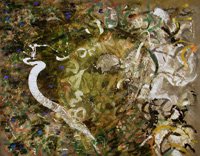
I'm getting around, at last, to looking at my notes from Don Reichert's Nature Morph, a show of his work at the Gallery of the Canadian Embassy in D.C. I was there at the end of March for a bit of a Canadian-Culture blow out (represent, prairie provinces, represent!), and was glad to see both work that I recognized (Reichert's wonderful, large, abstract expressionist canvases) and work that looked like a new direction (computer-manipulated images of the bridge and riverbank near Reichert's studio). Reichert's always been a very painterly painter at heart, with exquisite brush-stokes and a mastery of those drip and pour techniques we all know about from Jackson Pollack. There's even something calligraphic about him. But while he's grounded in that abstract expressionist tradition, he's always been curious about other things, and willing to tackle them seriously. I remember listenig as a kid in the 1970s to his haunting electronic music, for example, and I remember, too, a large exhibit which opened after the first Gulf War. That show came out of Reichert's travels in Mexico, where he's seen pre-Columbian art drenched in the imagery of human sacrifice. He picked this imagery up in some very powerful and disturbing pieces like Fuel for the Sun, which consisted of 100,000 individual sketches of skulls arranged into a giant wall. It looked Mayan, but represented the more conservative estimate of the number of Iraqis killed in that war (the title had to do with the Mayan belief that human sacrifices fueled the sun, but there was also something lurking in there about oil, and the connection of all those deaths to our deep addiction to fossil fuels). So he's always exploring different media, techniques and effects.

Looking at the new show, though, I began to think about what has held his work together over the decades, and I think I'm on to something. Here's my thesis: Reichert's work almost always explores the intersection of controlled, even mechanistic effects and organic-seeming effects. Like any one-size-fits-all thesis, this is not so fine as a haute couture interpretation tailored to individual works, but I think it's not bad for pret a porter. Check it out:

--Some of Reichert's early paintings look like a strange cross between abstract expressionism and color field paintings, with canvasses divided geometrically between beautiful brush-stoked areas and flat colored sections. This work came out of some time spent in Spain, looking at the elegant abstract tilework and architectural ornamentation left by the Moors, but the fascination for Reichert really seems to have been in the juxtaposition of a very controlled, cool element and a more open, warmer, more organic element.

--Many of Reichert's large canvas works, the kind for which he is best known, include beautiful, warm, organic, layered elements that look like the moss-patterns that grow over decades on the granite outcroppings of the Canadian Shield. (If you ever watch Painter in the Landscape the CBC documentary about him, you'll see Reichert painting on canvasses spread over these rocks, and you'll see how he invites happenstance into his compositons, dousing areas with water, for example, to soften the effect. You'll also see one of my favorite art-documentary moments, in which Reichert, standing near an enourmous painting of his on a museum wall, is asked by a curator how far away he stands from these while he paints them. "Oh," says Reichert, "about five foot nine.") Anyway -- along with the layered organic elements you often find a hard edge or line, something straight or with a ninety-degree angle to it, something utterly unlike the natural forms that seem to have almost grown on the canvas. These come from folding the canvas over in the process of composition, but the effect is very strange, like a specifically human or technological intrusion.

--The newest work at the Canadian Embassy combines natural imagery (photos of a the foliage along a riverbank) with very industrial imagery (big steel girders from a bridge), and it does so in a digitally-manipulated format that pulls it into almost crystaline patterns that, in their angles and symmetries, seem both geological-organic and technological.

In all of these things we see a continued obsession with edges and growing things, with the mechanical form and the organic. You know, Reichert grew up in a little farm town on the prairies, and I'm willing to bet that the place he grew up in had something to do with these obsessions. What's a farm but the combination of machines and nature? Or, to put it another way, the meshing together of that which evolves naturally and that which we impose on nature? And farm guys have a combination we don't see in the sentimental suburbs: they know about nature but they also really, really like machines.

There was more to enjoy besides the paictures at the embassy event that night, too. I ran into the art critic Robert Enright, for example, and tried to pitch an article to him about one of my favorite artists in Chicago, Jason Salavon (whose work you can see at his website) for his magazine, Border Crossings. Enright was all kinds of enthusiastic about this, and said many encouraging things to me about the article, about me being a poet, and so forth. Then he sent me over to talk to his partner and co-editor Meeka Walsh, who gave me a stern editorial look and a hundred (entirely worthwhile and defensible) criteria the article would have to meet to be right for the magazine. I saw right away why Border Crossings has been such a successful art magazine (check it out at bordercrossingsmag.com sometime) -- the Enright-Walsh dynamic of enthusiasm and judgment is exactly right for the Quixotic enterprise of art publishing.

The night ended with a bunch of us rolling out of the embassy after too much wine, holding hands in a circle beneath the big postmodern rotunda, and discovering that it had exceptional echo-chamber acoustics when we sang an off-key and intermittently lyrically-challanged version of "Oh, Canada." Even without the paintings that would have been worthwhile.

Friday, May 20, 2005

Rhizome Mannerism, or The Knight of Faith on a Thousand Plateaus


I've been thinking a bit about postmodernism and the avant-garde lately, and not just because I'm an effete and pretentious intellectual (although I'm certainly all that, oh mandarin me, oh my). Louis Armand wrote from Prague a few weeks ago, asking me to contribute to a collection of essays on the possibilities of avant-gardism under postmdern conditions. I've got a plan for that paper, and it doesn't look anything like the wierd little idea I'm going to lay down today, but today's notion is a kind of fallout from Armand's assignment.

So here's the deal: the Knight of Faith must traverse a thousand plateaus.

Cryptic, eh? It's my overly effete way of saying that the kind of postmodernism articulated by Gilles Deleuze and Felix Guattari needs to be challenged by a kind of thinking best symbolized by the Knight of Faith, a figure drawn from that somewhat dusty tome of Soren Kierkegaard's, Fear and Trembling.

Remember Deleuze and Guattari's A Thousand Plateaus? It was the sequel to their Anti-Oedipus, and is probably best known as the book in which they describe the rhizome as a form of intellectual organization appropriate to our postmodern condition. Traditionally, they maintain, we treat form as a kind of tree-root: that is, we think of good organization as unified organization, with all the various roots and branches of our discourse coming together in a single unified trunk. Think of the last class you taught or took in composition, and you've got the idea. All parts are suborinate to the whole, and the work is put together hierarchically. If we're talking about an essay, the individual sentences serve the topic sentence of the paragraph, and the topic sentences serve the overall thesis -- you know, that sort of thing. And the same goes for a traditional novel. Think of something like Thomas Hardy's Jude the Obscure. In a book like that, the parts (fancy deconstructions notwithstanding) tend to add up to a pretty coherent whole. Sue and Arabella, the women in the very spiritual Jude's life, serve as foils for one another (one being presented in intellectual terms, the other in bodily terms). The settings (farm town, university town, cathedral town) play up the theme of body vs. mind vs. soul, and so on. A big old oak tree, that book.

But that's all old-school, as far as Deleuze and Guatarri are concerned. And so is the kind of organization they call the fascicule. This, they say with some disdain, was beloved by the modernists. Man, do I hate the casual dismissiveness in their book -- I mean, I think they've got something important to say, but that whole "people who wrote before us must have been naive because that was a long time ago" thing is a bit hard to swallow. What's next? "They're dead, ergo they couldn't have been up to much"? But I digress. Deleuze and Guatarri's image for the fascicule is a bunch of roots severed from the trunk that would have held them together. So imagine a bunch of fragments that don't seem, at first, to add up -- but then hey presto, they do, if you can infer the principle that once held them together. The big modernist works really do fit this model pretty well: T.S. Eliot's Waste Land looks like a collection of miscellenious bric-a-brac, but when you pick up Jessie Weston's book on the grail myth, you suddenly see how it all holds together. James Joyce's Ulysses is another instance of the fascicular text, maybe even of the fascicular text par excellence. I taught it for the first time this spring, and while it struck many of my students as something of a shitpile of unrelated wierdness at first, once they got their hands on the Linati Schema (a kind of secret-decoder-ring cheatsheat Joyce made for his pal Carlo Linati), everything fell into place for them. I mean, judging by their papers, they nailed that book (did I mention I really think we get some kickass students at Lake Forest? Really. I've taught at big universities and small, in Europe and America, and these kids are alright). So the fasciule is the apparently fragmentary text that can be unified by a kind of heroic act of interpretive inference.

And then there's the rhizome, the form D and G really like. They claim that the best way to think of it is as a system of roots like what you'd find in a potato field. My botanist colleague tells me that potato plants aren't rhizomes, though, indicating that French theorists are just about as in touch with potato-picking as you'd expect them to be. Luckily, Deleuze and Guatarri give another image for the rhizome: a series of interlocking tunnels, a kind of prairie-dog village of text (as a kid from the Canadian prairies, I prefer this anyway). You've got bits and pieces that intersect in all sorts of ways, and other bits that don't connect with anything. You've got modules, nodules, and overlaps, without a single unifying hermeneutic master-key. I think Pound's Cantos are kind of like this, even though Pound didn't want them to be ("I cannot make it cohere!" he laments, near the end). Kathy Acker's books always seem this way to me, too. There's cohesion here and there in all sorts of sideways fashions, but nothing like the clear order, the subordination of part to whole that you see in Thomas Hardy. D and G, I suppose I should say, don't just propose the rhizome as a strategy for literary form -- these guys are serious. They want us to reorganize all sorts of things (psychology, the various social sciences, etc.) on rhizomatic principles. But it works for literature too.

But you knew all that, right? I mean, the rhizome seems pretty well established in the hipper American poetry and litcrit circles. In fact (and this at last starts to bring me to my point) I think it's become a bit of a mannerism in some circles, and I suppose that's why I want to have a good thwhack at it, using Kierkegaard's Fear and Trembling as my thwacking-implement. It is a bit unfortunate Kierkegaard's book is so slim, especially in the bantam-weight Penguin edition I own -- otherwise I could work up a cool image of squashing a rhizome-grown potato with a big weighty tome of Danish philosophy. Alas.

Anyway. The rhizome as mannerism, even as cliche -- it first occured to me at one of the Modernist Studies Association conventions, I think the one up in Wisconsin, at that great lakeside convention center designed by Frank Lloyd Wright. I was hanging out by a TV set up in the corridor, watching Notre Dame lose to some henious team of steroid-gulping mutants. I did this with, oddly enough, a fully-costumed, giant-shoe-wearing clown as a companion (he was there to entertain some kids who were part of a non-MSA event down the hall). Turning away in disgust from the Flounderin' Irish, I overheard a gaggle of my fellow academics on the way into a panel. "My paper's even more modular and fragmentary than usual!" one said with pride. "Ooh, mine too!" said another, not to be outdone. So there it was: more-rhizomic-than-thou was the order of the day. It was around this time, too, that I started to get a lot of student writing workshop pieces that took great pride in not adding up, in being collections of miscellaneous parts. When I would ask about the criteria of selection, or about how the various stands related I'd get pitying sighs, followed by the weary statement that "it's postmodern." Some of these were actually quite good -- especially one about an imaginary earth where the sky had been converted into a videodome projecting Disney images. But the point is that there seemed to be a climate of expectation in which ones intellectual or writerly bona fides were established by the rhizome. It was the new minor 6-4-1-5 chord progression, the go-to form for the culturally hip. And, as a new orthodoxy (or micro-orthodoxy -- a way of showing one belongs in advanced circles), it deserves a challenge. Enter, from the west gate of my imaginary Medieval Times jousting arena, Kierkegaard's Knight of Faith. Since the potato analogy turns out to be false, I suppose we'll have to imagine his rhizomic opponent as a giant prairie dog.

The Knight of Faith is Kierkegaard's figure for the person who could, against all the evidence of the world, struggle through and achieve faith in divine providence ("on the strength of the absurd" Kierkegaard says -- and you see right away why the existentialists loved him). Abraham, willing to sacrifice Isaac, is the embodiment of this kind of faith. Kierkegaard brings this up because what he sees all around him in the university coffee shops of Copenhagen is a kind of easy, breezy dismissal of faith. Everyone, he says, is talking about "getting beyond faith" -- and he's not sure we've even got to faith in the first place. Here's how he puts in in the preface to Fear and Trembling, written in the persona of Johannes de Silento: "Today nobody will stop with faith; they all go further. It would perhaps be rash to inquire where to, but surely a mark of urbanity and good breeding on my part to assume that in fact everyone does indeed have faith, otherwise it would be odd to talk of going further. In those old days it was different. For then faith was a task of a whole lifetime, not a skill thought to be acquired in either days or weeks."

Do not freak out. I am not about to lay some Christian trip on you, despite my earlier reference to Notre Dame. It isn't religious faith I'm interested in here, but the idea of trying to get beyond something that we may not even be able to achieve in the first place. Substitute "formal coherence" for "faith" in the above passage, and you'll have a sense of where we are now: we often disdain the tree-root and fascicle of textual coherence as mere modernism (D and G sure do), but there's some question as to whether we're even up to that level of achievement.

I'm not saying we should ditch the rhizome and try to write like Thomas Hardy. Hey, some of my best friends write rhizomes. But I am concerned about the idea of the rhizome being received uncritically. I don't want the prairie dog stamped out, but I think it will be stronger for having wrestled with the Knight of Faith. I mean, we should ask ourselves: is this rhizome more or less interesting than it would have been with a greater degree of coherence? I suppose my biggest concern is that the rhizome has become a kind of marker of advanced style, and that we may find poets writing rhizomatically because they come to think that that's what they're supposed to do as experimental poets (there's a contradiction for you: doing what you're supposed to do to be experimental). Just as the old saw "show me, don't tell me" became a cliche of American poetry in the writing workshops of the 70s, I think we may be in a period where the unexamined assumption in some circles is that tree-root or fascicular coherence is for chumps, and the rhizome is the only way to go.

(Picture: Catherine Daly, author of DaDaDa


Looking at some poems from Catherine Daly's DaDaDa may be one way of getting at what's at stake here. Not only is she an interesting poet with whom I share both a publisher and (oddly) a blog format and background (check it out at: http://cadaly.blogspot.com/) -- she writes in both the rhizomatic and the fascicular mode. The two extended sequences of poems near the start of DaDaDa are good examples of rhizomic and fascicular poetics, respectively. The first sequence, "Palm Anthology," is a loose collection of notes in which the language of technology -- specifically the Palm Pilot PDA -- gets twisted up with the language of a kind of kinky eros. The effect is intertesting, but unless I'm missing something Daly doesn't try to get it add up into a coherent whole. She's more interested, here, in a field of intersections and ruptures than in an overall structure. In contrast to this we have "Mistress Plot," the second sequence. Here Daly gives us fragments again, but they seem to represent a catalog of all possible (or at any rate all common) patriarchal plots about women. What looks fragmentary at first is in fact united, and you can infer the principle of coherence. This one is really good, and reminds me more than anything else of one of those old-school books of structuralist criticism, like Barthes' A Lover's Discourse, in which the author anatomizes a cultural system. Daly's got some kind of engineering background and it shows here. She knows how to break something down into parts. This is where her real genius lies, but she seems pulled by the forces of period style to write in rhizomes more than in fascicles. I can't wait for her next book (which should come soon, since she's astonishingly prolific) but I hope it has more of what is particular to her, and less of what the age seems to demand of its hipper poets.

Sunday, May 08, 2005

Return to the Supermarket: Sentimentalist Poetics Then and Now

Many things to blog, including the John Matthias retirement gathering at Notre Dame and a great show of Don Reichert's new works at the Canadian Embassy, but first, a moment of astonishment. As I was thumbing through an old issue of the NYRB, I turned with a certain ghoulish pleasure to Christopher Benfey's review of Helen Vendler's latest collection of essays. Oh boy, I thought, here we go: the usual obsequious east coast praise for the Queen of Harvard. I was all set to take a kind of perverse pleasure from witnessing the act of intellectual abasement. Oh, how wrong I was. Not only did Benfey leaven his praise with some actual criticism of Vendler, but it seems she's actually made a good point -- or almost made a good point -- about Walt Whitman. Let me explain.

The book Benfey reviews, Poets Thinking, has a chapter on Whitman that looks like it may have come close to the truth about the sage of Camden. Vendler sets out to "rescue" Whitman from charges of primitivism by old-school guys like Thoreau (who said of Whitman "it is as if the beasts spoke") and Santayana (who found in Whitman a "wealth of perception without intelligence"). She observes that Whitman not only registered detail on his retinas, he also thought, and that this thought found its way into the poems in a reprise-like structure, in which a scene is presented first as a "solely transcriptive" retinal record and then as an intellectually processed record. Let's check it out, shall we? Here's the example Benfey takes from Vendler's book, Whitman's poem "Sparkles from the Wheel." It begins with a senses-only presentation of a knife grinder:

Where the city's ceaseless crowd moves on the livelong day,
Withdrawn I join a group of children watching, I pause aside with them.
By the curb toward the edge of the flagging,
A knife-grinder works at his wheel sharpening a great knife,
Bending over he carefully holds it to the stone, by foot and knee,
With measur'd tread he turns rapidly, as he presses with light but
firm hand,
Forth issue then in copious golden jets,
Sparkles from the wheel.


Right. There's the unprocessed description. But here's the follow-up:

The scene and all its belongings, how they seize and affect me,
The sad sharp-chinn'd old man with worn clothes and broad
shoulder-band of leather,
Myself effusing and fluid, a phantom curiously floating, now here
absorb'd and arrested,
The group, (an unminded point set in a vast surrounding,)
The attentive, quiet children, the loud, proud, restive base of the
streets,
The low hoarse purr of the whirling stone, the light-press'd blade,
Diffusing, dropping, sideways-darting, in tiny showers of gold,
Sparkles from the wheel.


For Vendler, this shows that Whitman is a thinker of sorts: he takes the sense-or-retinal scene and adds to it a humanizing intellect (a "human response" added to a "perceptual registration," says Vendler). He does this by presenting the man as "sad" (an interpretation) and so forth. Okay. Yeah. Vendler's right here, and she's actually done a service to poetry by pointing out that this pattern is to be found everywhere in Whitman's poetry (note, though, that this service does not come close to cancelling out Vendler's disservice to poetry in helping Jorie Graham get Seamus Heaney's old job at Harvard -- Jorie Graham! The unholy fusion of the worst of Iowa and the worst of Buffalo! The muddle-headed mistress of mediocrity! Oh, her vagueness and pretence! Her giving-of-prizes-to-friends, her writer's-retreat realpolitik! Holy Christ! But I digress...). Here are some more examples, which again I lift from Benfey's quotation of Vendler's quotation of Whitman:

The little one sleeps in its cradle,
I lift the gauze and look a long time, and silently brush away flies with my hand.

The youngster and the red-faced girl turn aside up the bushy hill,
I peeringly view them from the top.


Okay! Yes! There it is: retina first, and then something more processed by the mind. But I'm not at all sure Vendler's gotten to the bottom of things, unless she does something important that Benfey doesn't mention (possible -- but I can't bear to read another of her books. The one on Shakespeare nearly killed me -- as did my Shakespearian colleague, when he saw me with it and called it a scandal for its historical ignorance). Here's the thing: it isn't so much that Whitman is thinking. I mean, "that guy looks sad" isn't really much of a thought -- hell, I think my neighbor's dog cogitates thusly when he sees me come home from a particularly trying faculty meeting. It is that he moves from a sense-record without any trace of his own filtering personality to a record filtered through the presence of the self. This isn't intellection so much as it is Romantic sentimentality -- as described (insert here an academic throat-clearing) -- by Schiller.

Schiller has loomed large in my intellectual life, and his essay "On Naive and Sentimental Poetry" has been big in my theory seminar (we get to Barthes “The Death of the Author” via Jung’s “On the Relation of Analytic Psychology to Poetry” and sometimes Breton’s “The Automatic Message,” and we get to those essays from Schiller). While I was googling around looking for a link to an English version of the essay (no luck, folks), I was surprised to see that the composer John Adams, who likes the essay, describes it as “a once-influential essay from 1795 which has by now been all but forgotten.” Aw, crap. It deserves to be read, if only to show grad students that sophisticated literary thinking didn’t begin in 1968. And now, since I can’t find an online copy, I’m forced to choose between running up to campus to get my copy, or quoting from Adams’ program notes, where he quotes Isaiah Berlin’s merely adequate summary of the essay (which a colleague of mine in German described as “the jewel in the crown of nineteenth century German criticism,” which is a hell of a claim). I have no desire to hit campus only a day after graduation, so here’s a paragraph of Adams/Berlin on Schiller:

“Naive” and “sentimental”: I use these two terms knowing they may at first be misunderstood. I mean them not as we commonly interpret them but rather in the sense that Schiller used them in his essay “Über Naive und Sentimentalische Dichtung”... Schiller saw essentially two types of creative personalities: “those who are not conscious of any rift between themselves and their milieu, or within themselves; and those who are so conscious.” (I [that is, Adams] quote from Isaiah Berlin, who so succinctly summarizes Schiller’s point of view.) The “unconscious” artists are the naive ones. For them art is a natural form of expression, uncompromised by self-analysis or worry over its place in the historical continuum. “They see what they see directly, and seek to articulate it for its own sake, not for any ulterior purpose, however sublime.” Schiller cites Homer, Shakespeare, Cervantes and his own contemporary, Goethe, as examples of the naive. Opposed to this is the sentimental poet whose art “comes about when man enters the stage of culture where the primordial, sensuous unity is gone…The harmony between sense and thinking, which in the earlier (naive) state was real, now exists only as an ideal. It is not in a man, as a fact of life, but outside him, as an ideal to be realized.” The sentimental voice arises when the unity has been broken, and the poet (or composer or painter, etc.) seeks to restore it or, going to the opposite extreme, parodies or satirizes it. In Isaiah Berlin’s words, the sentimental artist “looks for the vanished, harmonious world which some call nature, and builds it from his imagination, and his poetry is his attempt to return to it, to an imagined childhood, and he conveys his sense of the chasm which divides the day-to-day world which is no longer his home from the lost paradise which is conceived only ideally, only in reflection.” For Schiller the poet “is either himself nature (and thereby naïve), or else he seeks nature (and is thereby sentimental).” (from http://www.earbox.com/sub-html/comp-details/nsm-de.html)


Okay, that’s not so bad, really -- in fact, it is quite good. But what it leaves out is Schiller’s observation about the different relation of the self to the poem for the two different types of poet. The naive poet, feeling no alienation of self and world, presents the world without ever presenting the self. Think of Homer’s poems -- you never get any editorializing, or any sense of the man Homer, if in fact there ever was such a man, as I understand is questionable. Or think of Shakespeare -- much has been made of his aloofness from his own work (personally, I don’t see how Goethe fits the paradigm, but I’ll bow to Schiller’s superior Goethe chops any day). The sentimental poet, though, can’t help but make the self, the individual sentiment or sensibility, the core of the poem. I mean, think about Wordsworth’s “Tintern Abbey,” where the ratio of Abbey-to-Wordsworth is something like 1:20. When Wordsworth writes, in the “Preface to Lyrical Ballads,” of “feeling giving importance to action” rather than action to feeling, he’s tipping his hand as a sentimentalist. His poems will be about his yearning self, rather than about the world in its fullness -- which is the naive poet’s selfless gesture.

So Whitman's gesture of representing first the retinal impression, and then the impression mediated by the self, is neither the barbarity seen by Thoreau and Santayana, nor the intellectualizing seen by Vendler. It is a sentimentalizing, an insertion of the individual sensibility into a world first perceived as innocent or naive. This should come as no surprise --the a Whitmanic "Song of Myself" is every bit as much a matter of Romantic self-centered sentiment as "The Prelude, or, the Growth of the Poet's Mind." You just know, too, that this sentimentalizing is somehow connected to Whitman's particular eros. He's such a perv, God bless him. A voyeur for sure (remember the "twenty-eight bathers" section of "Song of Myself"?). And a leading literary auto-eroticist of the nineteenth century (Benfey remarks on this, in a slightly creepy reading of "Sparkels from the Wheel"). His isn't the naive erotic gaze, simply taking in the other. His is an eros that requires the notion of himself as intruder or observer or creeping lingerer. I'm sure Allen Ginsberg really did find him in that supermarket in California, lurking and leering and "eyeing the grocery boys." It wouldn't just be the thought of the boys that got Whitman going. It would be the thought of himself watching the boys. Sentimental eros, not naive.

Interestingly, we still seem to be in a sentimental age for poetry, despite various alternatives (objectivism's new version of Schiller's naivete, say, or langpo's play at eliminating the self through other means). I mean, what is Jorie Graham if not a poet who spreads the sheen of a somewhat precious sensibility over the Big Ideas she likes to reference?

Sunday, March 20, 2005

How Catholic is Stuart Dybek? And Other Questions from the Lake Forest Literary Festival

I spent much of last Friday evening behind a martini glass, drafting an encyclopedia article about John Matthias and deep-chilling after a week of playing host to the first annual Lake Forest Literary Festival, an invention I dreamed up with my colleague Davis Schneiderman more than a year ago. We're calling it the "first annual" festival as an expression of faith, since we're still putting together the funding and participants for next year. I'm glad I waited a few days to blog the event, since in the middle of the battle I found myself swearing never to do it again. Misplaced writers, room-booking hijinks, the wounded egos of a number of writer-wannabes and people who mistake hosting a lit fest for something glamorous -- all the usual chickenshit had me down. In the end, though, the thing went off well, as I guess I knew it would.

Some highlights for me, in the form of questions:

1. How Catholic is Stuart Dybek?

Stuart was the BMOC for this year's festival (behold my naive, indeed touching, faith that we'll get our act together for another year, and another yet...), which focused on Illinois writers. One of the many flaming hoops he had to jump through during his stay at Lake Forest was a lunchtime faculty talk in the gray box we call, not without a sense of irony, the faculty lounge. In the course of his talk he mentioned a couple of things that redlined on my "Pious II signature series Catechism 3000 Catholometer": firstly, there was a strangely fond recollection of the infant Jesus in Prague, a statue elaborately dressed each day in beaded, bejewelled and embroidered outfits by local nuns; secondly, there was his statement about the nature of imagination and the writer's craft. This isn't usually the sort of thing that sets off the Catechism 3000, but the thing started bleeping uncontrollably about fifteen seconds into the discussion. Dybek was talking about teaching creative writing, and the resistance he (like everyone who teaches writing) encounters from the type of student who heard somewhere that Jack Kerouac just got hopped up on speed and typed all night on a scroll of paper so he wouldn't have to slow down and think. "The craft of writing," said Dybek, "can feel constraining -- those techniques can feel constraining, and they are, at first." But, he continued, "that craft is the only access, the -only- access, we have to the imagination." Okay. So I wasn't sure at first why this set off the Catholometer the same way the infant of Prague did. Then it occurred to me that this was the same sort of thing I'd heard over and over (I've got three degrees from Notre Dame) about the rituals and dogmas of the Catholic Church. "Yes," a broadminded priest might concede in the grotto outside the Basilica of the Sacred Heart, "all this ritual and hierarchy and tradition and dogma can seem artificial, even repressive, but this is how we have access to religion, and we don't have anything without it." I was never willing to concede jack to any grotto-haunting dogma-peddler, but I'm down with Dybek on this. And I'll bet you a pound of Friday fishsticks that the man goes to church.

2. Where does Reginald Gibbons get his Clothes?

Reg looked sharp, as he always does. He read in an interesting kind of back-and-forth way with Ricardo Cortez Cruz (best known for inventing the rap novel with his book "Straight Outta Compton"), trading poem for poem and prose passage for prose passage, each finding a way to link his piece to the other guy's writing. A highlight for me was when both read poems with quotations from one of Chicago's best African-American poets, Sterling Plumpp. It was cool, and they hadn't planned it. But I digress: my point was Reg's clothes. I kind of thought he'd be overwhelmed in that department by Cruz. I'd met Cruz the day before, and saw right a way that he was the kind of guy who knows how to wear a big cross medallion and make it work. But Reg showed up in a slick blazer and cleverly tied scarf. One of the poems he read was about meeting a guy in a diner late at night, a man who turned out to be an old tailor from eastern Europe. The old tailor praised the speaker of the poem (who, in a post-New Critical gesture, I'm going to call "Reg") for his clothes, and then told Reg he knew where he could get some really fine stuff on the cheap. I'm going to assume that Reg's autobiographical impulse is stronger than his desire to fabricate fictions, and work up the courage to ask him where he shops.

3. What's with the Cult of the Editors?

When Davis and I were planning this shindig, we added, at the last minute, a panel made up of the editors of some of Chicago's main literary magazines. I'm not sure why we did it, unless it had to do with how both Davis and I are unrepentant serial offenders in the world of little magazines, starting our own publications up from time to time and suffering the slings and arrows that all editors inevitably suffer (ever met a writer who loved his editor? You did? I got news for you, Chet, that dude was lying). Anyway -- we put the panel in a classroom, rather than an auditorium, since we thought hardly anyone would attend. We ended up with standing room only -- in fact, I ended up standing out in the hallway, bullshitting with Dybek and Cruz, becuase there wasn't even room for us to stand at the back.

Barry Silesky came from ACM, wearing the kind of cap Jack Kerouac wears in the picture on the Burkhardt-designed T-shirt you used to be able to get at the Aspidistra Bookshop on Chicago's Clark Street (if you got yours in the early nineties, you probably bought it from me -- I was the guy with the mangy ponytail, the one who'd had slightly less Guinness than the older guy who yelled at you about how Kerouac was a drunk and a hack). Marie Hays came from Story Quarterly, with a giant box of free samples for the audience. Eirik Steinhoff came from Chicago Review (on the train home that night I missed my stop, talking with him and with the painter David Schutter). And the crowd, all students, ate it all up. Maybe they showed up because I'd billed the event as "how to get published" (always an eye-catcher), but I wish I'd been able to squeeze in and see what happened.

Other questions remain unanswered, too: Did I drink the Chicago Tribune critic Patrick Reardon's cocktail at dinner by mistake? Why didn't David Park read his Bob Odenkirk piece at the open mike? Where will the money come from to pay for next year's much larger extravaganza? Where's my copy of "The Coast of Chicago"? But I do know this: I'm glad we got our act together, and I'll try to remember that midway through next year's festival, when some jackass writer has decided he needs the red M+Ms picked out from the bowl of candy in his dressing room and I'm telling myself I'll never do it again.