Tuesday, October 17, 2006

At Last, Adorno


Right then. Here at last is my first contribution to the ongoing project of blogging about Adorno's Aesthetic Theory with Mark Scroggins and Dave Park, both of whom have gotten down to business before I have.

Like Mark and Dave, I'm working with the Robet Hullot-Kentor translation, which tries to preserve Adorno's style — huge paragraphs, no subject headings, sentences that give with one dialectical hand while taking away with the other. We're working on the first sixteen pages at the moment.

Unlike Adorno, I'm a great believer in section headings, so let me begin this way:

1. Obligatory Opening Statement on Adorno's Style

Martin Jay nailed it when he called Adorno's style "paratactic, anti-systematic, non-cumulative." Reading Aesthetic Theory isn't really like reading most philosophy or social thought: there's no sense of thesis-supporting points-conclusions to it. Much has been made out of this. People often seem to want to say that this is a product of Adorno's desire not to be assimilated into any blandifying culture industry pap, not to be dumbed-down and standardized. I suppose there's something to this. And there's something to the idea that Adorno's style comes out of his dialectical thinking -- his sense that there's no such thing as a simple transhistorically true thesis, but that all thinking is contextual and that ideas tend to generate their own contradictions.

As I slowly warm to the style (something I did not actually expect to do), though, I feel more and more that the effect of Adorno's style is like the effect of listening to an exceptionally bright and clever and ironic colleage thinking out loud, and trusting you to catch his ironies, hyperboles, and arcane references, as well as those moments when he's kidding on the square. He begins going in one direction, maintaining, say, that art is hopelessly implicated in the dominant ideology of the time; then suddenly he'll react to the limits of his own thesis, and argue the other way, without entirely ceasing to believe what he'd been arguing. If you can stop worrying about determining Adorno's exact position, you can learn to love the way he writes. Negative dialectics and negative capability are less far apart than one might think.

2. So What's Art For, Anyway?

This is one of the questions animating the first few pages of Aesthetic Theory: Adorno begins by saying that nothing is self-evident about art anymore, least of all its right to exist. As it turns out, he's talking about one of my own favorite themes: the autonomy of art, once it ceases to have a cultic/religious function (as it did for all of those painters of Renaissance altar pieces), or a directly ideological function (as it does in, say, Hyacinth Rigaud's immensely rhetorical portrait of Louis XIV), or even much of a market function (as, say, Dickens' Christmas books did). From about 1910 on, Adorno says, art has been very much on its own, reveling in freedom but worrying about its role in the world.

There's no easy way out of all this, for Adorno: art just wouldn't be art anymore if it decided to take up a directly social function, as Socialist Realism did. Or as a lot of art did in the 1970s, when it hooked up with identity politics: the other day while flanneuring my way through the local Borders Books I put down a Denise Levertove book I was browsing in when I ran into the section that seemed to renounce art in order to deliver no-doubt-valuable social statements like "That a woman never leave meaningful work for a man; that a man never leave meaningful work for a woman," words just as artless to that effect. Good feminism, but kind of crappy poetry from a poet who has done much better work.

Adorno, probably relishing the scandalousness of his lines, even writes that art may well have no function any more, it may be over with. One senses a thin-lipped smirk appearing briefly on his gravid visage as he thinks of what Hans in Hamburg will think when he reads that.

There does seem to be a purpose to art, often, though it's one Adorno feels quite ambivalent about. I suppose we could call that purpose otherworldliness, though that's not really Adorno's term.

3. The Other Worlds of Art

Adorno maintains that art creates other worlds, different from the empirical world around us. (But what about abstract art? you ask. Good question! But Uncle Teddy Adorno will get there, worry not). These other worlds tend to be consoling, says Adorno, even if they aren't pastoral idylls or splendid utopias. They console, often, simply because they posit the possibility of another way of life. So, I suppose, one could say that even as depressing and elegaic a writer as Thomas Hardy can be consoling: sure, he shows us a comforting and tough-but-authentic country world only as it is dying, being replaced by a soullessly technological and administrated world. But at least he posits the countryside as a kind of other world, a repository of dying virtues. The weary bourgeois may put aside the copy of Tess of the D'Urbervilles he's been re-reading in order to teach it at, say, Lake Forest College, glance over at his wife and say something like "Hey, Valerie -- whaddaya say we rent us a cottage in the Cotswolds next summer?" This consolation is bad news for Adorno, though: it is the opiate of the masses, the pap for the dispossessed, the thing that keeps us from changing the unjust world in which we live.

Abstract art, or art that otherwise refuses to be about, or in the service of, anything but itself (think Mallarme, say), is just as suspect to Adorno. Its radical autonomy, and its rejection of the empirical world

The principle of autonomy is itself suspect of giving consolation: by undertaking to posit totality out of itself, whole and self-encompassing, the image [of another world] is transferred to the world in which art exists and that engenders it.


Think of Huysmans' Des Essenties from A Rebours here, or of any dandyish aesthete living on and for art alone. To lose oneself in art serves much the same function as losing oneself in a Hardyesque dream of the virtuous other world of the countryside. Or imagine the bourgeois and his wife taking a weekend trip down to, say, The Art Institute of Chicago, and tripping on the Calders and Mondrians, and feeling a general sense of peace and harmonious balance in all those clean well-lighted rooms as they let the disorder of the external world take care of itself. On the way back to their Honda they'll pass homeless people looking for handouts, but by the time they're home they'll be pawing through the exhibition catalog and chatting happily about it all.

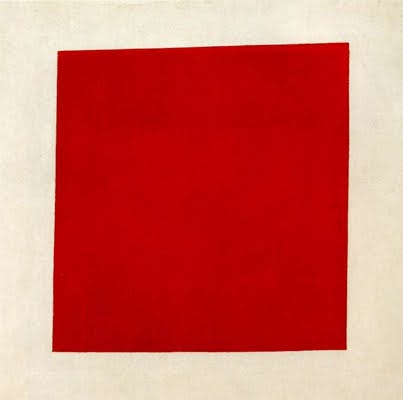
And that's not all. Check this out, a continuation of Adorno's last bit on autonomous art. Autonomous art is suspect of giving consolation "by virtue of its rejection of the empirical world ... art sanctions the primacy of empirical reality." Okay! By Adorno's reckioning, then, when a guy like Kazimir Malevich painted his red squares on white backgrounds, he was treading on dangerous ground. And when Malevich said that he wanted his ideal viewer to stand in front of his painting and say "everything I knew is dead -- before me stands a red square on a white field" he was in even deeper trouble. Instead of making a bold, past-clearing gesture, a gesture that puts us in touch with the primal act of seeing, Malevich was surrendering to the world as it is. His viewer gives up on any engagement with the world out there and, gooned on red, becomes a kind of lotus-eating quietist. Art becomes an opiate — if not for the masses, then at least for the connoisseurs.
4. But no!

And here's where Adorno does a little dialectical pirouette. While he finds art that consoles to be insufferable in a deeply unjust and imperfect world, he thinks that art that interrogates or attacks or investigates its own foundations — art that takes a good hard look at what it is that art does — to be potentially redemptive. It can be as oppositional as it is (malevolently) consoling.

What does this mean? I suppose Adorno has something like Dada in mind: avant-garde art that questions what it is art is for. So when the Dadaists displayed their art with hammers and axes next to it, for the viewer who didn't like it to smash it to bits if he so desired, they were showing us all sorts of fundamental things about the bases of art. For one, they were showing us how passive our relationships with art objects usually are: we're just supposed to soak up art's consolations, and if we find those consolations problematic we're left with little recourse but some private grumbling. (There's a terrible irony in what's happened to Dada: exhibited at places like the National in D.C. reverantly, and with nary a hammer to hand, and with no one taking the provocation to blast what one dislikes seriously. I've been thinking about this lately, and I think I can make a chapter of my next book out of the fate of the Dada tradition. I mean, the institutions have really eaten Dada. One wonders if Dada poisoned them in the process, changing them fundamentally as much as the institutions changed Dada? But I digress).

I think Adorno's observation about self-interrogating art's ability to contest as well as console applies to a lot of art we wouldn't think of as avant-garde, though. Consider this poem of Ken Smith's, which I had the pleasure to publish in Samizdat back in 1998:

Countryside Around Dixton Manor, Circa 1715


[Countryside around Dixton Manor is the title of a huge painting by an anonymous artist, dated circa 1715, on view in Cheltenham Art Gallery.
The harvest verse is from Five Hundred Points of Good Husbandry, 1580, by Thomas Tusser, published by OUP, 1984]

Now strike up drum
come harvest man come.
Blowe horne or sleapers
and cheere up thy reapers


Layer under layer under the paintwork
England is making its Midsummer hay—

the dancing morris, pipelads and drum,
scythemen and rakers, cockers and carters

and centrefield my lord with his ladies
riding where now the pylon hums

with its wires over spring wheat
through the early morning mist.

These are the same hedgebacks,
same lie to the landscape, Mickle Mead,

Barrowdine, Harp Field and Sausage
still here though the names gone now.

*

In oils, unsigned, anonymous, a jobber
moving through landscape, used maybe
the wide angle lens of the camera oscura
for this sweep of a corner of Gloustershire,

back when all was thought well enough,
and nothing would change beyond this—
these peasants sweating in harvest
content dreaming brown ale and a fumble

among the haycocks, and the dancers dance off
to their drink and their shillings. My lord lies now
and since and soon and thereafter in Alderton
in St Mary of Antioch, long dead.

*

Long gone, nameless maids in a row,
long curve of the back of 23 men
in a Mexican wave of swung scythes

to their lost graves. Two gossips
by the gate that is still a gate
maybe went for infantry, and the pipeboy

shipped out to the far world, most
stayed, went hungry, died anyway.
The painting’s a lie, the landscape true

where the field keeps its shape. Everything
beyond this moment is yet to happen.
Everyone here is part of the dust now.

*

If my heart aches it’s for this
though none of it’s true:

the world we have lost never was
so we never lost it:

glitter of horse brass, bells
rolling over the evening:

all my lord’s dream of himself
in a hired man’s painting:

same tale then as now
and this has not changed either:

the enrichment of the rich,
impoverishment of the poor.

None but the reaper
will come to your door.


On the one hand, the poem is all about pastoral consolations. On the other hand, Smith acknowledges the fictive nature of those consolations: he knows that what his heart aches for (a just and better and altogether more congenial world) never existed, at least not under the old squirearchy in the eighteenth century. So he lets us feel deeply his (and, be extention our) need for a better world, gives it as local habitation and a name by embodying it in the painter's vision, and then tells us that there's no point pining for that past. We're consoled, but we're also left questioning what we could do, and where in the world we could turn, to find or make the better, other world.

5. A Bunch of Stuff on the Origin of the Work of Art

Adorno next tells us that there's no single, authoritative concept of what art must be. Definitions are historically contingent and prone to change. This was probably a more interesting and controversial section back when the academy still harbored tweedy old coots who though the Greek ideas were the best ideas because the Greek ideas were the first ideas. There's a kind of anthroplogical The Raw and the Cooked quality to this section: Adorno makes a big deal out of art being defined, at each historical moment, against whatever the culture deems to be "non-art."

The most interesting bit for me, here, has to do with autonomous art again: Adorno tells us that "artworks became artworks only by negating their origin." That is, only after they left off their "ancient dependency on magic" and their "servitude to kings and amusement" did they become art, in the present sense of the word. Autonomy is essential to the artwork at this particular point in time, and we define it against religious artefacts, ideological shills, and mere fun. (Here's a point where you can feel that things have changed since Adorno wrote: the high/low distinctions in art, and the art/fun distinctions have been largely eroded — I'm sure Adorno would have something clever and interesting to say about this, too).


Yargh. I've got to catch a train, and I see that I've covered only about four pages of Adorno. Well, more later. Metrarail is a cruel mistress.


Saturday, October 14, 2006

Beyond Close Reading and the G.I. Bill: A Secret History of the New Criticism


What's that you say? You can't make it down to Tulsa, Oklamoma next week to hear me talk about the New Criticism and read my poems at the eighth annual Modernist Studies Association Conference? You're kidding! What are we going to do about this terrible state of affairs? Oh, come on. No whining. Okay, fine. But only since you insist. Here's the paper I'm giving.

If any of you ever want to cite it in some dusty academic article, or perhaps attack it in a firey editorial, you can pretend you were in Tulsa and give it the full treatment:

Archambeau, Robert. "Beyond Close Reading and the G.I. Bill: A Secret History of the New Criticism," Modernist Studies Association Convention, Tulsa Oklahoma, October 22, 2006.


The essay is based on some material I was asked to eject, as irrelevant to my main argument, from the Laureates and Heretics manuscript. I did so at the behest of the very sharp and well-informed anonymous reader evaluating it for the press, a reader I'm increasingly convinced has to be Keith Tuma (J'accuse, Keith!).

Oosh. I just realized that I'll have to come back to this post and fix all the formatting errors my cut-and-paste job is sure to introduce. No italics, and no footnotes will appear (and some of the "works cited," will seem irrelevant, as the works were cited in the footnotes).If you're reading this in 2008 and the italics still haven't reformatted, odds are I've given up on actually getting around to the task.

Anyway Here it is:

  • Beyond Close Reading and the G.I. Bill: A Secret History of the New Criticism

    As I hope my attempt at a sexy title makes clear, I want to talk a little about some of the less-frequently-discussed elements of the rise of the New Criticism. The story of that rise has been told countless times in many a graduate seminar, and tends to go something like this:

    Once upon a time there was a small group of men who cared about poems, but not much else. They wanted to discuss poems in terms of their form, and such was their love for poetry they wanted these poems to be perfect, for every detail to balance out every other, and for the poems to come together in wonderfully ironic wholes. They worked hard reading those poems, searching for unities and ironies and balances, and they called this hard work “close reading.” This was all a terrible mistake, but they didn’t know it, because Derrida had yet to come down from his mountain with the ten commandments of deconstruction. And the men so loved poems that they didn’t want the messiness of the world to enter into the poems, so they read the poems they loved without reference to context. They worked hard to avoid looking at history and ethics and politics, and they called this hard work “formalism.” This too was a terrible mistake, but they didn’t know it because Greenblatt had yet to come down from his mountain with the ten commandments of the New Historicism. But these men, misguided as they were, came to dominate our English Departments, because something called the G.I. Bill came along, leading behind it a long line of eager and ambitious people, a new generation of students who hadn’t been prepared for college at fancy prep schools. Someone had to find a new way to teach them, a way that didn’t depend on the students having prepped for college at Groton or Choate or some provincial equivalent. And the New Critics came forward and said they didn’t need for their students to do anything but closely read a few short poems and all would be well. But all was not well until the New Critics were driven from the land by Derrida and Greenblatt, for whom we should all give grateful thanks.


    Anyone likely to be reading this — that is, anyone attending a seminar called “New Approaches to the New Criticism” — is likely to be dissatisfied with stories of this ilk. My own dissatisfactions with such stories are legion, but for the present context let me concentrate on just one: the insistence on unity where there is none to be found, really. In an oddly ironic way, those who tell stories like the one above are doing to the story of the New Critics exactly the sort of thing they are likely to condemn the New Critics for doing to a poem: taking a contradictory and dissonant thing and hammering it into something coherent, where all the parts are subordinated to an interpretive whole. What I’d like to do here, by way of chipping away at the dominant story of the New Criticism is this: I’d like to point out how the institutional imperatives that gave rise to the New Criticism within our universities also helped to exacerbate divisions that were latent in the movement from the beginning. The important institutional imperative, for my purposes, is not the need to serve a new generation of returning G.I.’s: it is the need to establish English as an autonomous discipline, a need created by the Germanic model of the university that became dominant in America in the twentieth century. My case study will be that of Yvor Winters, a New Critic who came to seem a marginal figure in the movement because his poetic and critical practices were at odds with this institutional imperative. Since I’ve indulged myself in this elaborate introduction, my demonstrations will of necessity be brief, but fret not: should you be so sadly addicted to this arcane topic that you hunger for more, I’ll be happy to inflict large chunks of my manuscript on you via email.

  • Autonomous Disciplines: Legitimating the Midcentury English Department

    While the common story of the rise of the New Criticism isn’t wrong in emphasizing the democratizing of higher education in postwar America, there is another factor to be considered in understanding that rise. This second factor in the success of the New Critics is the emphasis of many — but, as we shall see, not all — such critics on the autonomy of literary study, and their accompanying emphasis on the autonomy of the literary object. The American university, like its German model, is predicated on the assumption of discrete and autonomous areas of knowledge, and was therefore receptive to New Critical ideas of literary study as an autonomous endeavor.

    In addition to the need for a pedagogy that would suit the postwar student body, the American university turned to the New Criticism because it seemed that movement shared the universities’ amenability to an autonomous view of literature. The division-and-department administrative model of the university was one that favored the idea of autonomous areas of inquiry . This idea of clearly divided and administered knowledge-areas implies, as Gerald Graff puts it in Professing Literature, “the isolation of literature as its own autonomous mode of discourse with its own autonomous ‘mode of existence.’” Moreover, as Graff points out, the English Department’s mode of discourse and existence must, in this view, be “distinct from that of philosophy, politics, and history” and put a premium on “methods that seemed systematic and could easily be replicated” (145).

    This predisposition of the American university to autonomous rather than heteronomous views of knowledge predates the New Criticism considerably, having its origins as far as the founding of Johns Hopkins University on German educational models in 1867. By and large, though, literature departments lagged behind the sciences and social sciences in developing autonomous principles for the study of their subject matter. But by the mid-1930s (just as New Critics like Brooks and Warren were launching their fledgling academic careers) the institutions were ready for change. R.S. Crane of the University of Chicago, for instance, looked to reform his own department on the autonomous principle, calling, in 1935, for a faculty that did not subordinate formal to political or moral concerns: “…men of the type of the older impressionists we could hardly use, and as for the remnants of the Humanists, there is little to be hoped for from the kind of principles — essentially political and ethical rather than esthetic in character — for which they mainly stood” (4).

    Crane may not have known exactly what he wanted, but he knew what he didn’t want: heteronomous principles of literature, the prevalence of which seemed to threaten to subordinate literature to politics and ethics. It should come as no surprise that three years later, in the year of Understanding Poetry’s first edition, John Crowe Ransom would look back on Crane as a visionary, and praise him as a great reformer in the famous essay “Criticism, Inc.”. By 1950, many proponents of heteronomous principles of literature and literary study in the academy had come to feel that the reformers had them up against the ropes. MLA president and Harvard professor Douglas Bush’s address to the MLA two years earlier (“The New Criticism: Some Old Fashioned Queries”) had been less an act of resistance than an angry surrender to an enemy that dismissed his own ethical and humanistic views as nothing more than “the didactic heresy” (19-20). Then, as at many an MLA conference since, the desperate pleas of the president were ignored by the eager young assistant professors, ready to make names for themselves by following the next new thing.

    In an institutional environment that called out for a method of study based on autonomous principles of literature, critics like Tate and Ransom were there to supply what was needed. This is not to say that the they were nothing more than opportunists, merely that the ideas they produced happened to fit the demands of the academic/literary marketplace of the time. Then again, one can sometimes detect a whiff of opportunism in private correspondence, as when Ransom writes to Tate in 1937, saying that “I have an idea that we could really found criticism if we got together on it” and that “the professors are in an awful dither trying to reform themselves and there’s a big stroke possible for a small group that knows what it wants in giving them ideas and definitions and showing the way” (Young, John Crowe Ransom 85).

    Regardless of how deliberate any particular New Critics may have been in exploiting the universities’ need for a theory of literature as an autonomous object of study, those who prospered most seemed to embrace the idea that both the method and object of literary study were autonomous. Ransom’s “Criticism, Inc.,” for example, echoes R.S. Crane’s criticism of non-autonomous methods of literary study in claiming that the unreformed English department could “almost as well announce that it does not regard itself as autonomous, but as a branch of the department of history, with the option of declaring itself occasionally a branch of ethics” (Graff 148). A year later, in 1939, Cleanth Brooks would write in The Well-Wrought Urn that, without an insistence on formalist methods, professors of literature would wake up one day to find that they had been “quietly relegated to a comparatively obscure corner of the history division” or were being “treated as sociologists, though perhaps not as a very important kind of sociologist” (235). Against these dire consequences, Brooks held up a strictly formal method of literary study. By 1951, he felt able to codify the method in a number of “articles of faith” published in The Kenyon Review under the title “The Formalist Critic.” No minor sociologist he, but a professional practitioner in a proper field of inquiry.

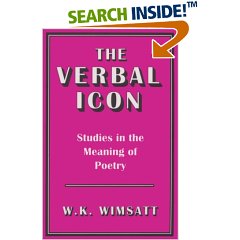
    The literary object of New Critical literary study, too, was to be an autonomous. When W.K. Wimsatt and Monroe C. Beardsley wrote, in “The Intentional Fallacy,” that “poetry is a feat of style,” (The Verbal Icon 4) they were codifying a position at a far pole from any notions of the poem as, say, a moral statement, an intervention in (or product of) history, an establishment of identity, or the like. This sense of the autonomy of the poem-as-poem was central to the idea of English as an autonomous discipline, and of great importance to the rise of critics like Wimsatt and Beardsley. But the triumph of this idea, fostered by an institutional structure with which it was eminently compatible, also created, or at any rate exacerbated, schisms within the New Criticism. One of these, to which we will now turn, involved the marginalization of one poet-critic associated with the movement: Yvor Winters.

  • The Heretic of Paraphrase

    In 1951 Randall Jarrell wrote:

    Is Clarity the handmaiden of Popularity, as everybody automatically assumes? How much does it help to be immediately plain? In England today few poets are as popular as Dylan Thomas — his magical poems have corrupted a whole generation of English poets, yet he is surely one of the most obscure poets who ever lived. Or take an opposite example: the poems of the students of Yvor Winters are quite as easy to understand as those which Longfellow used to read during the Children’s Hour; yet they are about as popular as those other poems (of their own composition) which grave Alice, and laughing Allegra, And Edith with golden hair used to read to Longfellow during the Poet’s Hour. If Dylan Thomas is obscurely famous, such poets as these are clearly unknown. (18-19).


    These comments, published four years later in Poetry and the Age are flippant but telling, in that they encapsulate much of the New Critical critique of Wintersian poetry and poetics. That critique, in most instances, boiled down to a preference for the interestingly obscure over the plainspoken or easily paraphrasable. While Winters, in one of his less tolerant moods, could write that “many poems cannot be paraphrased and are therefore defective” (see Von Hallberg, “Yvor Winters” 804), it would only be stretching things a little to say that the standard New Critical assessment of Winters was that his later poems were defective because they could be too readily paraphrased.

    This was the basic substance of John Crowe Ransom’s quarrel with Winters, and the substance of the critique that his student, Cleanth Brooks, would level at Winters. Both Ransom and Brooks objected to the statement-oriented, paraphrasable side of Winters’ poetics, and for the same reason: Winters’ work violated the autonomous principle of poetry. Two other New Critics, W.K. Wimsatt and Monroe C. Beardsley, would also object to Winters’ work on the same grounds. The repeated rejections were strong enough to sting even the thick-skinned Winters, who remarked in 1953 that the young Turks of Ivy League thought of him as “lower than the carpet” (Hall 224).

    Ransom explicity objects to Winters’ heteronomous principles of poetry — his subordination of formal concerns to moral concerns — in the 1941 volume that became the namesake of a movement, The New Criticism. Here he maintains that “Winters believes that ethical interest is the only poetic interest” (214). This is a problem, Ransom argues, because it looks to poetry for reasons other than “poetical interest” itself (that is, the autonomous principle of poetry):

    Now I suppose [Winters] would not disparage the integrity of a science like mathematics, or physics, by saying that it offers discourse whose intention is some sort of moral perfectionism. It is motivated by an interest in mathematics, or in physics. But if mathematics is for mathematical interest, why is not poetry for poetical interest? A true-blue critic like Eliot would certainly say that it is, though he would be unwilling to explain what he meant. I think I know why all critics do not answer as Eliot would: because criticism, a dilettante and ambiguous study, has not produced the terms in which poetic interest can be stated. Consequently Winters is obliged to think that mathematics is for mathematical interest — or so I suppose he thinks — but that poetry, in order that there may be an interest, must be for ethical interest. And why ethical? Looking around among the stereotyped sorts of interest, he discovers, very likely, that ethical interest is as frequent in poetry any other one. (214).


    The passage reverberates with the energies that were to bring the New Criticism to power in the universities: the science-based emphasis on a division of knowledge into discrete, autonomous fields; the condemnation of “dilettante” critics; the call for an articulation of “terms in which poetic interest can be stated” (terms, one imagines, like irony, balance, and unity — terms that stress complex structure over moral statement). Ransom takes a position that will advance New Criticism to the center of academic and literary authority. A great deal, in fact, depends upon his ability to establish the autonomous principle of literature: “there’s a big stroke possible for a small group that knows what it wants in giving [professors of English] ideas and definitions,” as Ransom wrote to Tate four years earlier. Winters, in this process, serves as a foil: he is the poet-critic who fails to grasp the autonomous principle; the representative of an outmoded, heteronomous aesthetic.

    Winters, never one to let a criticism of his own work go unanswered in print, objected to Ransom’s criticism in his scathing essay “John Crow Ransom, or Thunder without God” from The Anatomy of Nonsense. Here, he claims quite rightly that Ransom has a truncated notion of Winters’ moralism, which was never as simple a matter as demanding that a poem make an overt moral statement. Instead, the poet’s responsibility is to co-ordinate rational statements about the world with the emotional connotations appropriate to those statements (In Defense of Reason 502-507). Nevertheless, Winters still maintains that the subject matter of poetry is inevitably human experience and that “it can therefore be understood only in moral terms” (506). That is, “the act of the poet” should always be “an act of moral judgment” (503). The poet, in this view, is ultimately responsible to morality, rather than to internal or formal “poetic interest” alone. This is a profoundly heteronomous idea of literature, and it is heteronomy itself, rather than any particular definition of morality, to which Ransom objects.

    Brooks’ major contribution to the anti-Wintersian argument comes in the middle section of his famous essay of 1947, “The Heresy of Paraphrase,” where Inquisitor Brooks fingers Winters as the leading heretic. Like Ransom, Brooks objects to Winters’ emphasis on statement on the grounds that it violates the autonomous nature of literature. “Mr. Winters’ position will furnish perhaps the most respectable example of the paraphrastic heresy,” intones the Inquisitor, naming Winters as a heretic because “he assigns primacy to the ‘rational meaning’ of the poem” (963). This is a violation of the autonomous principle of poetry because “to refer the structure of the poem to what is finally a paraphrase of the poem is to refer it to something outside of the poem” (964). For true believers free from heteronomous heresies, poems are to be judged in terms of structure and “internal order” (964) only. In addition, Winters’ is condemned for conceiving of the language of poetry as continuous with the language of “science or philosophy or theology” (964). Brooks, like Ransom, holds to the dogma that poetry is a special kind of language, and so is unsympathetic to Winters’ idea that poetry does not differ in essence from prose. While no dunking stools were available for use on heretics academy, the most powerful weapon available was deployed against the heretic Winters: he was derided, and worse, ignored.

    One of last major attacks on Winters — or perhaps we should say, one of the last moments when Winters’ work is taken seriously enough by a New Critic to merit sustained attack — comes in W.K. Wimsatt’s 1954 study The Verbal Icon. Even here much of the material devoted to Winters comes in a which Wimsatt co-wrote with Monroe C. Beardsley in 1946. In addition to making light of Winters’ concerns about improperly motivated emotion, they repeat the standard New Critical case against Wintersian poetics when they say they will not embrace “the extreme doctrine of Winters, that if a poem cannot be paraphrased it is a poor poem” (35). While they are willing to use some of the ideas about the emotive qualities of poetry, they share neither Winters’ sense of the dangers of unmotivated or spontaneous emotion, nor his sense of the poem as statement. He is, for them, largely passé.

    For critics like Ransom, Brooks, Wimsatt and Beadsley, the poems most favored were “obscurely famous,” centered on formal concerns, and consecrated because of those concerns. Had the Robert Lowell of Lord Weary’s Castle not been born, the New Critics would have had to invent him in a secret laboratory beneath Kenyon College’s biology building. But the poems of Yvor Winters, like those of his unnamed students in Jarrell’s Poetry and the Age, were “clearly unknown.” It was their clarity, in fact, that kept them that way. And it was his insistence on such clarity, and on a heteronomous poetic, that made him marginal in an movement that was riding high on the American university’s autonomous imperatives.


  • Works Cited

    Bledstein, Burton J. The Culture of Professionalism: The Middle Class and the Development of Higher Education in America. New York: Norton, 1978.

    Bush, Douglas. “The New Criticism: Some Old-Fashioned Queries.” PMLA 64 Supplement Part 2 (March 1949): 18-21.

    Brooks, Cleanth. “The Formalist Critic.” Kenyon Review 13 (1951): 72-81.

    Brooks, Cleanth. “The Heresy of Paraphrase.” Critical Theory Since Plato. Revised Edition. Ed. Hazard Adams. New York: Harcourt Brace Jovanovich, 1992:961-968.

    Brooks, Cleanth. The Well-Wrought Urn: Studies in the Structure of Poetry. New York: Dobson, 1968.

    Crane, R.S. The Idea of the Humanities, vol. 2. Chicago: University of Chicago Press: 1967.

    Graff, Gerald. Professing Literature: An Institutional History. Chicago: University of Chicago Press, 1989.

    Hall, Donald. “Rocks and Whirlpools: Archibald MacLeish and Yvor Winters.” Paris Review 121 (1991): 211-251.

    Jarrell, Randall. “The Morality of Mr. Winters.” Kenyon Review 1 (1939): 211-15

    Jarrell, Randall. Poetry and the Age. London: Faber and Faber, 1955.

    Ransom, John Crowe. “Criticism, Inc.” Westport, Connecticut: Greenwood, 1979.

    Ransom, John Crowe, The New Criticism. Norfolk, Connecticut: New Directions, 1941.

    Richter , David, ed.. The Critical Tradition: Classic Texts and Contemporary Trends. New York: Bedford/St. Martin’s, 1989.

    Von Hallberg, Robert. “Yvor Winters.” American Writers: A Collection of Literary Biographies. Supplement Two, Part Two. Ed. A. Walton Litz. New York: Scribner’s, 1981: 785-816.

    Wimsatt, W.K., and Monroe C. Beardsley. The Verbal Icon: Studies in the Meaning of Poetry. Lexington, Kentucky: University of Kentucky Press, 1967.

    Winters, Yvor. In Defense of Reason. Denver, Colorado: Swallow, 1947.

    Young, Thomas Daniel. John Crowe Ransom: An Annotated Bibliography. New York: Garland, 1982.
  • Tuesday, October 10, 2006

    Avant-Post Arrives!


    That's Avant-Post people, not to be confused with the post-avant. The latter is either a school of poetry or a hopelessly vague abstraction, depending on whom you task. The former is a new book edited by Louis Armand, featuring work by a host of notables. And my essay "The Death of the Critic," which is about Benjamin Friedlander, among others. And about the fate of lit crit in these our indifferent times.

    Here's the press copy:

    Now available from Litteraria Pragensia Books...

    Avant-Post: The Avant-Garde Under "Post-" Conditions
    Ed. Louis Armand
    ISBN 80-7308-123-7 (paperback).
    300pp.
    Published: October 2006.
    Available for purchace online.

    Avant-Post engages the question of whether or not avant-garde practice remains viable under the prevailing conditions of a whole series of "post-" ideologies, from Post-Modernism and Post-Structuralism, to Post-Historicism, Post-Humanism and Post-Ideology itself.

    Contributors include Johanna Drucker, Michael S. Begnal, Lisa Jarnot, Ann Vickery, Christian Bök, Robert Archambeau, Mairead Byrne, R.M. Berry, Trey Strecker, Keston Sutherland, Rachel Blau DuPlessis, Robert Sheppard, Bonita Rhoads, Vadim Erent, Laurent Milesi, and Esther Milne.


    Check it out! Also worth checking out: recent posts on Adorno's Aesthetic Theory by both Mark Scroggins and Dave Park. I'm meant to join this cross-blogging phenomenon, and am now the Official Laggard of the group.

    Monday, October 02, 2006

    The Figure Five in Gold: William Carlos Williams Between the Visionary and the Utilitarian


    So there I was, circa 1991, sitting with my fellow grad students around a certain self-styled radical feminist professor's dining room table in her rambling midwestern Victorian house, drinking too much wine and listening to her spiel about William Carlos Williams, which seemed to pivot on the observation that, because he liked to sleep around, he was a bad man (plausible) and a bad poet (manifestly untrue). Leaning over to my neighbor, another grad school newbie, a lanky Chicagoan whom I thought might be sympathetic to my discontent with the limits of the prof's view of things, I asked if he thought there might be more to Williams than what our prof seemed to think of as the primal sin of priapism. "This red wheelbarrow, it -- I -- I mean..." he sputtered "I mean, that's just... what's it got to say about... I mean, it's just stupid." It was a bit surprising: this was a guy who read Pynchon and DeLillo and Paul Auster, a man destined to write a sharp dissertation on difficult historiographic metafiction. He was every bit as hostile to Williams as our prof, although for very different reasons. She had a kind of moralistic objection to the man that translated into a dismissal of the work. My fellow grad student simply didn't seem to have anything in his otherwise well-equipped interpretive toolbox with which he could grab the little poems from Williams' Sour Grapes and pry them open.

    Later, after we left, I told him I thought Williams had been treated unfairly, but when he asked me to explain why I liked poems like "The Red Wheelbarrow" and "The Great Figure" I didn't acquit myself well. I think I mumbled some poorly remembered lines about "the visual chord of imagism" from T.E. Hulme, and left it at that. He was as unconvinced as he ought to have been. And he's far from alone in being left cold by those poems. When I'm teaching freshmen, "The Red Wheelbarrow" is one of the poems I can count on my some of my students having read in high school. A decade of teaching has taught me, though, that they almost invariably despise the poem. I think they've had a bad experience, with the poem having been shoved at them by a teacher who, thinking its brevity and simple diction make it accessible, doesn't really do much better than I did at explaining why he found it charming and interesting in the first place.

    I think, though, that I've finally found the perfect crowbar to use on Williams' imagism-derived poems of the early twenties. I found it while rummaging through Aldous Huxley's The Doors of Perception and his Heaven and Hell, of all books. I've been teaching some of Blake's prophetic books, and, one evening, decided to pull my unread-since-undergrad days copy of Huxley down off the shelf to see if there was anything clever on Blake (from whom he derives his title). There wasn't much on Blake I could use in Huxley's grab-bag of art history, peyote memoir, semi-Jungian jive and mystical ramblings, but when I hit his section on color and visionary experience I finally felt I could have given a decent reply to the scholar of postmodern metafiction who sat next to me in that seminar fifteen years ago. Talk about your esprit d'escalier already.

    In both The Doors of Perception and Heaven and Hell Huxley makes a big deal out of the significance of color in visionary experience. When he trips on mescaline in California, he's almost overcome by the sight of light falling on a blue chair, for example; and he quotes extensively from various mystics and visionaries who remark on the luminous, intensely colored world they perceive around them. To understand why this seems so important to him, we need to get a sense of the difference between ordinary and visionary perception as he understands them. Essentially, he tells us that ordinary perception is a very selective perception, a mode of experience that filters out anything that doesn't somehow help us get through the day; while visionary perception is an (inevitably limited) opening out toward experiencing the world as it really is, in all of its overwhelming and (to us) useless totality. Here'e what he says after his mescaline experience, which he takes as having approximated visionary experience:

    Reflecting on my experience, I find myself agreeing with the Cambridge philosopher Dr. C.D. Broad, "that we should do well to consider much more seriously than we have hitherto been inclined to do the type of theory which Bergson put forward in connection with memory and sense perception. The suggestion is that the function of the brain and nervous system and sense organs is in the main eliminative.... The function of the brain and nervous system is to protect us from being overwhelmed and confused by this mass of largely useless and irrelevant knowledge, by shutting out most of what we should otherwise perceive or remember at any moment, and leaving only that very small and special selection which is likely to be practically useful." According to such a theory, each one of us is potentially Mind at Large [*a note from Archambeau: This sounds loopier than it is. I take Huxley to mean something like "each one of us has a potential for perception that is disinterested, not filtered through screens of utility"]. But in so far as we are animals, our business is at all costs to survive. To make biological survival possible, Mind at Large has to be funneled through the reducing valve of the brain and nervous system. What comes out at the other end is a measly trickle of the kind of consciousness that will help us stay alive on the surface of this particular planet.


    Huxley's got a point about the reductive or eliminative nature of ordinary, utilitatian perception. If I could be forgiven for moving from the sublimity of visionary experience to the ridiculousness of an experiment involving a guy in a gorilla suit, I'd mention a psychological experiement in which people were asked to watch a videotape of a basketball game and keep track of the different plays. Here's what happened (really!), according to the British newspaper The Telegraph. The researchers

    played the tape to subjects and asked them to count the passes made by one of the teams. Around half failed to spot a woman dressed in a gorilla suit who walked slowly across the scene for nine seconds, even though this hairy interloper had passed between the players and stopped to face the camera and thump her chest. However, if people were simply asked to view the tape, they noticed the gorilla easily. The effect is so striking that some of them refused to accept they were looking at the same tape and thought that it was a different version of the video, one edited to include the ape.


    So we see what we're looking for, and we look for the things that are useful for the task at hand — in this case, watching the plays, not the gorilla. The reducing valve of utilitarian perception is in full effect.

    Anyway. The intense experience of color seems to correspond, for Huxley, with the seeing of a fuller or more than usually charged version of the ordinary world -- with the perception of (to use Huxley's favorite Blakism) "the world in a grain of sand." He recounts a bunch of visionary experiences from a variety of people (including the Irish poet AE). Here he moves beyond description to analysis:

    At the antipodes of the mind, we are more or less completely free of language, outside the system of conceptual thought. Consequently our perception of visionary objects possesses all the freshness, all the naked intensity, of experiences which have never been verbalized, never assimilated to lifeless abstractions. Their color ... shines forth with a brilliance that seems to us preturnatural, because it is in fact entirely natural — entirely natural in the sense of being entirely unsophisticated by language or the scientific, philosophical or utilitarian notions by which we ordinarily re-create the world in our own drearily human image


    So the perception of, and fascination with, brilliant color can be an indication that we're pushing the limits of ordinary, interested (as opposed to disinterested), utilitarian perception, and entering a broader perception of experience. We may not be seeing the world in a grain of sand, but we're in one of those rare and privileged moments when we're seeing more than we need to see in order to get by.

    Okay. Right. But what's it all got to do with William Carlos Williams? Well, this, I guess: A bunch of Williams' short poems from the early twenties, including some of the best known, give us two elements of a single object: its utilitarian value and the fascination of its brilliant color. I'm convinced this is significant: Williams is showing us that the ordinary objects around us glow with the possibility of the kind of visionary perception Huxley is trying to get at. Williams values the objects for their ordinary utility, but he's always ready to see the world in the grain of sand. Or, rather, in the wheelbarrows and firetrucks of New Jersey. Check it out. Here's the way-too-familiar "The Red Wheelbarrow":


    so much depends
    upon

    a red wheel
    barrow

    glazed with rain
    water

    beside the white
    chickens.


    "So much depends..." — we begin with an assertion of the utilitarian value of the wheelbarrow, its role in supporting the family and working the farm and all the rest of it. But then comes the color, both of the wheelbarrow itself and of the (equally utilitarian) chickens. And, of course, the wheelbarrow gleams, its color popping (uselessly, from a utilitarian perspective, or from the point of view of those who depend on the wheelbarrow to work and survive) with rain-glaze. If you turn to a standard explanation of the poem, such as you'd get in Exploring Poetry, you'll read that "...the word 'glazed' evokes another painterly image. Just as the reader is beginning to notice the wheelbarrow through a closer perspective, the rain transforms it as well, giving it a newer, fresher look. This new vision of the image is what Williams is aiming for." All of which is totally true. But explanations like this miss what I think is most important about the poem: its insistence that there is both an interested/utilitarian and a disinterested/visionary perspective to be had. On the one hand, the wheelbarrow has an economic value, which Williams notes at the beginning. On the other hand, it exceeds mere utilitarian value, and pops with a brightness that opens up for us the idea that the world pulses and gleams with a vivid life all its own, beyond its value as a tool for our survival.

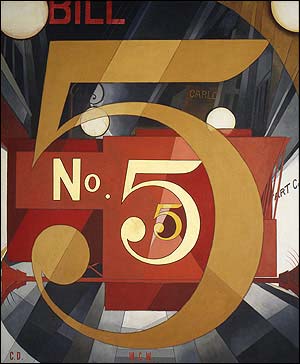
    "The Great Figure" is even better as an example of this kind of dialogic take on perception in Williams' early poems.

    Among the rain
    and lights
    I saw the figure 5
    in gold
    on a red
    fire truck
    moving
    tense
    unheeded
    to gong clangs
    siren howls
    and wheels rumbling
    through the dark city


    The firetruck is a supremely utilitarian object, and on a serious mission in which lives may well be at stake. And the number of the truck is a sign of bureaucratic society, social organization and useful orderliness: it shows us that we live in a world of departments and social services designed to help us out in disasterous situations. It is a sign of how we've formed a utilitarian survival mechanism and learned how to put it into operation. But all of this is almost lost in the sense-overload of the number, its glaring goldness (which, like the wheelbarrow, is accentuated by a halo-glaze of water). It is the goldness of the numeral, the very extravagence of this, that fixates Williams (and that would soon fixate Charles DeMuth, in his painting based on the poem). The firetruck has its real and valuable utility (in this instance a very urgent utility), but its gleaming color also serves, here, to show us that we are capable of perceiving a world beyond utility. There it is, in all its splendid alterity, all its strangeness and gleaming, irreducible reality. I'm sure this kind of contrast between utilitarian and what I'll call visionary perception is hugely important to a full appreciation of Williams' poems.

    There's a lot more to say here, I'm sure — one could probably riff for a while on how both Williams and the man who was in many ways his opposite, Wallace Stevens, are both heirs to the Blakean visionary Romantic tradition. I mean, Stevens' "Of Mere Being," with its gold and "fire-fangled" bird, glowing brightly "without human meaning" is probably a good counterpart to these Williams poems. And there's probably something to say about the idea of language as a reducer of experience. Huxley talks about this, and so does T.E. Hulme, the main theorist of imagism. But I've got to kick it into gear and grade some of the papers I had my students write about Blake's prophetic books. Urizen, ho! Onward, Ahania!


    Postscript: Those of you who have been in touch with me via email about blogging on Adorno will no doubt have noticed that this is not an Adorno post. I'm getting there! But the new semester has crushed me beneath her voluminous academic trappings, and I gasp for air. Whatever else Adorno may be, he is not air.

    Sunday, September 10, 2006

    Mohammad vs. Silliman (No, Not That Mohammad)


    K. Silem Mohammad is onto something over at his blog, with his Sept. 1 post, Notes on (Dis)quietude and the "Post-Avant". So onto something is he that gladly would I have cornered him after his reading here in Chicago last Friday — had I not been entering the second week of my annual the-students-are-back-and-breathing-exotic-germs-on-me illness.

    Anyway: here's what Kasey's onto: Silliman's Big Manichean Dichotomy of Poetry, (in which the world is divided into a mere two camps, the so-called School of Quietude and the so-called Post-Avant) depends on an untenable assumption. The assumption being that aesthetic radicalism = political radicalism, and aesthetic conservatism = political conservatism. Here's how he puts it:


    I am sympathetic in some ways to Ron Silliman's (in)famous classification of "School of Quietude" vs. "Post-Avant"*, at least within limited historical parameters. I have used the terms myself from time to time, effectively as synonyms for "mainstream" and "experimental" (labels that are admittedly problematic in themselves). But a central problem with Ron's binary is that it attempts to conflate two separate (though often coinciding) realms of distinction: the aesthetic or formal, and the social or political. At one point, perhaps, such markers pointed to a tangible divide, but that divide has itself become divided so many times over that it has become increasingly less possible to maintain the dichotomy. What kinds of conceptual violence have to be committed in order to make, say, Adrienne Rich fit into a quietudist pigeonhole, or in order to think of Jorie Graham as post-avant in Ron's sense?


    Sharp, eh? And entirely right.

    I've been thinking a lot about this sort of thing lately — this summer I finally got the first parts of a new book of litcrit, The Aesthetic Anxiety, off the ground, and one of the things I want to do in that book is describe the history of exactly the kind of conflation of aesthetic and political radicalism that Kasey is onto in Silliman.

    Long story short: this sort of thing has been going on since at least the late nineteenth century. You find the assertion of an identity between aesthetic radicalism and political radicalism in all sorts of unlikely places (like Swinburne's prose, for example). By the time you get to the twentieth century, this has become kind of a reflexive position for avant-garde movements: it's one of the recurring themes of Andre Breton, for example. And it lives on today.

    Why, you ask, did this conflation occur? I mean, Kasey's mention of Adrienne Rich would seem, by itself, to blow a great gaping whole in the side of the argument, through which would seep a sea of other examples, drowning the good ship S.S. Avant-Smug beneath the waves. An excellent question! I try to answer it in the first essay from the book, which will come out (oh glacial pace of academic publishing) sometime next year. But the gist of it, I think, is this: once art becomes something done for its own sake (not for the Church, not for the Noble Patron, not for the bourgeois market) (and of course much art continues to be made for all of those things) (but some isn't) — once art becomes something done for it's own sake, a lot of artists who love the freedoms of this autonomy become haunted by the idea of uselessness, irrelevance, etc. How to be both free and useful? Believe that freedom is a kind of radical political utility! Shazam! Problem solved.

    Well, it's all a little more complicated than that, but the record really does seem to bear this out to some degree (Oh, hours in the archive! Oh mildew and lousy light! Frolic did the nymphs and swains this summer, while Archambeau did moulder in the tower of fusty learning, oh!).

    As a guy who has been trying to get a grip on these things through looking at the history of the ideas involved, I'm especially glad to see the historicizing note at the end of Kasey's piece:

    The error of distinctions like "quietude vs. post-avant," or for that matter "quietude vs. disquietude," is that they attempt to abstract outward from specific discontents and insufficiencies to general judgments about larger formations, and to maintain those judgments across time. It is harder than it ever was before to argue that there is a consistent "mainstream" whose adherents uniformly subscribe to dominant ideologies of literature and culture--just as it is increasingly hard to argue that anything like a consistently "resistant" avant-garde is comprised by the totality of writers who adopt "experimental" aesthetics.


    *****

    In other news, Natalia kicks some poetic butt.

    Thursday, September 07, 2006

    Archambeau World Tour Fall 2006


    Okay, peeps, here's the globe-trekking my agent put together for this fall. Fire up the Volkswagen microbus and get your tie-die on! Not since Phish perished in that tragic exploding ukelele accident has such an ambitious tour been assembled! Onward, oh pionerrs, on! Feel those blue highways roll beneath you!

  • October 5, Chicago

    Poetry Reading at Powell's Bookstore (2850 North Lincoln Avenue), along with Will Alexander, Chris Glomski, Davis Schneiderman, and Tod Thilleman. All those Spuyten Duyvil guys, and me a Salt poet...

  • October 21 & 22, Tulsa

    Oct. 21 Poetry Reading, venue TBA
    Oct. 22 "Autonomous Fields, Autonomous Subjects, and the Fate of Poetry." Modernist Studies Association Convention, Doubletree Hotel

  • NOVEMBER 11, Chicago

    "Is There a There There? The Chicago Poetry Scenes." Midwest MLA, The Palmer Hilton

  • Sunday, September 03, 2006

    Utopia of the Neocons: A Vision in a Dream

    Fret not! The title of this post notwithstanding, I'm not about to lay some heavy jive on you about the dream-world of Leo Strauss and his trained monkeys. No portrait of that deeply-wounded man's ghastly ideal republic follows. Instead, I've chosen to ask Sir Thomas More, author of that great classic of Renaissance literature, Utopia, what he has to say about the political situation in which we find ourselves today.

    What? How did I manage to interview the long-dead Chancellor to Henry VIII? I don't want to go into all the gory details just now, but suffice it to say that it had something to do with the lovely and talented Valerie Archambeau's absence this week. She's in Paris, being important and cool and emailing me about her frequent, expense-account driven trips to chic restaurants, while I schlep entropically on here in Chicago. Those of you who know me know what happens when Valerie's out of town, and it isn't pretty: picture the poet in his tattered terry-cloth robe up late, smoking White Owl Cigars, slugging back SoCo from a pocket flask, and obsessively gambling online and you'll get a picture of my spiritual, if not exactly my literal, state of being. So anyway, long story short, I think the slice of ancient pizza I chorfed down before drifting off in front of A Man for All Seasons may have had something a little nasty growing on it, something that allowed me to drift off into the Visionary World of Lucid Dreaming, in which I met our man, Sir Thomas More. No, really.


    Anyway, after drifting off I seemed to wake in some kind of luxurious yurt or pavillion, whose tent-flap opening revealed hints of a scenery both lush and harmonious etc. From outside issued lute-notes of exquisite sweetness, and the love-yelps and giggles (no less sweet) of maidens and swains cavorting to the tambour's gentle rum-tee-tum-tum etc. Rising from my palfrey or palanquin or whatever the hell you call those renaissance daybeds, I made for the door, heedless of the impression I might make on the inhabitants beyond, clad as I was in the soiled terrycloth garmet of my temporary bachelorhood. Imagine my dismay, though, when a strong hand clutched my shoulder from behind, and a stern voice spoke out with virile clarity, saying: "Who the hell let you into my yurt?" Turning, I stood amazed: for my questioner was no other than the mighty More himself, all in ermine clad etc.

    Archambeau: Uh. Right. Sorry. I'll just be leaving now, out to where the tambour-playing maidens are frolicking. Nice palanquin, by the way. Really lovely. Must be going, though.

    More: Not so fast, unshaven interloper! I see by the remote control in your bathrobe pocket that you come to this Arcadia from a benighted time! No doubt the gods have sent you here to receive my coucil. Have a seat on that palinode, or on the pailing or palisade if that's more comfortable. No -- not there, cullion! The palfrey's for special company.

    Archambeau: Oh, right. Special company. Well, I'll just step outside then, and see if the cavorting maidens know of a more suitable place for me to crash, then...

    More: Enough! Sit, sir! I see from your glazed eyes and tousled mane, yea I see from the cheese-fry in your beard that you need guidance, that you may take it back to your people in this their troubled time. I know the very thing! Ophelia! Deliah! Juliana! Bring in the mighty tome!

    In answer to More's shout, several comely lasses with tresses fair and eyes that shone with the light of suns, a dainty troupe of graces with hairs of golden-wire and the scent of sweet gillyflowers etc. traipsed in, snuggling up to More like a favorite uncle, and deposited a bejewelled folio (or perhaps it was a gold-encrusted quarto, or a bedazzling codex, I can't remember which) into his waiting hands. "Nice bathrobe," said one of the nymphs, taking my lapel in her delicate fingers before tracing them gently down my sleeve, letting the ever-so-slightly-pink-and-plump, indeed cherubic, hand linger for the slightest of most enticing moments before she traipsed out through the tentflap and into the lute-and-tambour echoing glades where the gentle doe doth nuzzle 'neath the waterfall's warm and gentle spray etc.


    More: Quit staring at her snow-white bosom fair, you base and low-born ogling knave! We're on a mission here, already. And aren't you married?

    I shuffled my feet and looked at the richly carpeted and be-tapestried floor, before mumbling a shame-faced "how'd you know?"

    More: Just look at you. Unshaven, crazy-haired, wrapped in a bathrobe of unspeakable condition, with a half-eaten slice of moldy pepperoni and onion sticking out of your pocket. A single man living your life would never have reached your advanced age, good cullion, so a philosopher might well reason that you're a man of marriage, but one whose fair bride has stepped out for a few days. Long enough for you to get covered in cigar-ash, anyway. And... [he paused, to sniff the perfumed air] ... and something other than our customary myrrh and viburnum taints the air. When's the last time you showered?

    Thanks be to Charles Schultze's Pigpen, patron saint of all husbands on their own for a week, he didn't press the question, but ambled over to a nearby lectern and cracked open the jewel-encrusted codex.

    More: Now, let's see...

    [At this point he licked his index finger and began leafy furiously backwards and forwards through the book, pausing to squint every now and then, or peer closely into the book, his nose nearly touching the vellumated sheets of the tome.]

    More: Ah! The very passage! Well. Looking you over, my base and debilitatingly shaggy intruder, I see that you wear the garb of the American male in those early years of the twenty-first century. Moreover, judging by the unbearable harshness of your vowels, indeed, by the way your every word grates upon my ear with the sound of a rusty trombone being sawn in half by a particularly unskilled chimpanzee, I divine that you hail from the midwestern zone of that mighty continent. I reason, therefore, that you have been thrust into my tent to bear back urgent advice to your King George on this, his current war. Is this not so?

    Before I could raise my voice in feeble protest against what seemed a dreary fate, perching on a palanquin or palinode while all the youths and maids cavorted tambour-wise in the palace of pleasant breezes visible just beyond the glade of a thousand delights outside, he continued in his booming and prophetic tones.

    More: So. Here it is. Some dialogue of that great traveler Raphael Hythlodaeus, which I had the great wisdom and foresight to record in my immortal Utopia. Check it out, oh base and debased rough-clad cur. I believe your King will be grateful when you bear these honey-sweet words of steely wisdom to his fairly-curving, regal ear. Here's a good bit about the advice old Raphael would offer to the King of France, should that august lord find himself overextended and be-quagmired in a fruitless war against the dread Italians. Here the words!

    He gestured grandly skyward with his right hand, continuing with as much dignity as possible considering his ministerial rings got caught up in the cloth-of-gold filigree of the ceiling tapestry. Staring me down lest I chuckle indecorously, at length he quoted from out that gilded folio's richy calligraphed and fine-limned pages etc:

    Now when things are in so great a fermentation, and so many gallant men are joining councils, how to carry on the war, if so mean a man as I should stand up, and wish them to change all their councils, to let Italy alone, and stay at home, since the Kingdom of France was indeed greater than could be well governed by one man; that therefore he ought not to think of adding others to it: and if after this, I should propose to them the resolutions of the Achorians, a people that lie on the southeast of Utopia, who long ago engaged in war, in order to add to the dominions of their prince another kingdom, to which he had some pretensions by an ancient alliance. This they conquered, but found that the trouble of keeping it was equal to that by which it was gained; that the conquered people were always either in rebellion or exposed to foreign invasions, while they were obliged to be incessantly at war, either for or against them, and consequently could never disband their army; that in the meantime they were oppressed with taxes, their money went out of the kingdom, their blood was spilt for the glory of their King, without procuring the least advantage to the people, who received not the smallest benefit from it even in time of peace; while their King, distracted with the care of two kingdoms, was the less able to apply his mind to the interests of either.


    Of a sudden I felt a sharp sting across my cheek: More had flung some kind of fustilarian gidget or flirt-gill at me. "Yo! Paunchy maggot-pie! Listen up!" he growled menacingly. I let drop the tent-flap I'd surreptitiously lifted, that I could gaze outward at the cavorting calves of the pale-and-pinkish nymphs and dryads, and resumed the posture of the dutiful academic listener, nodding frequently and stroking my beard in concerned thought, in the process dislodging the errant cheese-fry from where it rested. It lay on his richly-carpeted mille-fleures floorcloths like an accusation of sloth and debasement, until I kicked it beneath the palinquin. Oblivious to my subterfuge, More continued reading aloud:

    When they saw this, and that there would be no end to these evils, they by joint councils made an humble address to their King, desiring him to choose which of the two kingdoms he had the greatest mind to keep, since he could not hold both; for they were too great a people to be governed by a divided king, since no man would willingly have a groom that should be in common between him and another. Upon which the good prince was forced to quit his new kingdom to one of his friends (who was not long after dethroned), and to be contented with his old one. To this I would add that after all those warlike attempts, the vast confusions, and the consumption both of treasure and of people that must follow them; perhaps upon some misfortune, they might be forced to throw up all at last; therefore it seemed much more eligible that the King should improve his ancient kingdom all he could, and make it flourish as much as possible; that he should love his people, and be beloved of them; that he should live among them, govern them gently, and let other kingdoms alone, since that which had fallen to his share was big enough, if not too big for him. Pray how do you think would such a speech as this be heard?


    "So," uttered More, with immense satisfaction. That's that, then. You'll convey the message to your Lord and King, George the Mumbler?

    Archambeau: You want I should tell George Bush to choose between his two kindgoms?

    More: Oh, milk-livered barnacle with your tattered terrycloth! No! Infer a little, won't you? I want you to tell George Bush to move to his precious new kingdom, the one he thought so well of that he'd spill his soldiers' blood and bleed his treasury pale as a dryad's nether-thigh! Tell him to bring home his soldiers and, since the people of his new kingdom will, in his own prophetic words, greet him as their liberating savior, tell him to go there himself and rule with his characteristic moderation and wisdom. Think, man! There's a good lad.

    It was then that the faintest spark lit up, short-circuit like and low-wattage, in the back depths of my mind. There, behind all of the "remember the dry cleaning" urgencies and "pack your keys, pack your keys, don't forget to pack your keys" inscriptions, a dusty box opened, a box labeled "English 211, Lake Forest College." From said box issued forth the faint memory that Raphael, the traveler who'd so regaled Sir Thomas Moore, had gone on to say that there was no point in an intellectual going public and trying to influence his king. I said as much to More, who protested that Raphael was a weak-kneed fool, and bald of pate, to boot. He, the great Thomas More, has been a great mind of his age, and an adviser to no less Invincible and Sublime a Monarch than Henry of England, the eighth to bear that stout and storied name.

    "How'd that work out for you?" I asked, noting the slight crease around More's neck, the only sign left in this arcadian afterlife to indicate the nature of his untimely death by the blade of Henry's executioner. He flushed first red, then richly purple, then white and a kind of odd greenish yellow. He trembed a moment in princely rage, the force of his limbs in their restraint seeming that of a thousand stallions in goodly devise and apparel etc. Then, his rage past, he looked up, a little sheepishly.

    More: Right, right, and right you are, foul-smelling dunderhead. Let us off, then, after all, and have a tumble with the tambour-playing nymphs, whose gentle bells do jangle with the sound of their most naked and unclothed and youthful frolic. He flung the tent flap wide and strode out with me in tow.

    But just then, from the depth of my bathrobe's pocket, from deep beneath the pizza crust and White Owl stub, my cell phone rang. The special ring that could only indicate my wife, calling from across the sea. I woke from my vision, with much delight. Around me sprawled my own wide world, with all its delights and urgencies.

    Sunday, August 27, 2006

    The Earthward Pointing Thumb, Redux


    From the deep, muggy swamps of Florida, from beneath the very shadow of Katherine Harris, and from the lingering pile of hanging chads and butterfly ballots, Mark Scroggins heroically blogs away about negative poetry reviews, among sundry other topics. Specifically, he notes my comment about the scarcity of negative reviews, a state clearly out of whack with the state of the art (we don't live in Lake Wobegon, so not all the books are above average). He notes my earlier comments on these things, but then rightly wonders if I'm not missing the elephant in the room:

    I wonder if Bob ain't skirting the more proximate reason why there aren't more bad reviews of new books of poetry in the circles in which we travel: ie, because it's after all a pretty small world, the world of contemporary poetry that one cares about or theoretically ought to care about, & one's always chary of treading the toes of someone who might be willing to publish or review one's own work the next time around.


    Too right! This is one more way that poetry reviewing is different from movie reviewing. I mean, Beyond the Valley of the Dolls aside, Roger Ebert doesn't harbor any ambitions to make another movie, so he doesn't worry about ticking off Clint Eastwood or Bruce Willis when he pans a movie. Not so in the deminmonde of poetry! Not in this our shadowy world of petty ambitions and resentments, where every reviewer has a manuscript of poems just waiting to be put into PDF format and sent off to press; where every journal editor has a similar manuscript; where half the publishers are in the same boat; and where the prize-givers are looking out for their pals. Ay yi yi. Someday American poetry's own low-rent version of L'Affair Jack Abramoff will come to light, I'm sure.

    I mean, check out the gymnastics poor Mark Halliday has to go through in Pleiades when he wants to make some constructive criticisms of Helen Vendler's latest effusion of poetry criticism. Before he gets to his criticisms, he lists five reasons to praise Vendler, and then gets to that ever-present fear of those who write about big-wheels like Vendler: that the criticized bigwig will come down on the hapless reviewer hard, with the full weight of some kind of coked-up bionic sasquatch:

    There is also a shady sixth reason to praise Vendler's book: she wields power in the contemporary poetry world; I might benefit from her goodwill, or suffer from her ill will! But of course it would be disrespectful both to myself and to Vendler if I were to let this worry skew my review.


    Oh, Mark -- too late! I image you'll soon find yourself reduced to self-publishing on scraps of birch bark! And all that, just to say the truth: that the poetry world is too small and too incestuous for any kind of bad review to be safe. Except, of course, for the negative review of a book from The Other Tribe. You're safe if you've identified with one tribe of baboons and want to hurl feces at baboons from the neighboring tribe. (Was that my worst figure of speech yet? Surely I have sunk even lower...) I mean, you can sneer at the langpo guys if you're one of the new formalists, or dismiss as the product of the "School of Quietude" anything you don't like if you've signed up as one of Silliman's Mouseketeers (uh, I mean "as a practitioner of the Post-Avant"). So when we do get bad reviews, they're often more a matter of mutual antagonism than of careful and considered judgment.

    What gets missed in all of the mutual back-scratching and inter-tribal chest-thumping is something we might call the "thumbs down because we care" review. Scroggins bemoans this situation, crying out from the kudzu-covered poetry yurt in his backyard:

    I'm all for those careful, descriptive reviews of projects that one's largely sympathetic with; I'd like to see more critical, even cutting evaluations of worthwhile projects that one wishes succeeded but don't.


    Oh, indeed. This is what we need. But the forces that condition our behavior mitigate against this sort of thing developing. That the material and social rewards for poetry remain pathetically low-stakes does little to change the situation. I suppose that's unsurprising to anyone who saw the fight over the preferable stapler in the movie Office Space, though. My guess is that the only solution to the problem is to not care about receiving the little rewards and perks of poetry, to let come what will, but not to jockey around trying to get an allegedly more prestigious job or a place in posterity. Easier to say than to do, but important, really.

    **

    In other news, Simon DeDeo has relocated to our fair city of Chicago. Already the weight of the hidebound eastern hierarchy falls away from his weary shoulders! Already he breathes the free midwestern air! Lo! See! Yea, he starteth a new journal.

    Tuesday, August 22, 2006

    On the Sign of the Earthward Pointing Thumb


    This just in from Jeffrey Bershaw, whose sentiments echo those in a number of messages I received about "The Worst Living Irish Writer"/"The Decay of Twilight"/"The Decadent of Moyvane":

    Mr. Archambeaux,

    Oh, oh! Your review made me laugh and then a sentence or two later, I'd laughed again. After reading scathing reviews, however, I often wonder why people write them. Why spend the energy to write about something one doesn't enjoy? Unless, of course, one enjoys writing scathing reviews.

    Thanks, anyway, though. Fun read. I like your writing. One day, I'll check out your poetry. When I do, I wonder if I'll like it, too.

    Best regards,

    Jeffrey B.


    And voila, my attempt at a response:

    Hey There, Bershaw

    Great question! About writing negative reviews, that is. I mean, a lot of people think it is mean-spirited to say something bad about a book of poetry, although curiously enough people don't seem to mind it when a movie gets ripped by a critic. I suppose some of the logic of this apparent contradiction goes like this:

    A movie reviewer is payed to give advice to potential consumers, so his loyalty is to the viewer, and he should only be nice to the film,and by extention the film-maker, when the film deserves it. But a poetry critic isn't getting paid, or if he is, it isn't much (true! I tend to get crappy token payments for some of my reviews, like maybe 50 bucks, and most I do for free) (*A parenthetical note to editors: Thanks for the fiddy! Really! I'll take what I can get...). Moreover, there's hardly any audience for poetry, and if you're in an actual bookstore you can sneak a peek into the book and decide for yourself. Consumer advice hardly enters into the matter. So why say something negative about a book of poems, if it isn't to serve the reader (much) or make (much) money?

    Good questions! In my own case, I'll say this: most of the time when I'm asked to review books, and all of the time when I go to an editor suggesting a review of my own volition, I review books that I find interesting. But I suppose it is important to note that what I find interesting can be different from what I love. Usually I do love (okay, usually I like) the book in question. But when the Keltoi people sent me Fitzmaurice's book and asked me to review it, things were different. I thought it was lousy poetry, but the particular way it was lousy was interesting to me.

    Here's how -- I teach Irish lit sometimes, and read a lot of it, and know some writers over there, etc., and one of the things I'd been interested in was the development of a kind of postcolonial nationalist poetry tradition in Ireland. It's all a bit more complicated than that, but you get the idea. You can see it grow and change over the course of the period of Irish lit I teach: roughly: 1880-now. And you can see it become less well adapted to the local conditions: what ws once liberating becomes confining (again, there are all kinds of variations and contradictions involved, but let this serve for shorthand). You can even see new traditions being born. In my review of Fitzmaurice's book I even named a few people whom I see, in my deeply-flawed crystal ball, as inventing a new Irish poetry. But the book Keltoi sent me seemed like the last gasp of an old tradition. Watching Fitzmaurice trying to write in that tradition was like watching someone triy to play a bassoon with a worn-out reed.

    So I thought there was some interesting significance to the ways the book sucked. (Who am I to say it sucked? Another good question! Man, if I didn't have a job, I'd try to answer it too. For now I'll just say that my usual working assumptions on these issues come from David Hume's "Of the Standard of Taste" — don't be put off by the old-school title — and Pierre Bourdieu's Distinction, though the two works aren't really compatible). And I wrote the review because I thought people who are into Irish lit, that being the crowd that reads Keltoi, would be interested. All of this is a bit hard on Fitzmaurice, the hapless poet, I guess, although when you put your book out there you've got to be willing to take some honestly-intended knocks. (So, yeah, Jeffrey, I know, you're going to read my book, and if you honestly think it blows in interesting ways, I guess I'll have to take my lumps too, which I'm sure is easier said than done). I guess I didn't have to post a link to the review on my blog, but if there's any other audience beyond the Irish-lit crowd who'd be interested, my guess is that it would be people who read my writing — a crowd that would fit in a small enough space, I know.

    I suppose there's a lot more to say if we look at the Big Picture. We could talk about the idea of professionalism and disinterested evaluation, and the limitations of those ideas, and the form of the book review, and the strangely low ratio of negative reviews to postive reviews. But this about does me in for the time being, what with the new semester banging on my office door, behind which I cower.

    So I hope that answers your question. I'm hoping I don't come off as an ogre out to smash egos for the hell of it. And anyway: Fitzmaurice wrote so many poems about how the critics just won't get him that part of me thinks he'll just feel confirmed, if he ever stoops to read the piece.

    P.S. There's no x at the end of Archambeau, though it'd be cool if there were.

    Best,

    Bob

    Monday, August 21, 2006

    The Worst Living Irish Poet, or The Decay of Twilight


    Snappy titles, eh? But why two titles for a post consisting of only a few sentences, you ask? Well, the titles are actually alternate versions of "The Decadent of Moyvane," which is what I chose to call a little piece I wrote for Keltoi about a peculiarly Irish form of poetic degeneration. Irish poetry is alive and kickin', sure, as any look into a book by Mairead Byrne or Randolph Healy or Catherine Walsh or Trevor Joyce will tell you, but good gawd there's a lot of crap generated over there by the Dead Hand of Tradition. Anyway, check out the Archambeau take on the decay of an old Irish tradition over at e-Keltoi. They've even got a print-friendly PDF you can get to from here. Slainte!

    Sunday, August 20, 2006

    So It's Come to This... (In Which I am Appalled)


    Since you insist, well, alright: here's the letter I'm sending to The New York Times in response to Christopher Caldwell's article "The Post-8/10 World," an opinion piece that bears the chillingly non-ironic subtitle "Are You Still a Civil Liberties Absolutist?":


    Are you still a civil liberties absolutist?
    Are you still wild-eyed and gooned-up on the headiness of habeus corpus?
    Does the quaint idea of privacy awaken your inner jihadi?
    Are you still writing the truth in your diary?
    Why don’t you open the door a crack, and let the nice man from the secret police look in?

    Friday, August 18, 2006

    The Prescience of Ann Lauterbach


    Having stuffed a fourteen-year-old issue of Global City Review in his pocket (it being the only truly pocket-sized journal), that he may have something to read on the train, the poet-as-professor saw that Ann Lauterbach had anticipated the beginning of fall semester in the year 2006:

    on the bateau, in wild heat
    children laughed through the history lesson
    through the great facades in the Year of Friendly Fire

    (from "Arm's Reach, Harm's Way")