What's that you say? You can't make it down to Tulsa, Oklamoma next week to hear me talk about the New Criticism and read my poems at the eighth annual Modernist Studies Association Conference? You're kidding! What are we going to do about this terrible state of affairs? Oh, come on. No whining. Okay, fine. But only since you insist. Here's the paper I'm giving.
If any of you ever want to cite it in some dusty academic article, or perhaps attack it in a firey editorial, you can pretend you were in Tulsa and give it the full treatment:
Archambeau, Robert. "Beyond Close Reading and the G.I. Bill: A Secret History of the New Criticism," Modernist Studies Association Convention, Tulsa Oklahoma, October 22, 2006.
The essay is based on some material I was asked to eject, as irrelevant to my main argument, from the Laureates and Heretics manuscript. I did so at the behest of the very sharp and well-informed anonymous reader evaluating it for the press, a reader I'm increasingly convinced has to be Keith Tuma (J'accuse, Keith!).
Oosh. I just realized that I'll have to come back to this post and fix all the formatting errors my cut-and-paste job is sure to introduce. No italics, and no footnotes will appear (and some of the "works cited," will seem irrelevant, as the works were cited in the footnotes).If you're reading this in 2008 and the italics still haven't reformatted, odds are I've given up on actually getting around to the task.
Anyway Here it is:
Beyond Close Reading and the G.I. Bill: A Secret History of the New Criticism
As I hope my attempt at a sexy title makes clear, I want to talk a little about some of the less-frequently-discussed elements of the rise of the New Criticism. The story of that rise has been told countless times in many a graduate seminar, and tends to go something like this:
Once upon a time there was a small group of men who cared about poems, but not much else. They wanted to discuss poems in terms of their form, and such was their love for poetry they wanted these poems to be perfect, for every detail to balance out every other, and for the poems to come together in wonderfully ironic wholes. They worked hard reading those poems, searching for unities and ironies and balances, and they called this hard work “close reading.” This was all a terrible mistake, but they didn’t know it, because Derrida had yet to come down from his mountain with the ten commandments of deconstruction. And the men so loved poems that they didn’t want the messiness of the world to enter into the poems, so they read the poems they loved without reference to context. They worked hard to avoid looking at history and ethics and politics, and they called this hard work “formalism.” This too was a terrible mistake, but they didn’t know it because Greenblatt had yet to come down from his mountain with the ten commandments of the New Historicism. But these men, misguided as they were, came to dominate our English Departments, because something called the G.I. Bill came along, leading behind it a long line of eager and ambitious people, a new generation of students who hadn’t been prepared for college at fancy prep schools. Someone had to find a new way to teach them, a way that didn’t depend on the students having prepped for college at Groton or Choate or some provincial equivalent. And the New Critics came forward and said they didn’t need for their students to do anything but closely read a few short poems and all would be well. But all was not well until the New Critics were driven from the land by Derrida and Greenblatt, for whom we should all give grateful thanks.
Anyone likely to be reading this — that is, anyone attending a seminar called “New Approaches to the New Criticism” — is likely to be dissatisfied with stories of this ilk. My own dissatisfactions with such stories are legion, but for the present context let me concentrate on just one: the insistence on unity where there is none to be found, really. In an oddly ironic way, those who tell stories like the one above are doing to the story of the New Critics exactly the sort of thing they are likely to condemn the New Critics for doing to a poem: taking a contradictory and dissonant thing and hammering it into something coherent, where all the parts are subordinated to an interpretive whole. What I’d like to do here, by way of chipping away at the dominant story of the New Criticism is this: I’d like to point out how the institutional imperatives that gave rise to the New Criticism within our universities also helped to exacerbate divisions that were latent in the movement from the beginning. The important institutional imperative, for my purposes, is not the need to serve a new generation of returning G.I.’s: it is the need to establish English as an autonomous discipline, a need created by the Germanic model of the university that became dominant in America in the twentieth century. My case study will be that of Yvor Winters, a New Critic who came to seem a marginal figure in the movement because his poetic and critical practices were at odds with this institutional imperative. Since I’ve indulged myself in this elaborate introduction, my demonstrations will of necessity be brief, but fret not: should you be so sadly addicted to this arcane topic that you hunger for more, I’ll be happy to inflict large chunks of my manuscript on you via email.
Autonomous Disciplines: Legitimating the Midcentury English Department
While the common story of the rise of the New Criticism isn’t wrong in emphasizing the democratizing of higher education in postwar America, there is another factor to be considered in understanding that rise. This second factor in the success of the New Critics is the emphasis of many — but, as we shall see, not all — such critics on the autonomy of literary study, and their accompanying emphasis on the autonomy of the literary object. The American university, like its German model, is predicated on the assumption of discrete and autonomous areas of knowledge, and was therefore receptive to New Critical ideas of literary study as an autonomous endeavor.
In addition to the need for a pedagogy that would suit the postwar student body, the American university turned to the New Criticism because it seemed that movement shared the universities’ amenability to an autonomous view of literature. The division-and-department administrative model of the university was one that favored the idea of autonomous areas of inquiry . This idea of clearly divided and administered knowledge-areas implies, as Gerald Graff puts it in Professing Literature, “the isolation of literature as its own autonomous mode of discourse with its own autonomous ‘mode of existence.’” Moreover, as Graff points out, the English Department’s mode of discourse and existence must, in this view, be “distinct from that of philosophy, politics, and history” and put a premium on “methods that seemed systematic and could easily be replicated” (145).
This predisposition of the American university to autonomous rather than heteronomous views of knowledge predates the New Criticism considerably, having its origins as far as the founding of Johns Hopkins University on German educational models in 1867. By and large, though, literature departments lagged behind the sciences and social sciences in developing autonomous principles for the study of their subject matter. But by the mid-1930s (just as New Critics like Brooks and Warren were launching their fledgling academic careers) the institutions were ready for change. R.S. Crane of the University of Chicago, for instance, looked to reform his own department on the autonomous principle, calling, in 1935, for a faculty that did not subordinate formal to political or moral concerns: “…men of the type of the older impressionists we could hardly use, and as for the remnants of the Humanists, there is little to be hoped for from the kind of principles — essentially political and ethical rather than esthetic in character — for which they mainly stood” (4).
Crane may not have known exactly what he wanted, but he knew what he didn’t want: heteronomous principles of literature, the prevalence of which seemed to threaten to subordinate literature to politics and ethics. It should come as no surprise that three years later, in the year of Understanding Poetry’s first edition, John Crowe Ransom would look back on Crane as a visionary, and praise him as a great reformer in the famous essay “Criticism, Inc.”. By 1950, many proponents of heteronomous principles of literature and literary study in the academy had come to feel that the reformers had them up against the ropes. MLA president and Harvard professor Douglas Bush’s address to the MLA two years earlier (“The New Criticism: Some Old Fashioned Queries”) had been less an act of resistance than an angry surrender to an enemy that dismissed his own ethical and humanistic views as nothing more than “the didactic heresy” (19-20). Then, as at many an MLA conference since, the desperate pleas of the president were ignored by the eager young assistant professors, ready to make names for themselves by following the next new thing.
In an institutional environment that called out for a method of study based on autonomous principles of literature, critics like Tate and Ransom were there to supply what was needed. This is not to say that the they were nothing more than opportunists, merely that the ideas they produced happened to fit the demands of the academic/literary marketplace of the time. Then again, one can sometimes detect a whiff of opportunism in private correspondence, as when Ransom writes to Tate in 1937, saying that “I have an idea that we could really found criticism if we got together on it” and that “the professors are in an awful dither trying to reform themselves and there’s a big stroke possible for a small group that knows what it wants in giving them ideas and definitions and showing the way” (Young, John Crowe Ransom 85).
Regardless of how deliberate any particular New Critics may have been in exploiting the universities’ need for a theory of literature as an autonomous object of study, those who prospered most seemed to embrace the idea that both the method and object of literary study were autonomous. Ransom’s “Criticism, Inc.,” for example, echoes R.S. Crane’s criticism of non-autonomous methods of literary study in claiming that the unreformed English department could “almost as well announce that it does not regard itself as autonomous, but as a branch of the department of history, with the option of declaring itself occasionally a branch of ethics” (Graff 148). A year later, in 1939, Cleanth Brooks would write in The Well-Wrought Urn that, without an insistence on formalist methods, professors of literature would wake up one day to find that they had been “quietly relegated to a comparatively obscure corner of the history division” or were being “treated as sociologists, though perhaps not as a very important kind of sociologist” (235). Against these dire consequences, Brooks held up a strictly formal method of literary study. By 1951, he felt able to codify the method in a number of “articles of faith” published in The Kenyon Review under the title “The Formalist Critic.” No minor sociologist he, but a professional practitioner in a proper field of inquiry.
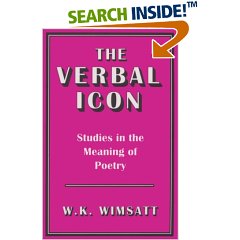
The literary object of New Critical literary study, too, was to be an autonomous. When W.K. Wimsatt and Monroe C. Beardsley wrote, in “The Intentional Fallacy,” that “poetry is a feat of style,” (The Verbal Icon 4) they were codifying a position at a far pole from any notions of the poem as, say, a moral statement, an intervention in (or product of) history, an establishment of identity, or the like. This sense of the autonomy of the poem-as-poem was central to the idea of English as an autonomous discipline, and of great importance to the rise of critics like Wimsatt and Beardsley. But the triumph of this idea, fostered by an institutional structure with which it was eminently compatible, also created, or at any rate exacerbated, schisms within the New Criticism. One of these, to which we will now turn, involved the marginalization of one poet-critic associated with the movement: Yvor Winters.
The Heretic of Paraphrase
In 1951 Randall Jarrell wrote:
Is Clarity the handmaiden of Popularity, as everybody automatically assumes? How much does it help to be immediately plain? In England today few poets are as popular as Dylan Thomas — his magical poems have corrupted a whole generation of English poets, yet he is surely one of the most obscure poets who ever lived. Or take an opposite example: the poems of the students of Yvor Winters are quite as easy to understand as those which Longfellow used to read during the Children’s Hour; yet they are about as popular as those other poems (of their own composition) which grave Alice, and laughing Allegra, And Edith with golden hair used to read to Longfellow during the Poet’s Hour. If Dylan Thomas is obscurely famous, such poets as these are clearly unknown. (18-19).
These comments, published four years later in Poetry and the Age are flippant but telling, in that they encapsulate much of the New Critical critique of Wintersian poetry and poetics. That critique, in most instances, boiled down to a preference for the interestingly obscure over the plainspoken or easily paraphrasable. While Winters, in one of his less tolerant moods, could write that “many poems cannot be paraphrased and are therefore defective” (see Von Hallberg, “Yvor Winters” 804), it would only be stretching things a little to say that the standard New Critical assessment of Winters was that his later poems were defective because they could be too readily paraphrased.
This was the basic substance of John Crowe Ransom’s quarrel with Winters, and the substance of the critique that his student, Cleanth Brooks, would level at Winters. Both Ransom and Brooks objected to the statement-oriented, paraphrasable side of Winters’ poetics, and for the same reason: Winters’ work violated the autonomous principle of poetry. Two other New Critics, W.K. Wimsatt and Monroe C. Beardsley, would also object to Winters’ work on the same grounds. The repeated rejections were strong enough to sting even the thick-skinned Winters, who remarked in 1953 that the young Turks of Ivy League thought of him as “lower than the carpet” (Hall 224).
Ransom explicity objects to Winters’ heteronomous principles of poetry — his subordination of formal concerns to moral concerns — in the 1941 volume that became the namesake of a movement, The New Criticism. Here he maintains that “Winters believes that ethical interest is the only poetic interest” (214). This is a problem, Ransom argues, because it looks to poetry for reasons other than “poetical interest” itself (that is, the autonomous principle of poetry):
Now I suppose [Winters] would not disparage the integrity of a science like mathematics, or physics, by saying that it offers discourse whose intention is some sort of moral perfectionism. It is motivated by an interest in mathematics, or in physics. But if mathematics is for mathematical interest, why is not poetry for poetical interest? A true-blue critic like Eliot would certainly say that it is, though he would be unwilling to explain what he meant. I think I know why all critics do not answer as Eliot would: because criticism, a dilettante and ambiguous study, has not produced the terms in which poetic interest can be stated. Consequently Winters is obliged to think that mathematics is for mathematical interest — or so I suppose he thinks — but that poetry, in order that there may be an interest, must be for ethical interest. And why ethical? Looking around among the stereotyped sorts of interest, he discovers, very likely, that ethical interest is as frequent in poetry any other one. (214).
The passage reverberates with the energies that were to bring the New Criticism to power in the universities: the science-based emphasis on a division of knowledge into discrete, autonomous fields; the condemnation of “dilettante” critics; the call for an articulation of “terms in which poetic interest can be stated” (terms, one imagines, like irony, balance, and unity — terms that stress complex structure over moral statement). Ransom takes a position that will advance New Criticism to the center of academic and literary authority. A great deal, in fact, depends upon his ability to establish the autonomous principle of literature: “there’s a big stroke possible for a small group that knows what it wants in giving [professors of English] ideas and definitions,” as Ransom wrote to Tate four years earlier. Winters, in this process, serves as a foil: he is the poet-critic who fails to grasp the autonomous principle; the representative of an outmoded, heteronomous aesthetic.
Winters, never one to let a criticism of his own work go unanswered in print, objected to Ransom’s criticism in his scathing essay “John Crow Ransom, or Thunder without God” from The Anatomy of Nonsense. Here, he claims quite rightly that Ransom has a truncated notion of Winters’ moralism, which was never as simple a matter as demanding that a poem make an overt moral statement. Instead, the poet’s responsibility is to co-ordinate rational statements about the world with the emotional connotations appropriate to those statements (In Defense of Reason 502-507). Nevertheless, Winters still maintains that the subject matter of poetry is inevitably human experience and that “it can therefore be understood only in moral terms” (506). That is, “the act of the poet” should always be “an act of moral judgment” (503). The poet, in this view, is ultimately responsible to morality, rather than to internal or formal “poetic interest” alone. This is a profoundly heteronomous idea of literature, and it is heteronomy itself, rather than any particular definition of morality, to which Ransom objects.
Brooks’ major contribution to the anti-Wintersian argument comes in the middle section of his famous essay of 1947, “The Heresy of Paraphrase,” where Inquisitor Brooks fingers Winters as the leading heretic. Like Ransom, Brooks objects to Winters’ emphasis on statement on the grounds that it violates the autonomous nature of literature. “Mr. Winters’ position will furnish perhaps the most respectable example of the paraphrastic heresy,” intones the Inquisitor, naming Winters as a heretic because “he assigns primacy to the ‘rational meaning’ of the poem” (963). This is a violation of the autonomous principle of poetry because “to refer the structure of the poem to what is finally a paraphrase of the poem is to refer it to something outside of the poem” (964). For true believers free from heteronomous heresies, poems are to be judged in terms of structure and “internal order” (964) only. In addition, Winters’ is condemned for conceiving of the language of poetry as continuous with the language of “science or philosophy or theology” (964). Brooks, like Ransom, holds to the dogma that poetry is a special kind of language, and so is unsympathetic to Winters’ idea that poetry does not differ in essence from prose. While no dunking stools were available for use on heretics academy, the most powerful weapon available was deployed against the heretic Winters: he was derided, and worse, ignored.
One of last major attacks on Winters — or perhaps we should say, one of the last moments when Winters’ work is taken seriously enough by a New Critic to merit sustained attack — comes in W.K. Wimsatt’s 1954 study The Verbal Icon. Even here much of the material devoted to Winters comes in a which Wimsatt co-wrote with Monroe C. Beardsley in 1946. In addition to making light of Winters’ concerns about improperly motivated emotion, they repeat the standard New Critical case against Wintersian poetics when they say they will not embrace “the extreme doctrine of Winters, that if a poem cannot be paraphrased it is a poor poem” (35). While they are willing to use some of the ideas about the emotive qualities of poetry, they share neither Winters’ sense of the dangers of unmotivated or spontaneous emotion, nor his sense of the poem as statement. He is, for them, largely passé.
For critics like Ransom, Brooks, Wimsatt and Beadsley, the poems most favored were “obscurely famous,” centered on formal concerns, and consecrated because of those concerns. Had the Robert Lowell of Lord Weary’s Castle not been born, the New Critics would have had to invent him in a secret laboratory beneath Kenyon College’s biology building. But the poems of Yvor Winters, like those of his unnamed students in Jarrell’s Poetry and the Age, were “clearly unknown.” It was their clarity, in fact, that kept them that way. And it was his insistence on such clarity, and on a heteronomous poetic, that made him marginal in an movement that was riding high on the American university’s autonomous imperatives.
Works Cited
Bledstein, Burton J. The Culture of Professionalism: The Middle Class and the Development of Higher Education in America. New York: Norton, 1978.
Bush, Douglas. “The New Criticism: Some Old-Fashioned Queries.” PMLA 64 Supplement Part 2 (March 1949): 18-21.
Brooks, Cleanth. “The Formalist Critic.” Kenyon Review 13 (1951): 72-81.
Brooks, Cleanth. “The Heresy of Paraphrase.” Critical Theory Since Plato. Revised Edition. Ed. Hazard Adams. New York: Harcourt Brace Jovanovich, 1992:961-968.
Brooks, Cleanth. The Well-Wrought Urn: Studies in the Structure of Poetry. New York: Dobson, 1968.
Crane, R.S. The Idea of the Humanities, vol. 2. Chicago: University of Chicago Press: 1967.
Graff, Gerald. Professing Literature: An Institutional History. Chicago: University of Chicago Press, 1989.
Hall, Donald. “Rocks and Whirlpools: Archibald MacLeish and Yvor Winters.” Paris Review 121 (1991): 211-251.
Jarrell, Randall. “The Morality of Mr. Winters.” Kenyon Review 1 (1939): 211-15
Jarrell, Randall. Poetry and the Age. London: Faber and Faber, 1955.
Ransom, John Crowe. “Criticism, Inc.” Westport, Connecticut: Greenwood, 1979.
Ransom, John Crowe, The New Criticism. Norfolk, Connecticut: New Directions, 1941.
Richter , David, ed.. The Critical Tradition: Classic Texts and Contemporary Trends. New York: Bedford/St. Martin’s, 1989.
Von Hallberg, Robert. “Yvor Winters.” American Writers: A Collection of Literary Biographies. Supplement Two, Part Two. Ed. A. Walton Litz. New York: Scribner’s, 1981: 785-816.
Wimsatt, W.K., and Monroe C. Beardsley. The Verbal Icon: Studies in the Meaning of Poetry. Lexington, Kentucky: University of Kentucky Press, 1967.
Winters, Yvor. In Defense of Reason. Denver, Colorado: Swallow, 1947.
Young, Thomas Daniel. John Crowe Ransom: An Annotated Bibliography. New York: Garland, 1982.