Showing posts with label politics. Show all posts

Sunday, August 03, 2014

Israel Has Already Lost: American Public Opinion and the Conflict in Gaza


A few years ago, I was at my local Democratic Party ward captain's house, listening to a congressional hopeful give a speech to rally the troops in preparation for the coming primary election.  When question period came, someone asked about his position on Israel, and he said that the Israeli administration had his full support. Such support was not controversial, he continued—indeed, it was not, and shouldn't be, a partisan issue in Washington.  Support was solid on both sides of the aisle.

There are many measures by which it is still true that American support for Israel is bipartisan.  Both the House and the Senate recently passed resolutions, with virtually no dissent from either party, supporting Israel in the current conflict in Gaza, and such support is not merely rhetorical: approval for emergency funding for Israeli military systems has also passed with strong bipartisan support. But the actions of the American political class no longer reflect the reality of public opinion as well as they once did.  Public opinion has begun to divide, and the division has followed both generational and party lines.

Consider the following graph, with information from a recent Gallup poll (I reproduce it from an article in The Economist):


The news is in the numbers. Younger Americans are, rightly or wrongly, critical of the actions of the Israeli administration.  And only Republicans strongly support Israel in the Gazan conflict. They do so by a considerable margin, but Democrats and Independents tend to take the opposite view.  

The American political system will probably not reflect these shifts in opinion immediately, nor strongly.  Indeed, the likely Democratic nominee, Hillary Clinton, recently made her commitment to the Israeli administration very clear.  But it is significant that she did so on Jon Stewart's Daily Show, where she had to chide the host, whose criticisms of Israel played well with his youngish, heavily liberal audience.

It is plausible that the end of the conflict in Gaza will lead to a restoration of some support for Israel, and even of Netanyahu, outside the Republican party.  But it is also quite likely that one result of this war will be a slow shift away from the model of unwavering bipartisan support for Israel.  For young people in particular, opinion is less a matter of automatic and overwhelming support for Israel, and this will likely make for a different future for American-Israeli relations. Given how much Israel still depends on American financial, military, and political support, this shift will matter for Israel, probably more than any military victory on the ground in Gaza does. Indeed, it makes military victory pyrrhic.

Regardless of how one feels about the events in Gaza, there is a sense in which Netanyahu's administration has already lost this war.  

Sunday, April 18, 2010

We Interrupt this Blog for a Moment of Political Outrage


Bewildered by what happened on Wall Street? Furrow that brow no more. The Samizdat Blog financial research team has figured it all out. It's like this:

If General Motors behaved like Goldman Sachs, they'd make their money by taking out life insurance policies that paid off when drivers of Chevrolets died. Then, noticing that they'd make more money if more people died, they'd start building cars without brakes.

Seriously. This is exactly what credit-default swaps were like. Wall Streeters sold bundles of bad mortgages to pension funds and other investors, knowing these were bad. Then (this is the credit default swap) they bet that these bundles of crap would fail. They made money, and everyone else (the people who couldn't pay the mortgages they'd been suckered into, the people who rely on their pensions being there, etc.) lost.

Somebody's got to go to jail for this.

Saturday, November 21, 2009

Modern Jacobins: What Elite? What People?


“The movement conservatives of our time seem the heirs of the French rather than the American Revolution.”
       —Sam Tanenhaus, The Death of Conservatism


We’ve become used to it, over the past year, this spectacle of The People Enraged. Red-faced or tear-streaked, they shouted down their elected representatives in town hall meetings across the nation. Flags and homemade banners waving, they stomped angrily through D.C., denouncing the treachery not only of the government but of the very media that exaggerated the protesters’ numbers and kept them at the center of public debate. It isn’t just the current political administration and the government apparatus that The People Enraged denounce, either: they consign government and media elites to the same circle of hell where they would hurl academic elites, scientific elites, and experts of all kinds. The spectacle in front of us is one in which the outraged populace rebels against the legitimacy of authority. That their most beloved representative, Sarah Palin, is reviled by these elites for her ignorance, her lack of curiosity, her inattention to rigor in thought or fact in argument, merely increases the fervor of their support. Palin’s legitimacy comes not from the respect of these elites: it comes from embodying, or seeming to embody, the ethos of The People Enraged.

Sam Tanenhaus, editor of The New York Times Book Review as well as that paper’s “Week in Review” section, certainly qualifies as a card-carrying member of the media elite, and it is small wonder that, in his book The Death of Conservatism, he looks with some alarm on the spectacle of public outrage. While the enragés tend to wrap themselves in the trappings of conservatism and American patriotism, Tanenhaus sees their true ancestors elsewhere, in French radicalism. For him, The People Enraged are modern Jacobins. There is a profound sense in which he is entirely correct: like the Jacobins, The People Enraged seek to delegitimate powerful elites in the name of the people. But there is another sense in which Tanenhaus’ claim is misleading. When we look at just what is being challenged in the name of the people, and just who invokes the idea of the people to make the challenge, we find we are dealing not with Jacobins but with something else entirely.

The wave of radicalism that washed over Europe in the last decades of the eighteenth century and the early decades of the nineteenth century drenched the continent in a rhetoric of popular legitimacy. The radicals of the time looked on the old regime, with its privileges reserved for heads that wore crowns or bishop’s mitres, and scoffed at the philosophical and theological underpinnings of the old versions of authority. Against the supposedly divine source of the sovereign rights of popes, emperors, bishops, and kings, the radicals invoked a new source of legitimacy: the people themselves. And just who were the people? The English man of letters William Hazlitt gives a sense of what his fellow Jacobin-inspired radicals meant in the opening paragraph of his 1818 essay “What is The People?”:

And who are you that ask the question? One of the people. And yet you would be something! Then you would not have the People nothing. For what is the People? Millions of men, like you, with hearts beating in the bosoms, with thoughts stirring in their minds, with the blood circulating in their veins, with wants and appetites, and passions and anxious cares, and busy purposes and affections for others and a respect for themselves and a desire for happiness, and a right to freedom, and a will to be free. And yet you would tear out this mighty heart of a nation, and lay it bare and bleeding at the foot of despotism: you would stay the mind of a country to fill up the dreary aching void with the old, obscene, driveling prejudices of superstition and tyranny: you would tread out the eye of Liberty (the light of nations) like ‘a vile jelly,’ that mankind may be led about darkling to its endless drudgery, like the Hebrew Sampson (shorn of his strength and blind), by his insulting taskmasters: you would make the throne everything, and the people nothing, to be yourself a very slave, a reptile, a creeping, cringing sycophant, a court favorite, a pander to Legitimacy…


We have met The People, and they are us. And what opposes us? Entrenched privilege, hereditary despotism, and the mindset that grants unwarranted legitimacy to a hierarchical system of traditional authority. The choice in the great political struggles of the era seemed clear enough, to the radicals: we, the people, against the intellectually and morally bankrupt representatives of traditional elitism and their sycophantic lackeys.

The radical notion that sovereignty lay with the people, and equally radical notion that the intellectuals who read writers like Hazlitt were one with the people, did not go unchallenged. Consider the words of one of the master-statesman of nineteenth century European counter-revolution, the Austrian Prince von Metternich in a secret memorandum sent to Russia’s Czar Alexander in 1820. “Kings have to calculate the chances of their very existence in the immediate future,” wrote Metternich, for “passions are let loose, and league together to overthrow everything which society respects as the basis of its existence; religion, public morality, laws, customs, rights, and duties — all are attacked, confounded, overthrown, or called in question.” Metternich, though, is quick to add that revolution is not inevitable, as the great mass of the people remain indifferent to politics, and yearn only for “a repose which exists no longer, and of which even the first elements seem to be lost.”

If not the people, who, then, sought to undermine the old order? “The presumptuous man,” said Metternich, the man who would question long-established traditions of “religion, morality, legislation, economy, politics, [and] administration.” “Faith is nothing to him,” Metternich snarls, for the presumptuous new man “substitutes for it a pretended individual conviction.” For Metternich, the easy identification of intellectuals and populace united against privilege — the identification assumed by writers like Hazlitt — is a fiction. The people, far from being sovereign, are an indifferent mass, wanting only to be left alone. Agitation comes from an emerging intellectual elite that is rootless, arrogant, and without respect for the stabilizing influence of tradition.

August Comte was one of the relatively few political thinkers who transcended the debate between radicals like Hazlitt and the Jacobins, on the one side, and defenders of the old order like Metternich, on the other. Hazlitt and Metternich merely articulated political positions: Comte, the founder of Positivism and the grandfather of modern sociology, envisioned the evolving history in which these positions played a part. In doing so he saw further into the idea of “the people” and their position vis-à-vis elites than either Hazlitt or Metternich could.

Looking around at the aftermath of the French Revolution and the dawn of the Industrial Revolution, Comte came to the conclusion that society was in the process of evolving. In his 1822 Plan of the Scientific Operations Necessary for Reorganizing Society, Comte argued that society had emerged from what he called a Theological Phase, in which legitimacy had been based on a notion of God, and on authority — such as the divine right of kings or the apostolic succession that underwrote the power of the Papacy — based on notions of the divine. It had accomplished this emergence by entering what Comte called the Metaphysical Phase: the philosophical phase of revolutionary thinking in which old forms of authority were made to seem illegitimate by the idea that the people themselves, not god-sanctioned kings, were sovereign. The difference between Comte and a thinker like Hazlitt is that Comte saw the idea of the people as an abstraction, not as a reality. You can’t, after all, meet with the people, nor is it possible to reduce such a heterogeneous bunch to a single entity with a single opinion. In many ways, the idea of “the people” is an illusion. But they are a powerful illusion, capable of stripping away the aura of legitimacy surrounding the old order.

For Comte, such a stripping-away is really all that the Metaphysical Phase, with its belief in the people, can accomplish. Appeals to “the people” can tear down old authority, but aren’t a practical way to establish new authority. Even if we could assemble the people, we would still face the problem of competence in the various areas of government. “Let the mass of men become as highly instructed as possible,” says Comte, and we still have problems, because “it is evident that the greater part of the general conceptions currently received can only be accepted by them on trust and not as the result of demonstration.” The people cannot govern directly, nor can public opinion (if, in fact, it can be accurately measured) guide us in the highly technical issues of a modern, complex society. For that, we need experts: experts in economics, in the sciences, in the management of large organizations, in the administration of the law. Such people were, for Comte, the heroes of the emerging phase of civilization, the Positive Phase, in which the theological and populist forms of legitimacy are to be replaced by the legitimacy of expert knowledge. With Comte, the idea of the modern technocratic state was born.

So the Jacobins, and generations of radicals they inspired, were against traditional authority and inherited privilege of elites who grounded their authority, ultimately, in notions of god. But what of the new popular anger? Tanenhaus is right in calling them Jacobins in that they present themselves as representing the anger of the people at elites. But his analysis is inexact, because the kind of authority, and the kind of elite, to which the modern populists object is entirely different from the theologically-sanctioned authority and traditionally-established elite to which the Jacobins objected. What the modern populists object to, really, are the elites and modes of authority Comte saw as belonging to the Positive Phase of society: it is the elites of expertise that are under attack.

It is not, of course, the case that we are ruled by an elite entirely composed of experts in the various fields of human endeavor. Most power in our society resides in the hands of those who control capital: if, for example, the energy industry were controlled by experts on energy policy, we’d be working a lot harder and a lot faster at getting ourselves off the diminishing supply of environmentally unsafe fossil fuels. Clearly, vested capital interests are the most powerful faction in our elites. But there is another faction of the elite, composed of what sociologist Alvin Gouldner called “the new class”: people whose power derives not from capital but from expertise. These are the people who staff government agencies, who fill the universities, who work with nonprofit organizations, who form the ranks of the professions and, sometimes, find their way into high-level positions in some political administrations. They are often at odds with the elites of capital, seeking to curb or regulate (though not to eliminate) the otherwise unbridled power of capital. When the new populists line up behind Sarah Palin to attack the elite, it is this particular branch of the elite they have in mind. The other branch of the elite — the elite of capital, rather than the elite of expertise — is not just exempt from much of movement conservatism’s populist outrage: often, it sponsors that very outrage.

So, in the end, we do not have a new Jacobinism in which an entrenched elite is undermined by a popular movement. Rather, we have a pseudo-populism, in which resentment against one part of the elite is harnessed by a competing part of the elite. This is a far cry from Jacobin radicalism. It may well look, to paraphrase Metternich, like passions have been let loose, and league together to overthrow everything you and I (yes, fellow junior members of the elite of expertise, I’m talking about us) respect as the basis of social existence — science, tolerance, economic regulations, civil rights, and intellectual diligence. But in the end, The People Enraged who are so relentlessly pushed into our consciousness by the right-wing media are more spectacle than grassroots force. And they are as much instruments of the capital-owning elites (insurance companies, say) as they are manifestations of any program that could conceivably benefit the population at large. Which does not, of course, mean they aren't dangerous. It just means they aren't what they seem to be.

Thursday, September 03, 2009

Shamans of the G.O.P.: Health Care and Hysteria


As the tide of frothing-at-the-mouth anti-health-care-reform whack-jobs begins to recede a bit, many of us in the not-entirely-irrational community find ourselves asking questions that are, in one way or another, versions of "What the hell was that?" How, after all, could so many people have so much passionate intensity about a reform bill about which they clearly know next to nothing?

The answer, I think, lies less in the realm of ordinary political analysis, and more in the realm of anthropology. To get a sense of how the kind of mass hysteria we've seen at dozens of town-hall meetings can be conjured into existence, we need look no farther than Claude Lévi-Strauss' classic Structural Anthropology — specifically, the passage in which he explains the function of shamanism in tribal cultures.

Here, Lévi-Strauss makes a distinction between normal thinking and pathological thinking, and describes the traditional shaman’s role as a socially necessary intermediary between the two modes of thought:

In a universe which it strives to understand but whose dynamics it cannot fully control, normal thought continually seeks the meaning of things which refuse to reveal their significance. So-called pathological thought, on the other hand, overflows with emotional interpretations and overtones, in order to supplement an otherwise deficient reality….We might borrow from linguistics and say that so-called normal thought always suffers from a deficit of meaning, whereas so-called pathological thought (in at least some of its manifestations) disposes of a plethora of meaning. Through collective participation in shamanistic curing, a balance is established between these two complementary situations.


So, when we're thinking "normally," we face a world in which there's a surplus of phenomena and a lack of understood significance. We see things, we don't quite understand how they work or what explains them, and we try to fill in the blanks. We try to figure things out, and spread light into those obscure and darkened corners of the map labeled "here dragons be." When, however, we're thinking "pathologically," things go differently. We begin with a surplus of emotions — fear, say, or anger, or aggrievement — and we look for something to which we can attach those emotions. One of the more important functions of the tribal shaman, for Lévi-Strauss, is to offer an explanation of the world that A) satisfies our "normal thought" desire for an understanding of how things work, and B) that takes our free-floating "pathological thought" emotions and attaches them to a definite object.

If you're thinking this sounds a lot like the finding of scapegoats, you're on to something. Consider the situation in Germany leading up to the Second World War: a defeated and impoverished people wanted to know how they fell so low (a "normal thought" desire for an explanation); at the same time they harbored a lot of anger, resentment, and fear, the proper causes of which were complex and difficult to locate. A talented but completely unscrupulous and immoral group of politicians could go far by offering both an explanation for German defeat, and group of people upon whom to focus anger and fear. Of course those politicians did go far, coming to power while blaming Communists, Jews, Gypsies, and others for the state of affairs. That this explanation wasn't valid wasn't really relevant: it allowed people, as long as they didn't think too hard, to satisfy the desire for an explanation of things (normal thought), and it allowed them to project their anger and fear on conveniently vulnerable scapegoats (pathological thought). The propagandists of the new regime were, in effect, performing a particularly evil version of the shaman function. That they performed this shamanic function with modern media and technology contributes to the particularly uncanny combination of the technological and the atavistic that was so characteristic of the horrors of the holocaust (as Martin Amis so memorably put it, the German political powers “found the core of the reptile brain, and built an Autobahn that went there").

While the current situation differs greatly in scale and in general evilness from the German example, both represent moments when the shamanistic function comes to the fore in modern politics. I mean, think about it: there's an awful lot of free-floating anxiety out there now, in post-9/11, post-economic meltdown America, especially among some Republican constituencies, who until recently have had a harder time finding a focus for their negative emotions than Democrats have had. (The issue for Dems is easy: Bush is the bad guy. Focus of negative emotions found, explanaiton of our woes located). Where are people who don't want to blame Bush & Co. to locate their negative emotions? How are they to explain the sad state of affairs in our country? The G.O.P., and their allies in the insurance corporations, have some very sharp people handling their publicity, and they seem to have made a deliberate decision to direct people's anxieties toward a particular objects: the federal government and the idea of socialism in connection with health care. Both the federal government and socialism seem remote to most Republicans (familiarity with someone or something makes it harder to turn that person or thing into a scapegoat), and both come pre-equipped with negative connotations, connotations manufactured or magnified by decades of public relations efforts.

"Why do you feel uneasy? Why are you afraid?" ask the shamans of the G.O.P. "Because the socialists and the federal government have been out to get you! And before you know it they'll haul you before a death panel!" The fact that this is false doesn't rate: it's satisfying to both the normal and the pathological thought-processes. It doesn't have to be true: it works. Or so you might think if you're unscrupulous, and don't mind the fact that millions of people in this country go uninsured.

Frank Luntz, for my money the most powerful Republican shaman (or, in more conventional terms, "political consultant") is the great architect of this strategy. He's quite bright, and his book Words that Work: It's Not What You Say, It's What People Hear is depressingly on-point most of the time. He's the one who said, of the idea of expanding access to health care, "we have to turn this into a government takeover." It's his strategy that we see when those red-face, screaming people pop up at town-hall meetings. They're angry, they're afraid, they're insecure. And, ironically, their insecurities have been quite successfully attached to a reform bill that would, objectively, make them a hell of a lot less economically and medically insecure.

I wish I knew what to do about this, but really, I'm pessimistic. After all, we live in a country where scapegoating has a tradition going back to the Salem witch trials, and that in modern times has manifested in the Palmer Raids, the House Un-American Activities Committee, Reagan's talk of welfare queens, Lou Dobbs' anti-immigrant screeds, and the big scare around gay marriage. It's hard to fight this sort of thing with reason and evidence, since so much of what's involved is pathological rather than rational. And, perhaps foolishly, one hesitates to put on face-paint pick up the shamanistic rattles and snake-charms and work shamanistic strategies for one's own side. I mean, most of us just don't look good in wolfskin robes and ancestral totem masks.

**

In other news, the good people at Poetry are running a bit of a debate about my piece on the (temporary) obsolescence of the manifesto in the back pages of the current issue, with contributions by Henry Gould, Ange Mlinko, Michael Marcinkowski, as well as my own weak and fumbling response.

Saturday, December 27, 2008

Tragicomedy and the Politics of Poetry


Of all the responses I've received to "Poetry, Politics, and Leanings-Left", Mark Yakich's has been the most interesting. Mark's been kind enough to let me post it here:

I just read your essay in Poetry and you raise some important points. I think there are two that you don't mention, however, and they are the two responses (to my mind) contemporary poets favor: 1) using essentially nonfiction or oral history as witness; 2) using comedy or tragicomedy to subvert/engage the otherwise overly earnest dialogue of politics in "the world"/"society." There is the third way, the one [Joshua] Clover takes, though as you rightly point out it doesn't seem to engage in any overtly political way to the politic processes of the day, and (again to my mind) is much the same as the ole LANGUAGE poetry strategy which sought, as you know, to subvert syntax and grammar as as way of subverting the hegemony in the culture at large (a project, I would argue, that sounds nice but does little on the actual political stage).

To get back to my two points. The historical example of #1 above is Reznikoff's Holocaust, or his Testimony. A recent example of #1 is Ray McDaniel's series "Convention Centers of the World" (in Saltwater Empire) in which he uses the actual language of people who were in the Convention Center and Superdome in New Orleans. In talking with Ray, he told me that this was the only way he had of engaging the events — through the witnesses. Now, I think #1 is fine and of course reasonable and worthwhile; the problem I have is that nonfiction can do more in this regard (a good report on TV's 60 Minutes, say, or a film by Spike Lee) than poetry of oral reporting. The other problem, as Primo Levi pointed out, is that the only true witness is the dead witness — the ones who survive are one step removed from witnessing the horror of a tragedy. Levi takes an extreme position, one might argue, but he did live through a concentration camp, so who's going to argue with him?

To my main point: I believe that #2 above is an area that contemporary poets have largely failed to explore and exploit. Comedy and tragicomedy (as in Waiting for Godot, Slaughterhouse Five, Life is Beautiful, etc.) is doable in poetry, not just in film or fiction or stage). Again for me, outside of documentaries, I've always been most moved by tragicomic works, ever since first seeing Groucho Marx in Duck Soup and reading Slaughterhouse Five. There are a few poets who have worked in this vein, though they mostly get tossed off into some kind of "surrealistic" [sic] camp, and are mostly of the Latin American of East European variety. Tragicomedy (absurdity, if you like) in Central and Eastern Europe, as you well know, was the main strategy of subversion for decades. In the US, we didn't need as much of it of course because of our "free speech," and yet in the last eight years I feel that the only person pointing out the absurdity and engaging the politicos is Jon Stewart, with his Daily Show. This isn't news to anyone, I realize, but how come poets have been sitting around with their thumbs in their pieholes, debating "Oh, is poetry political or not? Should I or Shouldn't I? Oh, I'm so uncomfortable." For my bit, I tried in The Importance of Peeling Potatoes in Ukraine, to play the tragicomic card — perhaps a weak card to many poets or readers who take all humor to be patently unserious, but to me humor is the only thing to take seriously. In the words of Gabe Gudding, humor and comedy are not here to make you suffer better or more (as a great deal of earnest, protest, or memorial poems are meant to do) but they are to help you endure.


In other news, over at Able Muse R.S. Gwynn's crowd are having quite a discussion of my post about him. Mostly they're not too happy about what I have to say (I understand). Gwynn got in touch too, first threatening to kick my ass at the AWP (I'd mentioned that, given the content of the post, he more-or-less had the right to take a swing at me), and then letting on that he was joking about the impending ass-whupping, saying that he had enjoyed the discussion. A hell of a good sport, really.

Saturday, September 13, 2008

Republican Motives


So check this out:

What makes people vote Republican? Why in particular do working class and rural Americans usually vote for pro-business Republicans when their economic interests would seem better served by Democratic policies? We psychologists have been examining the origins of ideology ever since Hitler sent us Germany's best psychologists, and we long ago reported that strict parenting and a variety of personal insecurities work together to turn people against liberalism, diversity, and progress. But now that we can map the brains, genes, and unconscious attitudes of conservatives, we have refined our diagnosis: conservatism is a partially heritable personality trait that predisposes some people to be cognitively inflexible, fond of hierarchy, and inordinately afraid of uncertainty, change, and death. People vote Republican because Republicans offer "moral clarity"—a simple vision of good and evil that activates deep seated fears in much of the electorate. Democrats, in contrast, appeal to reason with their long-winded explorations of policy options for a complex world.
....
Our diagnosis explains away Republican successes while convincing us and our fellow liberals that we hold the moral high ground. Our diagnosis tells us that we have nothing to learn from other ideologies, and it blinds us to what I think is one of the main reasons that so many Americans voted Republican over the last 30 years: they honestly prefer the Republican vision of a moral order to the one offered by Democrats.


Okay. Right. So these are some of the opening words of Jonathan Haidt's article "What Makes People Vote Republican" over at Edge.org. He does a pretty good job of briskly summarizing much of the recent work on right-wing Americans and their ideology (there's a lot of good work by Bob Altemeyer, who revisits Adorno's Authoritarian Personality; by John Dean, who used to work for Nixon, the president who really got the authoritarian politics of resentment rolling; by Thomas Frank of What's the Matter with Kansas; by Chris Hedges, who wrote American Fascists; and by a host of others). Haidt seems like a bright, well-meaning guy. But this opening bit of his drives me crazy. There's a real error here, a false dichotomy so naive I hope it's just a mistake, a matter of bad writing. It's this: Haidt tells us that we can't explain the right-wing's views with reference to social psychology because those views are honestly held. This is preposterous: often, we hold our views most sincerely, and uphold our preferences most honestly, precisely because we are psychologically motivated.

Of course the views of the left are as psychologically and socially motivated as the views of the right, so it doesn't follow, as Haidt says, that the linking of right-wing thinking to such motives gives the left the moral high ground. Unless you define the moral high ground as a place of tolerance, individualism, and curiosity. And the most interesting and challenging part of Haidt's article comes when he asks whether we should really look to individualism and tolerance and curiosity and the like as the primary virtues. Noting that "the moral domain varies across cultures," Haidt asks whether group solidarity shouldn't also play a role, as it does in so many societies. He cites Emile Durkheim, whose work I've admired, but read only in part. If I remember correctly, though, the kind of group solidarity Durkheim describes depends upon the constitution of an ingroup by definition against a despised and demonized outgroup. This may be a good way to maintain social order in relatively homogenous groups who don't actually have much contact with people unlike themselves. It may also work when an isolated group is being exploited by powerful outsiders. I'm thinking, here, about something James Wright once wrote about the great Peruvian poet César Vallejo's upbringing in small mining town: "His home town was small and provincial," says Wright, "with an ancient and living tradition of large, affectionate families who were of necessity mobilized, as it were, against the physical and spiritual onslaughts of death in its ancient and modern forms: disease, undernourishment, and cold on one hand; the officials of the tungsten mines on the other..." I mean, I can certainly understand how the whole defense-of-the-ingroup vs. the hated outsiders thing would come about in a situation like this one. But — given that "the moral domain varies across cultures" — you've got to wonder about firm ingroup loyalty/outgroup hatred as an ethic for modern and postmodern societies, which are diverse, large, mobile, and in constant contact with other groups around the world.

I remember my own contact with the whole ingroup-vs-outgroup ethic, back when the neocons where just starting to ramp up their let's-go-to-war talk back in '02. I was on a committee at the college where I teach, a committee where representatives from all the college constituencies (faculty, students, staff, etc.) could discuss general topics. Someone asked whether we should in some way address the coming conflict. A faculty member suggested we should bring some Iraqi intellectuals to campus to get their view of things (from what I've read and heard from Iraqi intellectuals since then, I imagine we would have heard that Saddam Hussein was a very bad man with a very bad regime, and that invasion would lead to chaos). While this was being proposed, I saw a member of the coaching staff, who has since moved on to greener pastures, first furrow his brow, then set his jaw in stony determination. I don't recall him saying much else in that committee, but I vividly remember him getting up after the prof had finished, and saying "Why bring their side in? Why not bring in a vet of the Gulf War!" It puzzled me at first: the only Gulf War vet I know had told me he thought an invasion was a bad idea, and that Colin Powell had been right in stopping the first Gulf War from expanding beyond the liberation of Kuwait. But the more I mulled it over, the more it became clear to me: for the coach, we weren't proposing to get a full view of all sides of an issue — we were inviting the other team into our locker room. We were supporting the enemy. Liberal types valued the idea of critical discourse and individual judgement, but guys like this coach valued ingroup loyalty. To question, or even examine, national policy critically would be like refusing to execute the play the quarterback had called — it just didn't make sense.

The coach's mindset makes sense in a football game. I imagine it even makes sense in a lot of historical situations — but it strikes me as an older ethos that causes more harm than good in the diverse, globalized society we live in now. Ingroup feeling is still strong, and can be mobilized politically (to speak only of America, we can see examples in the McCarthy-era witchhunts, in the demonizing of gay people in the "defense of marriage" movement, or in the it-was-okay-when-my-ancestors-came-but-now-it's-different anti-immigrant hysteria we see from time to time). But it's a dangerous sentiment to exploit. I mean, I like football as much as the next guy with three degrees from Notre Dame, but life is more complicated than fourth-and-long.

Wednesday, September 03, 2008

Nietzsche Sounds Off on Barack Obama


It might have been the three bottles of Tsingtao, it might have been the extra-spicy shrimp chow fun, it might have been all those hours eyeballing the cable coverage of the Democratic National Convention while surfing the blogosphere for amateur punditry. Odds are they all played into the dream that came to me a few days ago as I slouched over my laptop in a living room lit only by the blue glow of small-hours MSNBC. And an oddly highbrow dream it was: the figures who habitually make appearances in my dreams tend to range across a spectrum the low end of which is my junior-high science teacher, demanding the carbon count of a benzene ring, and the high end of which is Jane Fonda as Barbarella, demanding something altogether different. But this time the dream-presence was an intense little man whose enormous moustache bristled with general defiance. I knew him immediately from the cover of a dog-eared college paperback still on my shelf: Friedrich Nietzche.

“It’s like this,” he began, jabbing toward my chest with the stub of his cigar. “Your man Obama has a problem. Half of his supporters want him to be Apollo, the other half want him to be Dionysus. He has to be both, but he could end up being neither — and then,” he paused, eyes boring into me from beneath eyebrows fit for Bigfoot, “you know... kaput!”

Before I could even unslouch myself enough brush the crumbs from my shirtfront, Nietzsche was pacing the room, flinging cigar ash at the potted ficus and occasionally picking up the chow fun carton and sniffing suspiciously. “‘Enough with the big rallies and the speeches’ says the Clinton woman — but they can’t get enough! 200,000 people in Berlin! 84,000 in Denver! This is what they yearn for, after two demoralizing terms of a Republican White House: to feel the power of their unity in a crowd, to lose their small selves there, to be a part of a movement. This is what Dionysus is all about, and Obama’s the first Democrat to understand it in years. The bond of citizen and citizen is forged by the magic of the Dionysian rite — and those benighted anemics who look down on Dionysus have no idea how cadaverous they seem to the rest of us. They might as well be Mike Dukakis!”

Realizing that trying to interject would be like trying to get a word in edgewise with cocaine-era Robin Williams, I shut up and let Nietzsche roll on. “So what do they want, the rally-haters? ‘Substance! substance!’ — they shout it from behind the wheels of their hybrid cars. After eight years of the dimwit Bush’s administration, they want the piercing, analytic gaze of rational Apollo. They want reason, specific plans, policy that comes from expertise, not gut-feeling. And Obama gives it to them: he gives them page after page of...” (here Nietzsche wrinkled his brow, and grasped in the air with both hands after the right word) “... page after page of wonkery, I believe you say. But what comes of this? ‘Elitist! Egghead!’ scream his enemies. ‘Too Harvard,’ says one, ‘inept bowler!’ says another. They won’t admit it, but even his supporters worry about this. The teeming crowds at his rallies? They want a left-wing Reagan, not a new Adlai Stevenson.

“Now,” he continued, underlining each word with a poke in my chest from his burnt-out cigar, “what — is — to — be — done?” I started to mumble something about swing states and swift-boating, but the man snorted with contempt. “Details! Bah! For untermenschen! Think big! What is the greatest achievement of civilization?” My mind quickly raced: was it chow fun? blogs? No, not blogs. Maybe Barbarella... “Greek tragedy!” shouted Nietzsche. “And why? Why has this pinnacle of art stood above us for centuries in lofty grandeur? Ah! Because they knew, the Greeks, that the greatest, most enduring appeal comes from the fusion of Apollo and Dionysus! Thought alone is nothing. And mere spectacle without reason is worse. But together — ah, together...” He seemed to swoon for a moment, before snapping back to attention. “Well, if Obama can keep Apollo and Dionysus together, the election is his. The election? No, the nation! The age! From his mountain swift-stepping Zarathustra descends, and...”

“But what about McCain?” I asked, mustering my courage. “Doesn’t he have something to prove, too? I mean, he doesn’t really rate as an Apollonian candidate of reason, does he? Not if he can’t tell his sunnis from his shia. And he’s never been able to give the religious conservatives the Dionysian thrill they so deeply desire. When his handlers put him in front of one of those mega-church audiences you can actually see him recoil and, you know, die a little.”

“Oh, him,” Nietzsche replied. “He isn’t particularly good at being Apollo or Dionysus. Sure. But as long as the media keeps spinning this election as a referendum on Obama, he doesn’t have to be much of anything. The less we think about him, the more likely it is he’ll win.”

I had more to ask the agitated old philosopher, but with a start I found myself in the morning sun as it shone on the empty bottles and food cartons. I was awake, groggy, and blinking in the wake of what had started to seem like a nightmare.

Tuesday, February 05, 2008

Illinois Primary Voting Irregularities: Argh!


So here's a press release from the Illinois Green Party, which won 10.4% of the vote in the 2006 gubernatorial election, and the right to be treated on par with the Republican and Democratic Parties. Sadly, this right has been denied, as I found out today at my polling place, where I was told on multiple occasions by multiple officials that there were no Green ballots on offer (that's precinct 218, Moraine Township, the Edgewater School polling place). When I insisted, and told them they were in violation of the law, they finally found one for me, but they hadn't offered them to anyone all day. Oy.

GREEN PARTY FIELDS NUMEROUS REPORTS OF VOTING IRREGULARITIES IN CHICAGO, ELSEWHERE

Voters who hoped to participate in the Illinois' first ever statewide Green Party primary are receiving a very rude reception at many polling places, especially in Chicago.

In the early hours of voting, Green Party officials began receiving reports from frustrated voters across the state who, in many cases, had been told by pollworkers that there are no Green Party ballots available at their polling places, or that they had to vote on suspect electronic voting machines, even while other parties use paper ballots.

Some of the most outrageous incidents, however, occurred across the wards of Chicago, where Green Party ballots have been apparently tampered with so they can't be read and accepted by voting machines, voters are given Democratic ballots despite requesting Green ballots.

Check ilgp.org for more reports as they are received. More information will also be available at the Green Party gathering tonight at Decima Musa Restaurant, 1901 S. Loomis, Chicago (in Pilsen).


If you're in Illinois and weren't offered a Green ballot along with the Republican and Democratic ballots, shoot a note off to election-problems@ilgp.org — even if you hadn't planned to vote for the Greens, the officials were required to offer the ballot, and in bringing violations to public attention you'll be helping everyone who thinks the two-party system has failed us.

Okay. Enough with the Righteous Indignation (for now). I think I need a scotch.

Wednesday, July 04, 2007

Fourth of July


Hot damn! The fourth of July! Life, liberty, and the pursuit of high cholesterol snack foods! But before I run outside to awaken my neighbors with an early morning barrage of quasi-legal Chinese fireworks, I thought I'd put my tenured shoulder to the wheel and push a little for the kind of democratic sentiment for which this country is meant to stand.

So here's the thing. The fourteenth amendment to the Constitution (the one that guarantees due process and equal protection) is looking about as besmirched as my Uncle Eddie's post-barbeque napkin. You know the drill at least as well as I do: Guantanamo Bay, the shredding of habeus corpus, and all the rest of it. But there's one relatively small infraction of that amendment that irks me today, given how it came to light of the eve of what should be a celebration of democracy.

What's this infraction that sticks in my throat like a splintered corndog stick, you ask? It's this. When the Supreme Court appointed Bush president in 2000, they did so in large part through the invocation of the fourteenth amendment's "equal protection" clause. For reasons still a bit murky, they felt that a recount of ballots in Florida wouldn't be fair to Bush, that it would violate his right to equal protection under the law. So you'd think equal protection would mean something to Bush. But when he commuted Scooter Libby's sentence, giving Libby clemency and claiming that he felt the punishment was too harsh, you had to wonder: was this equal protection? Did the 3,000 other citizens seeking clemency get the same consideration? When asked about this, White House Press Secretary Tony Snow said he "didn't know," which is, of course, a lie. We all know that people who aren't cronies of the president don't get equal protection under the law in the current administration.

Anyway. Here's something worth a look before running out to throw firecrackers into the potato salad (click for a larger view):

Wednesday, March 14, 2007

We Interrupt this Broadcast for a Bulletin from Ancient Sparta


So there I was, at the age of ten or eleven, sitting on the floor of my parents' weekend place in the Canadian wilderness. I had a perfectly functional tree fort outside, I had a canoe and fishing gear at my disposal. These being delightfully unenlightened years, I had an air rifle in my arsenal. I had a couple of Cree Indian kids as friends, causing much envy among my city pals, who imagined me in mocassins, creeping like a miniature Hiawatha through the underbrush. There was even an abandoned gold mine nearby, entirely verboten but easily accessible if you knew where to squeeze through the fence. But was I going to take advantage of any of these things? Not a chance, ace. I had a brand new book of world history, and I wanted to see if its illustrations of the battle of Thermopylae were going to be as mad-ass, awe-inspiringly cool as those of my other big book of world history, a book I'd pretty much destroyed through excessive and overzealous reading and rereading.

I say this to establish my credibility as an ancient history geek of many, many years standing. This goes deep with me, muchachos, deep.

So I know what you're thinking. You're thinking I'm going to rain on the big, fabulous, over the top parade that is 300, the new movie about Leonidas and his 300 Spartans at the battle of Thermopylae. You're thinking I'm going to list a thousand historical innacuracies of interest to no one but the most dire literalist. But seriously: I don't mind most of the liberties the filmmakers took with the story. You want to ditch the armor to go all-out with the chiselled Spartan abs? No problem. You want to make Xerxes into an actual giant? Sure, why not. Go nuts. No harm no foul. You want to cash in on Warholian Minute 14 of the whole body-piercing thing and make the Persian leaders look like they got drunk in the West Village on a Friday night and woke up looking like punked-out pin cushions? Hey, I'm down with it. I mean, you've gotta make the Persians look exotic, as they would have to the Greeks. (Of course the Persians looked exotic to the Greeks in no small measure due to their curious and foreign habit of wearing pants, but that's just not going to look weird to the avergae chino-wearing soccer dad at the multiplex, so the whole piercings-for-pants substitution can be seen as a legitimate act of translation).

What gets all up in my ancient-history-lovin' grill is this: the movie lies about the nature of Spartan society in ways that come too close to the kind of lies we hear about our own country in contemporary America. I just can't get past this in the name of fun & games the way I can get past Giant Xerxes or the Abdominizer Army. Let me explain.

You might wonder why a military powerhouse like Sparta could only field a paltry 300 soldiers. With so much at stake, why would the Spartans send the equivalent of about two infantry companies? There's a movie answer, and there's a real answer, and between the two lies a giant gulf.

The movie answer is this: the Persians bribed Greek priests in order to get the Oracle to say that the no army should be sent during the sacred Karneia festival. Despite these weak-willed, treacherous, peacenik enemies-at-home, 300 heroic Spartans are willing to defy the Oracle and Fight the Good Fight for Freedom.

The historical answer is this: Sparta was a brutal slave-state, and the ruling warrior class was in more-or-less constant fear that the Helot slave-class would rebel and win their freedom. Sparta couldn't spare many troops, becuase their own society was fraught with inequity.

So the movie masks a real class struggle and national disunity with — well, with what? With unthinking nationalism, and repeated (and unintentonally ironic) cries of "freedom!"

You, there, with the Dell laptop — I can hear you mumbling "You can handle a giant Xerxes, but you can't handle this?"

Yeah, I suppose that's true. I guess it's because I don't live in a country with a heavily pierced giant as president (which, you've got to admit, would probaby be an improvement). The things that bother us — unthinking nationalism, a complex, tragic war justified with too-simple shouts of "freedom" — have to be closer to home.

Friday, December 22, 2006

Not a Good Sign


So we now live in a country where this happens. One could say something about the irony of an administration that says it fights against those who "hate freedom" turning around and censoring the news. One could point out how this latest action is of a piece with the creeping authoritarianism of an administration that has gutted habeas corpus, sanctioned torture, run secret prisons, and continually lied to a public for which it clearly has contempt. One could point out how censorship of the press is perfectly in line with the general outlook of an administration that maintains the president is in effect above the law. One could look toward the future with trepidation.

But right now I'm too sad for any of that. This has happenend, here.

Sunday, September 03, 2006

Utopia of the Neocons: A Vision in a Dream

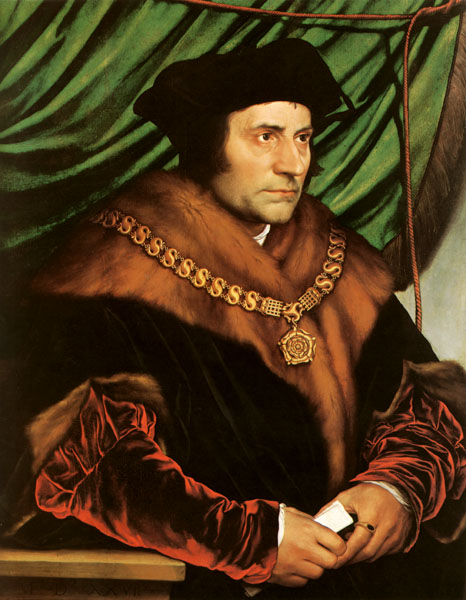
Fret not! The title of this post notwithstanding, I'm not about to lay some heavy jive on you about the dream-world of Leo Strauss and his trained monkeys. No portrait of that deeply-wounded man's ghastly ideal republic follows. Instead, I've chosen to ask Sir Thomas More, author of that great classic of Renaissance literature, Utopia, what he has to say about the political situation in which we find ourselves today.

What? How did I manage to interview the long-dead Chancellor to Henry VIII? I don't want to go into all the gory details just now, but suffice it to say that it had something to do with the lovely and talented Valerie Archambeau's absence this week. She's in Paris, being important and cool and emailing me about her frequent, expense-account driven trips to chic restaurants, while I schlep entropically on here in Chicago. Those of you who know me know what happens when Valerie's out of town, and it isn't pretty: picture the poet in his tattered terry-cloth robe up late, smoking White Owl Cigars, slugging back SoCo from a pocket flask, and obsessively gambling online and you'll get a picture of my spiritual, if not exactly my literal, state of being. So anyway, long story short, I think the slice of ancient pizza I chorfed down before drifting off in front of A Man for All Seasons may have had something a little nasty growing on it, something that allowed me to drift off into the Visionary World of Lucid Dreaming, in which I met our man, Sir Thomas More. No, really.


Anyway, after drifting off I seemed to wake in some kind of luxurious yurt or pavillion, whose tent-flap opening revealed hints of a scenery both lush and harmonious etc. From outside issued lute-notes of exquisite sweetness, and the love-yelps and giggles (no less sweet) of maidens and swains cavorting to the tambour's gentle rum-tee-tum-tum etc. Rising from my palfrey or palanquin or whatever the hell you call those renaissance daybeds, I made for the door, heedless of the impression I might make on the inhabitants beyond, clad as I was in the soiled terrycloth garmet of my temporary bachelorhood. Imagine my dismay, though, when a strong hand clutched my shoulder from behind, and a stern voice spoke out with virile clarity, saying: "Who the hell let you into my yurt?" Turning, I stood amazed: for my questioner was no other than the mighty More himself, all in ermine clad etc.

Archambeau: Uh. Right. Sorry. I'll just be leaving now, out to where the tambour-playing maidens are frolicking. Nice palanquin, by the way. Really lovely. Must be going, though.

More: Not so fast, unshaven interloper! I see by the remote control in your bathrobe pocket that you come to this Arcadia from a benighted time! No doubt the gods have sent you here to receive my coucil. Have a seat on that palinode, or on the pailing or palisade if that's more comfortable. No -- not there, cullion! The palfrey's for special company.

Archambeau: Oh, right. Special company. Well, I'll just step outside then, and see if the cavorting maidens know of a more suitable place for me to crash, then...

More: Enough! Sit, sir! I see from your glazed eyes and tousled mane, yea I see from the cheese-fry in your beard that you need guidance, that you may take it back to your people in this their troubled time. I know the very thing! Ophelia! Deliah! Juliana! Bring in the mighty tome!

In answer to More's shout, several comely lasses with tresses fair and eyes that shone with the light of suns, a dainty troupe of graces with hairs of golden-wire and the scent of sweet gillyflowers etc. traipsed in, snuggling up to More like a favorite uncle, and deposited a bejewelled folio (or perhaps it was a gold-encrusted quarto, or a bedazzling codex, I can't remember which) into his waiting hands. "Nice bathrobe," said one of the nymphs, taking my lapel in her delicate fingers before tracing them gently down my sleeve, letting the ever-so-slightly-pink-and-plump, indeed cherubic, hand linger for the slightest of most enticing moments before she traipsed out through the tentflap and into the lute-and-tambour echoing glades where the gentle doe doth nuzzle 'neath the waterfall's warm and gentle spray etc.
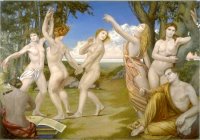


More: Quit staring at her snow-white bosom fair, you base and low-born ogling knave! We're on a mission here, already. And aren't you married?

I shuffled my feet and looked at the richly carpeted and be-tapestried floor, before mumbling a shame-faced "how'd you know?"

More: Just look at you. Unshaven, crazy-haired, wrapped in a bathrobe of unspeakable condition, with a half-eaten slice of moldy pepperoni and onion sticking out of your pocket. A single man living your life would never have reached your advanced age, good cullion, so a philosopher might well reason that you're a man of marriage, but one whose fair bride has stepped out for a few days. Long enough for you to get covered in cigar-ash, anyway. And... [he paused, to sniff the perfumed air] ... and something other than our customary myrrh and viburnum taints the air. When's the last time you showered?

Thanks be to Charles Schultze's Pigpen, patron saint of all husbands on their own for a week, he didn't press the question, but ambled over to a nearby lectern and cracked open the jewel-encrusted codex.

More: Now, let's see...

[At this point he licked his index finger and began leafy furiously backwards and forwards through the book, pausing to squint every now and then, or peer closely into the book, his nose nearly touching the vellumated sheets of the tome.]

More: Ah! The very passage! Well. Looking you over, my base and debilitatingly shaggy intruder, I see that you wear the garb of the American male in those early years of the twenty-first century. Moreover, judging by the unbearable harshness of your vowels, indeed, by the way your every word grates upon my ear with the sound of a rusty trombone being sawn in half by a particularly unskilled chimpanzee, I divine that you hail from the midwestern zone of that mighty continent. I reason, therefore, that you have been thrust into my tent to bear back urgent advice to your King George on this, his current war. Is this not so?

Before I could raise my voice in feeble protest against what seemed a dreary fate, perching on a palanquin or palinode while all the youths and maids cavorted tambour-wise in the palace of pleasant breezes visible just beyond the glade of a thousand delights outside, he continued in his booming and prophetic tones.

More: So. Here it is. Some dialogue of that great traveler Raphael Hythlodaeus, which I had the great wisdom and foresight to record in my immortal Utopia. Check it out, oh base and debased rough-clad cur. I believe your King will be grateful when you bear these honey-sweet words of steely wisdom to his fairly-curving, regal ear. Here's a good bit about the advice old Raphael would offer to the King of France, should that august lord find himself overextended and be-quagmired in a fruitless war against the dread Italians. Here the words!

He gestured grandly skyward with his right hand, continuing with as much dignity as possible considering his ministerial rings got caught up in the cloth-of-gold filigree of the ceiling tapestry. Staring me down lest I chuckle indecorously, at length he quoted from out that gilded folio's richy calligraphed and fine-limned pages etc:

Now when things are in so great a fermentation, and so many gallant men are joining councils, how to carry on the war, if so mean a man as I should stand up, and wish them to change all their councils, to let Italy alone, and stay at home, since the Kingdom of France was indeed greater than could be well governed by one man; that therefore he ought not to think of adding others to it: and if after this, I should propose to them the resolutions of the Achorians, a people that lie on the southeast of Utopia, who long ago engaged in war, in order to add to the dominions of their prince another kingdom, to which he had some pretensions by an ancient alliance. This they conquered, but found that the trouble of keeping it was equal to that by which it was gained; that the conquered people were always either in rebellion or exposed to foreign invasions, while they were obliged to be incessantly at war, either for or against them, and consequently could never disband their army; that in the meantime they were oppressed with taxes, their money went out of the kingdom, their blood was spilt for the glory of their King, without procuring the least advantage to the people, who received not the smallest benefit from it even in time of peace; while their King, distracted with the care of two kingdoms, was the less able to apply his mind to the interests of either.


Of a sudden I felt a sharp sting across my cheek: More had flung some kind of fustilarian gidget or flirt-gill at me. "Yo! Paunchy maggot-pie! Listen up!" he growled menacingly. I let drop the tent-flap I'd surreptitiously lifted, that I could gaze outward at the cavorting calves of the pale-and-pinkish nymphs and dryads, and resumed the posture of the dutiful academic listener, nodding frequently and stroking my beard in concerned thought, in the process dislodging the errant cheese-fry from where it rested. It lay on his richly-carpeted mille-fleures floorcloths like an accusation of sloth and debasement, until I kicked it beneath the palinquin. Oblivious to my subterfuge, More continued reading aloud:

When they saw this, and that there would be no end to these evils, they by joint councils made an humble address to their King, desiring him to choose which of the two kingdoms he had the greatest mind to keep, since he could not hold both; for they were too great a people to be governed by a divided king, since no man would willingly have a groom that should be in common between him and another. Upon which the good prince was forced to quit his new kingdom to one of his friends (who was not long after dethroned), and to be contented with his old one. To this I would add that after all those warlike attempts, the vast confusions, and the consumption both of treasure and of people that must follow them; perhaps upon some misfortune, they might be forced to throw up all at last; therefore it seemed much more eligible that the King should improve his ancient kingdom all he could, and make it flourish as much as possible; that he should love his people, and be beloved of them; that he should live among them, govern them gently, and let other kingdoms alone, since that which had fallen to his share was big enough, if not too big for him. Pray how do you think would such a speech as this be heard?


"So," uttered More, with immense satisfaction. That's that, then. You'll convey the message to your Lord and King, George the Mumbler?

Archambeau: You want I should tell George Bush to choose between his two kindgoms?

More: Oh, milk-livered barnacle with your tattered terrycloth! No! Infer a little, won't you? I want you to tell George Bush to move to his precious new kingdom, the one he thought so well of that he'd spill his soldiers' blood and bleed his treasury pale as a dryad's nether-thigh! Tell him to bring home his soldiers and, since the people of his new kingdom will, in his own prophetic words, greet him as their liberating savior, tell him to go there himself and rule with his characteristic moderation and wisdom. Think, man! There's a good lad.

It was then that the faintest spark lit up, short-circuit like and low-wattage, in the back depths of my mind. There, behind all of the "remember the dry cleaning" urgencies and "pack your keys, pack your keys, don't forget to pack your keys" inscriptions, a dusty box opened, a box labeled "English 211, Lake Forest College." From said box issued forth the faint memory that Raphael, the traveler who'd so regaled Sir Thomas Moore, had gone on to say that there was no point in an intellectual going public and trying to influence his king. I said as much to More, who protested that Raphael was a weak-kneed fool, and bald of pate, to boot. He, the great Thomas More, has been a great mind of his age, and an adviser to no less Invincible and Sublime a Monarch than Henry of England, the eighth to bear that stout and storied name.

"How'd that work out for you?" I asked, noting the slight crease around More's neck, the only sign left in this arcadian afterlife to indicate the nature of his untimely death by the blade of Henry's executioner. He flushed first red, then richly purple, then white and a kind of odd greenish yellow. He trembed a moment in princely rage, the force of his limbs in their restraint seeming that of a thousand stallions in goodly devise and apparel etc. Then, his rage past, he looked up, a little sheepishly.

More: Right, right, and right you are, foul-smelling dunderhead. Let us off, then, after all, and have a tumble with the tambour-playing nymphs, whose gentle bells do jangle with the sound of their most naked and unclothed and youthful frolic. He flung the tent flap wide and strode out with me in tow.

But just then, from the depth of my bathrobe's pocket, from deep beneath the pizza crust and White Owl stub, my cell phone rang. The special ring that could only indicate my wife, calling from across the sea. I woke from my vision, with much delight. Around me sprawled my own wide world, with all its delights and urgencies.

Sunday, August 20, 2006

So It's Come to This... (In Which I am Appalled)


Since you insist, well, alright: here's the letter I'm sending to The New York Times in response to Christopher Caldwell's article "The Post-8/10 World," an opinion piece that bears the chillingly non-ironic subtitle "Are You Still a Civil Liberties Absolutist?":


Are you still a civil liberties absolutist?
Are you still wild-eyed and gooned-up on the headiness of habeus corpus?
Does the quaint idea of privacy awaken your inner jihadi?
Are you still writing the truth in your diary?
Why don’t you open the door a crack, and let the nice man from the secret police look in?

Friday, March 24, 2006

The Acronym of Evil


Note: This panderometer seems to be set about a decibel too high, but it is the best I could find, what with the heavy demand these last few months. The guys at Radio Shack tell me the new, improved models won't be in until next week, which means I can pick one up when I go in to get the parts for the giant robot I'm building. The robot's going to look like Theodor Adorno. Well, like Theodor Adorno if he were thirty feet tall, had laser eyes, and the ability to crush cars with his magneto-grip (which he didn't have -- everybody knows that was Herbert Marcuse).

But what, you ask, prompted me to fire up the panderometer in the first place? An excellent question! I mean, whenever I plug that sucker in I risk blowing a fuse, especially if I do so while running the hair dryer. So I use it only under dire circumstances. But circumstances are, of late, somehwat dire.

(Consumer Warning: You know, I think I've been doing a good job of repressing my occasional urges to rant about politics here. But this latest news gets the better of me, so be forewarned: a rant follows.)

Newsweek's Howard Fineman tells us George Bush has a new story to tell, now that his old talking points are looking a little threadbare. The new White House talking points can be encapsulated, Fineman says, with a handy acroynm, WATITH -- the War Against Terrorists Inside The Homeland. And who are these enemies in the homeland? As Fineman puts it, they are "not just the terrorists themselves, but also wussie lovers of legalistic niceties that get in the way of investigations..." In this new story, it seems that those who don't toe the line and agree that Bush's law-breaking acts of surveillance on American citizens are both hunky and dorey are no better than terrorists.

Okay. Let us put aside the deep irony of a president who calls himself a lover of freedom who fights terror trying to intimidate those who would protect their constitutional freedoms. Let us concentrate on the creepiness of the tactic. Where have we heard words like this before? Where have we heard that war can be sustained in this manner? How about in the following passage:

...the people can always be brought to the bidding of the leaders. That is easy. All you have to do is tell them they are being attacked and denounce the pacifists for lack of patriotism and exposing the country to danger.


That was from an interview with Herman Goering. No, I'm not making this up. Nor am I saying that Bush is a Nazi. But it is fact, not opinion, that he's not above considering a tactic Goering embraced, nor above using it for similar ends. And we're not wrong to be appalled.

If this keeps up, I suppose I'll be seeing you all in Gitmo. But don't worry: my giant robot will set us free.