Wednesday, May 17, 2006

Text as, or vs, Experience, with a Peroration Concerning the Availability of British Experimental Poetry in the U.S.A.

Steve Halle and Joanne Chapman have an interesting dialogue about poetry, intertextuality, and obscurity going over at Seven Corners. Here's a bit from Steve's contribution that struck me as interesting:

When I started in poetry and wrote poems in the lyric/Romantic tradition, I struggled to find ways to include what I was reading and thinking, so much a part of my experience. Investigative poetics has freed/enabled/permitted me to use the source as is, so I don't have to translate something in order to use it in my own creative process.


What I find particularly interesting here is the disabling dichotomy between text and experience implicit in the post-Romantic tradition Steve's talking about. I've used the dichotomy myself sometimes -- I remember trying to talk to my students about the difference between Catherine Daly's DaDaDa and C.K. Williams' Repair by saying something like "well, his poems are based in his ordinary experience, while hers are based in textuality." I suppose I wasn't completely off base, in that the poems in Williams' book tend to be slice-of-life stuff, often autobiographical, while Daly will do things like slice and dice Spenser's "Amoretti" in her series "Adorata," or compress the plots of dozens of novels in "Mistress Plot." But the simple fact that should have been staring me in the face as I opined in the seminar room was this: reading texts is an experience. Reading Spenser is as much a part of Daly's autobiographical experience as taking a train through France is a part of Williams'. I suppose the dichtomy rests on a whole bed of unexamined and indefensible ideas about a distinction between mediated and unmediated experiences, with reading being a mediation of experience. What's that? You want proof that non-reading experiences are no less mediated than reading experiences? Okay. Look no further than the nearest Hummer H2, being driven by an actuary on his way to a time-share seminar. Look deeply into his eyes (I know it's a long way up from your battered Hyundais, oh poets, and I know you should be looking out for oncoming traffic, but this is important so bear with me, and take the risk). There -- see that strange, faraway gleam? That's the gleam of mediated experience, folks: that dude is experiencing the I-94 as an off-roadin' festival of manliness, bustin' stumps in the wilderness of his mind. Oyez. Anyway: the interesting question might not be why Daly downplays her travels and moments-with-nature, but why Williams, a well-read guy, downplays his reading experiences.

The false dichotomy between the experience of texts and other forms of experience is surprisingly pervasive in our culture. There's a whole racket out there in the vast wasteland of middlebrow contemporary educational theory devoted to this very distinction. One finds the dichotomy in discussions of poetry, too: usually in the writings of people who want to return poetry to a Romantic emphasis on the moment lived intensly in the presence of nature (I'd say "return" instead, but scare quotes were banned after the 1996 MLA -- too many repetitive stress injuries at the postmodernism panels). But you also sometimes see the dichotomy in the work of those who want to defend experimental or intertextual writing -- as in Eleana Kim's "Language Poetry: Dissident Practices and the Makings of a Movement," which holds up "deconstructive strategies" against "experiential" poetry. The irony here is this: when you buy into the distinction you've already surrendered too much ground to what I'm calling (for today) the post-Romantic tradition. Wordsworth may have bounded like a roe through the hills above Tintern Abbey, but this was no more or less experiential than Robert Duncan bounding like a roe up the stairs of Cody's Books. Dammit.

**

In other news, it seems I spoke too soon when I claimed that there was only one late 60s/early 70s era anthology of British experimental poetry, John Matthias' 23 Modern British Poets. Mark Scroggins has taken a minute off from jamming out like a crazed sasquatch on obscure stringed instruments to hail me from the confines of his thirty-story scriptorium in the swamps of Florida (where, when he's not jamming, he's busy with the deep, rich experience of sneezing over mouldering pages), and waves Michael Horovitz's 1969 anthology Children of Albion enthusiastically in the humid air. If anyone can tell me where to score a copy, let me know.
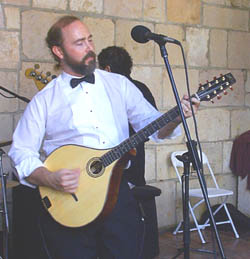
Mark also blogs away learnedly about British experimental poetry, noting that American ignorance of the stuff has a lot to do with material conditions: very little of it is readily available in the States. He's not wrong, but if you're in America and feel the urge to check it out, you can always order directly from the publishers. Salt, which puts out a lot of great stuff by British experimentalists, makes their wares available via Amazon.com, and so does Wild Honey, but some others don't. There's only one Reality Studios title available on Amazon.com, for example (Spitewater Provocations, a pamphet-length interview with Peter Riley). But you can do a bit better on Amazon.co.uk, the British Amazon, which will ship to the U.S., and is happy to accept your gringo greenbacks, reduced in value though they be by these late years of war and fiscal follies.

Thursday, May 11, 2006

Experimental British Poetry: An Open Letter to Stephen Burt

Stephen Burt, who has become ubiquitous in all print venues as a poetry critic, does all sorts of good things by way of getting the word out about developments in poetry. And I owe him one for teaching a session of my nineteenth-century Brit lit survey when he was in town last fall. So I revel in his ever-increasing visibility, and was glad to see his review of new books of poetry by Robin Robertson and Nick Laird in last Sunday's New York Times Book Review. Steve said some sharp things about both poets, but one of his opening remarks has been a bit of a stone in my shoe for the last few days. So here, by way of shaking the stone out from my sneaker, an open letter to Stephen Burt.

Dear Steve,

I was glad to see your piece in the New York Times the other day, but I can't help wondering about one of your opening remarks. You began the piece by claiming:

Americans do not read many living British poets, nor — except for international standouts like Seamus Heaney — do we see much current Irish verse. Poets who take their bearings from London or Edinburgh, Belfast or Dublin tend to depict realistic characters or places, in poems that grow from a sliver of plot or a stub of event. If these poets seem limited, that may be because we don't read enough of them. Their requirements — brevity, clarity, story — permit approaches as different as Robin Robertson's and Nick Laird's: the first stoic, generalizing and compellingly terse; the second loquacious, voluble, able to revel in details.


Spot on about Robertson and Laird! And I'm with you all the way about Americans not paying enough attention to the Brits. But this business about British poets as down-to-earth, low-key realists, giving us slices of ordinary life in clear, straightforward language -- I just don't think it's true enough to stand as a generalization. In fact, I think the persistence of this idea about British poets as post-Movement Larkinizers may be a part of the problem you're working so hard to solve. I'm with you, Steve, in your desire to spread the word about British poetry. But I think the notion that the British are formally conservative isn't just false, but an actual impediment to generating interest in British poetry on this side of the Atlantic.

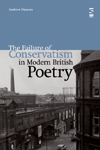
The idea of British poetry as fundamentally conservative in form (if not always in its thematic concerns) is a pervasive one, both over here and in many British circles. Andrew Duncan, in The Failure of Conservatism in Modern British Poetry, goes so far as to describe the idea as constituting a climate of received opinion, one so dominant that goes without saying in many of journals and syllabi that concern themselves with British poetry. Duncan tells us that the history of postwar British poetry, in this version of events, looks something like this:

  • 1950s: Larkin + Hill

  • 1960s: Hughes + Heaney

  • 1970s: Harrison

  • 1980s: Motion + Grace Nichols + Craig Raine + Muldoon

  • 1990s: Maxwell + Armitage


  • One might take issue with Duncan's assumption that Geoffrey Hill is formally conservative, but there's something to his view. I think most of my colleagues, when they think of British poetry since WWII, think of a history more or less like this.

    Low visibility, though, isn't the same as absence. Just because Britain has been presented as the Land that Modernism Forgot doesn't mean that modernist and postmodernist poetry haven't flourished there, beyond the charmed circle of public attention. There's a long history of British modernist poetry (David Jones, Basil Bunting, et al) and a whole range of postmodern British experimental poetry, too, from Roy Fisher, Jeremy Prynne and Tom Raworth, to Allen Fisher, Bill Griffiths and Geraldine Monk, to Caroline Bergvall, Rod Mengham and Peter Middleton, and on and on.

    There have, periodically, been attempts to dislodge the notion that British poetry is a conservative, Movement-oriented game. There was even a smaller version of America's anthology wars, in which John Matthias' 1971 book, 23 Modern British Poets was the central battleground. The anthology was edited, says Matthias in his introduction, as a wake-up call to all those whe felt that, in poetry, “‘British' means old or tired … Philip Larkin rather than Tom Raworth.” Matthias' anthology upset a few people, including Donald Davie, then one of the leading critics of British poetry, who chose to lash out at it as if it were but the most visible of a whole series of attacks on the cherished canon of Movement types:

    There are now on offer to the American reader anthologies of British poetry since 1945 [sic — there was only one such anthology, Matthias’], which claim to show that British writing over this period is as “exciting,” as little “genteel,” as what is being written in America. Of the poets I have considered, it should be plain which will be represented in such an anthology, which will be excluded from it. Let Larkin stand as an example of those who will be excluded. Yet, like it or not, Larkin is the centrally representative figure.


    It was remarks like that, I suppose (from Thomas Hardy and British Poetry), that helped to perpetuate the myth that British poets weren't experimental, (or, if they were experimental, weren't really British). That such myths die hard was shown clearly enough as late as 2001, when Keith Tuma's experimentally-inclined Oxford Anthology of Twentieth-Century British and Irish Poetry had a very divided, very heated reception. (In the interests of full disclosue, I'll own up to having been one of Oxford UP's readers for Tuma's book. I'll also own up to being published by Salt, which publishes many of the British experimentalists I've mentioned, as well as the poetry of John Matthias).

    There's much more to say about why the myth of British poetic conservatism persists, and just as much to say about a similarly pervasive myth about Irish poetry. But the question I'd like to turn to now is that of just how much damage the myth does to the presence of British poetry on the American scene. I don't know any way to quantify it, but I'm sure the idea of the Brits as conservative has put many American readers off. We live, after all, in the age of Langpo Triumphant, and in a scene where even the most stalwartly mainstream of publications has taken to pubishing poetry inflected by various forms of experimentation. The rise of Jorie Graham, a crossover/fusion figure if ever there was one, is a case in point, and the continued prominence of John Ashbery is another. American poetic tastes have turned, to some degree, toward the postmodern and experimental (albiet often in dilute or hybrid forms), and the perpetuation of the Movement idea of British poetry, with its Larkin-to-Armitage succession, won't help turn Americans on to the breadth and depth of British work in poetry.

    The American failure to appreciate British poetry in all its variousness is particularly disconcerting because some of the most vibrant British experimental poetry has something important to offer to American poetry. Romana Huk, one of the few American critics attuned to British poetry beyond the Larkin-Armitage variety, makes an acute point about this in "Between Revolutions, or Turns," her contribution to Word Play Place. She tells us that British experimental poets have been deeply interested in matters of geography and history, or what we might (if we're feeling just a bit academic) call the geo-historical location of poetic articulation. This, Huk tells us, is what separates the Brits from their peers in postwar American experimental poetry where, with a few notable exceptions, the emphasis lies more on linguistic disruption than on the locatedness of the poetic subject. “In Britain,” writes Huk, “interest in the collisions of historically influential discourses in contemporary frames occupies more time in experimental texts than does fully disjunctive assemblage of words made into material objects.” What is more, “the project of locating language rather than releasing it from particular places and speakers also might be said to differentiate British from American work.” I've ranted too much elsewhere about the need for American poets to get beyond the two dead ends of self-absorbtion and linguistic ideterminacy for me to bore you with my usual routine here. Suffice it to say that British experimental poetry's emphasis on matters beyond these may just be the cure for much of what ails us over here. But if the Movement myth persists, there's very little chance Americans will catch on.

    So, Steve, I thank you for reviewing Brit Poets in the most prominent book reviews section in the land. I can't help but think, though, that you've missed a chance to dispell a disabling myth. Then again, given your laudible ubiquity in so many jounrals and reviews, I'm sure you'll have plenty of chances to set the record straight. I'm looking forward to it!

    And I still remember that I owe you one for that class you covered last fall. Call in the favor any time.

    Warm regards,

    Bob

    Saturday, May 06, 2006

    Democracy, Sycophants, and Styles of Comedy: Madame De Stael Reads Stephen Colbert


    I know, I know, it's been a while, but ol' Archambeau's been busy, running the &NOW Festival of Innovative Art and Writing, and digging himself out from beneath the wreckage of the semester, so ease up already. But all that's behind us, and I return at last to the sunlit uplands of the blogosphere. I'm motivated, in no small part, by the fact that I'm soon going to be cashing a check from a major university that has hired me to talk about my blog, and it would all get a bit embarrassing if I chucked blogging just prior to the appearance. The gathered blog enthusiasts would render up an outcry such has not been heard since the assembled Newport folkies hurled abuse at the newly electrified Bob Dylan.

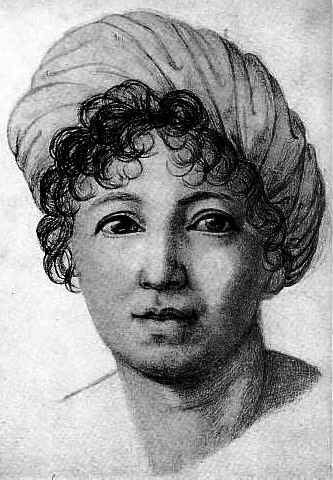
    But that's not why you stopped by. Nosiree. You wanted to know what Germaine Necker De Stael, the great French literary theorist of the late eighteenth century, would have to say about Stephen Colbert's perfomance at this year's White House Correspondent's Dinner. Have no fear, class, I'm hear to answer all your questions on the topic.

    You're all, of course, too intimately familiar with Madame De Stael's treatise of 1800, De la Littérature Considérée dans ses Rapports avec les Institutions Sociales to need any kind of recap, right? What? Really? Oh, very well. The relevant business goes like this: De Stael, having lived through the transition from the ancien regime to the French republic, took up the question of literary genres and styles from a historical vantage point, meditating on how comedy and tragedy were different under the two modes of political organization. Here's the basic breakdown:

    Under a monarchy, says De Stael, comedy tends to work through various modes of in-group affirmation and out-group exclusion. Since power is centralized, proximity to power is coveted, and conformity to the norms of the powerful is the only path to distincion, this makes a kind of cruel sense (if you attended high school, or have seen the movie Heathers you probably have some idea about this already).

    In monarchies ridicule is big, in that it re-enforces in- and out- group status (if you've seen Patrice Leconte's 1996 costume drama Ridicule, you've seen how they used to do this at Versailles back in the day). Ridicule is generally directed at those who act in ways that don't accord with their designated social station, so there's a big hierarchical element to it all. The monarchial system also encourages shibboleths, and all manner of jokes that allow the privileged insiders to revel in knowing things that the vast, unwashed hordes of peasants, fishwives, and bourgeoise undesirables don't know. In the end, Monarchial humor is all about being a sycophant in a system of concentrated power.

    Under the republic things are different, says De Stael. The most effective comedy will be that which takes aims at those who commit social ills. In such a system, the comedian is a social critic, ever on the lookout for the abuse of power. Such comedy will be very much of the moment, and may not age well -- think of Lenny Bruce killing, just killing, with material that doesn't go anywhere now. (One weird corollary of the view, I might add, is this: should all social problems be solved, there'd be nothing left to laugh at. Utopia would not be a funny place).

    So what happened when Colbert laid down some savage comic hoo-hah at the Correspondents' Dinner? I'll tell you what happened, peeps: the assembled correspondents, politicos, pundits and beltway barnacles were expecting monarchial humor, and got slapped upside the head with the comedy of a republic. Let's break it down, shall we, class?

    1. The White House Correspondents and Suchlike Insider Rabble Have Developed a Taste for Monarchial Humor

    Michael Scherer nailed this in Salon, when he wrote about how Wahington press and political types prefer, and have come to expect, "insider jokes that drop lots of names and enforce everyone's clubby self-satisfaction" such as "Did you hear the one about John Boehner at the tanning salon or Duke Cunningham playing poker at the Watergate?" It makes sense that they'd like this sort of thing, especially at their annual shindig. Even as it pretends to poke fun at them, this kind of comedy flatters their sense of insiderdom, their in-the-loop proximity to power. Give a feeling like that to a pack of journalists who spend their time chasing around the self-important stuffed shirts of Washington (you know, guys with real power), and you're doling out free doses of a powerful drug, baby.

    2. The Correspondents Expected This, But Colbert Gave Then the Comedy of a Republic

    I don't think I need to even cite examples here. But I want to, oh, how I want to. So here's one, delivered in Colbert's deadpan, fake-FoX News right-wingnutty persona:

    I stand by this man. I stand by this man because he stands for things. Not only for things, he stands on things. Things like aircraft carriers and rubble, and recently flooded city squares. And that sends a strong message that no matter what happens to America, she will always rebound with the most powerfully staged photo ops in the world.


    So okay, it was clear enough that Colbert made political wrongs, not personal foibles, the object of his humor. He did this to such an extent that some members of the affronted journalistic community have accused him of substituting partisanship for comedy. Which didn't happen, but when you're waiting to be flattered, and get skewered for your complicity with the regime, you're bound to be a bit miffed, and want to attack the comedian who flayed you on behalf of the citizenry. Of course, De Stael wouldn't be too sypathetic with the wounded journalistic egos. She'd recognize Colbert's brand of comedy as the very stuff of true patriotism.

    I suppose it is fitting for the political hangers-on of a country with an increasingly imperial presidency to expect monarchial forms of comedy. But the republic's not dead yet, folks, and yukking it up in front of the visibly steamed emperor is a good way to prove it. Vive les entarteurs!

    * * * * * * * * * *

    Oh yeah. I was informed today that, for reasons known only to themselves, the Illinois Arts Council has given me the state Literary Award. I kiddeth not. So I encourage you to celebrate wildly in the streets outside my lovely home -- it will help me slip unnoticed past the thronging papparazzi.

    Friday, March 31, 2006

    Bare or Bear?L'Affaire Fence, Chapter 194


    The new issue of Fence is out, and the old squabble about the Quinne cover on one of last year's issues continues. Editor Charles Valle is kind enough to cite my own contribution to the debate, and add it to his own reflections. Check it out, if you're still outraged about:

    A. A topless model demurely cavorting on the cover of a literary magazine.

    or

    B. People getting upset by A, above.

    The current issue, by the way, features a cartoonish representation of a bear. I for one am deeply, deeply offended by everything this implies.

    Thursday, March 30, 2006

    Archambeau World Tour, Summer 2006


    Okay, fans, you're in luck: this summer's Robert Archambeau World Tour is concentrated (so far) in the greater Chicago area, so you can catch both dates without having to put too many miles on the VW microbus you and your hippie pals had planned to use as both vehicle and residence as you followed me from town to town.

    The tour begins with a May 22 gig at the University of Chicago, as part of the Council of Advanced Studies' Poetry and Poetics Workshop Series. The talk is, at the moment, called "The Aesthetic Anxiety."

    After a brief hiatus, during which I'll be trashing hotel rooms, chasing supermodels, and dodging paparazzi, I'll emerge from my hiding place at the Chateau Marmot to speak on July 29th, at Northwestern University's Art and Craft Summer Writer's Conference, where I'll be talking about blogging on a panel with Bust magazine writer Wendy McClure and noted novelist/New Republic guy Kevin Guilfoile.

    What a long, strange trip it will be.*

    *Errata

    For "long", read "short."
    For "strange", read "somewhat placid and academic."

    Friday, March 24, 2006

    The Acronym of Evil


    Note: This panderometer seems to be set about a decibel too high, but it is the best I could find, what with the heavy demand these last few months. The guys at Radio Shack tell me the new, improved models won't be in until next week, which means I can pick one up when I go in to get the parts for the giant robot I'm building. The robot's going to look like Theodor Adorno. Well, like Theodor Adorno if he were thirty feet tall, had laser eyes, and the ability to crush cars with his magneto-grip (which he didn't have -- everybody knows that was Herbert Marcuse).

    But what, you ask, prompted me to fire up the panderometer in the first place? An excellent question! I mean, whenever I plug that sucker in I risk blowing a fuse, especially if I do so while running the hair dryer. So I use it only under dire circumstances. But circumstances are, of late, somehwat dire.

    (Consumer Warning: You know, I think I've been doing a good job of repressing my occasional urges to rant about politics here. But this latest news gets the better of me, so be forewarned: a rant follows.)

    Newsweek's Howard Fineman tells us George Bush has a new story to tell, now that his old talking points are looking a little threadbare. The new White House talking points can be encapsulated, Fineman says, with a handy acroynm, WATITH -- the War Against Terrorists Inside The Homeland. And who are these enemies in the homeland? As Fineman puts it, they are "not just the terrorists themselves, but also wussie lovers of legalistic niceties that get in the way of investigations..." In this new story, it seems that those who don't toe the line and agree that Bush's law-breaking acts of surveillance on American citizens are both hunky and dorey are no better than terrorists.

    Okay. Let us put aside the deep irony of a president who calls himself a lover of freedom who fights terror trying to intimidate those who would protect their constitutional freedoms. Let us concentrate on the creepiness of the tactic. Where have we heard words like this before? Where have we heard that war can be sustained in this manner? How about in the following passage:

    ...the people can always be brought to the bidding of the leaders. That is easy. All you have to do is tell them they are being attacked and denounce the pacifists for lack of patriotism and exposing the country to danger.


    That was from an interview with Herman Goering. No, I'm not making this up. Nor am I saying that Bush is a Nazi. But it is fact, not opinion, that he's not above considering a tactic Goering embraced, nor above using it for similar ends. And we're not wrong to be appalled.

    If this keeps up, I suppose I'll be seeing you all in Gitmo. But don't worry: my giant robot will set us free.

    Saturday, March 18, 2006

    The Schmoozie: Criteria Revealed!


    Since the Schmoozie award for most egregious self-promotion at or near the AWP was awarded a week ago (see my post of March 12), there's been a huge (okay, a moderate) outpouring of interest. Among the various emails asking me to reveal the full name of the winner, and the others guessing (mostly correctly) his full identity, there were a few asking about the criteria for the award. Since we at the Academy of Literary Conference and Festival Arts and Sciences stand for full disclosure and transparency, I here reveal the scoring system of that venerable award, The Schmoozie.

    Feel free to print up score cards to use at any MLA, MMLA, AWP, MSA, or other acronym-bearing conference. The system can also be used at poetry readings, such is its versatility.

    Minor afftonts to decency have a low point value:


    • Conspicuous nodding during a presentation: 1 point

    • Laughing loudly to prove one is in on the joke: 1 point

    • Name-tag gawking: 1 point

    • Carrying around a copy of your own book: 1 point

    • Offering to sign your book when you have not been asked to so do: 2 points


    The following phrases all have point value:

    • "Loved your book": 3 points

    • "I admire your work": 3 points

    • "I'm a big fan": 5 points


    Name dropping also has point value:

    • Naming This Year's Theorist: 2 points (note: in 2006, Franco Moretti holds the title of This Year's Theorist)

    • Referring to Helen Vendler, Marjorie Perloff, or John Ashbery by first-name only: 2 points

    • Referring to Ron Silliman by first-name only: 1 point


    Major affronts have point value appropriate to their egregiousness:

    • Hovering at the edge of a conversation where the famous have gathered: 3 points

    • Crashing a table at the hotel bar where the famous have gathered: 5 points

    • Giving your book to one of the luminous few, saying "I thought you should have one....": 10 points

    • Inviting yourself to dinner with the big dogs, when you have not been asked: 15 points

    • Inviting yourself onstage to read or speak when you are not in the program: 20 points


    Finally, there is a variable point value to be awarded for anyone who rises, after a presentation, to ask a question that is not in fact a question, but rather a rambling speech, the primary purpose of which is to hear the melodious sound of one's own voice echoing through the hallowed air of the lecture hall.


    • 1 point per sentence.


    The Academy of Literary Conference and Festival Arts and Sciences perpetually strives to improve its system of ratings, so please do not hesitate to add new categories based on observations of conference affrontery. We count on your field research!

    Robert Archambeau
    Provost and Dean of Affontery Studies
    Academy of Literary Conference and Festival Arts and Sciences

    Sunday, March 12, 2006

    Under the Pecan Trees and in the Academy

    Back from Austin, covered in glory. Or maybe that's barbecue sauce. Be that as it may, I bring you the following observations about the AWP fringes, along with an added bonus in the form of a note on the University of Chicago's recent conference on poetry criticism.

    1. There is no finer venue for a group poetry reading than the lawn behind the Bouldin Creek Coffeehouse on a warm spring evening.

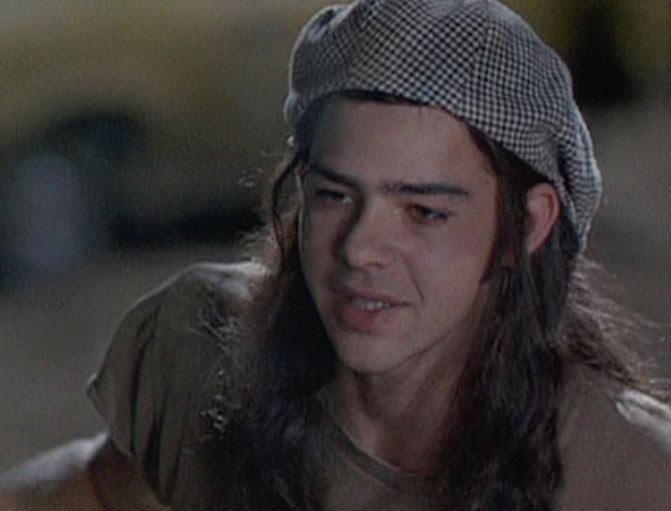
    You're guided in from the road by a fantastic neon sign featuring a reclining frog cradling a coffee cup and looking philosophically into the distance. You walk into the bar area, read the chalked-up specials, ponder for a moment whether to go with coffee or beer, then let your adoring fans put your drinks on their tab for the evening (thanks, Grant). The kid selling you your microbrew organic ale looks a lot like Rory Cochrane's character Slater in the Richard Linklater classic Dazed and Confused. You hang for a while with the poets and local scenesters, then head through a hang-out room, a big screened porch, and down a gentle slope. You stand outside at a microphone flanked by two Peavy amps and a 70s-era lamp, all beneath spreading limbs of a giant pecan tree. You turn to face the big crowd and feel like this is where you belong.

    2. The changing of the guard is always underway.

    The last time I was in the same room with Kass Fleisher, her husband Joe Amato, Maxine Chernoff and her husband Paul Hoover was in 1999, at a bar called the Cirque Divers in Liege, Belgium. We'd all been speaking at a literary conference for which Rosmarie and Keith Waldrop had been the eminences gris. At the Austin reading, though, it was Paul and Maxine who were the presiding literary couple, the locus of all gravitas. They sat together in the front row, Paul looking tall and distinguished in the American poet's black uniform, Maxine sitting sideways on her chair and emitting a sort of aura of kind benevolence. All the time I couldn't help thinking that, in an unspecified but no doubt shockingly brief-seeming span of years, I'll probably be at another such poet's hang (what's the progression after Belgian bar -- Austin coffeehouse? Nepalese used book store?), and see that Joe and Kass have become the iconic literary couple, presiding over the poets at play. Not a bad fate, really.

    3. Brett Eugene Ralph is the real deal.

    When I first saw Brett Ralph walk up to the mike in his trucker hat, biker boots, and general biker/redneck mien, I suspected he was going to be a mere garden variety prof-poet masquerading in a kind of western Kentucky drag as a way of distinguishing himself from the rest of us. But no! He's the real deal: former punk-zine editor, current poet and member of the band Rising Shotgun (which, mentioned as it is on my old pal Doug Shawhan's crackrabbit.com, must be good), and poet of the western Kentucky punk rock experience. "The Donkey," he said between poems, "always reminds me of punk. It's a docile, gentle, kindly creature, but when it opens its mouth it's just fuckin' awful..."

    4. The Chicago poetry mafia is everywhere

    Bill Allegreza, Ray Bianchi and Simone Muench were the venerable outfit's ambassadors to the reading.

    5. L'affair Fence lives on.

    I've admired Joanna Fuhrman's poems for a while, so I was glad to have a chance to talk to her after the reading, when she joined me and a few others over some of Bouldin Creek's finest tofu tacos. Fence came up, since they'd hosted a reading of their own across town. It turns out the Quinne cover still incites heated argument, in this case between an anti-Quinne faction (Joanna) and a pro-Quinne faction (me). Joanna didn't like that the image of Quinne wasn't in any meaningful way an attempt to ironize or deconstruct the kind of image of conventionally attractive women we see on so many glossy magazines. I maintained that the use of exactly this kind of undeconstructed image on a poetry magazine was a kind of shaking up of norms, precisely because we'd expect poetry magazines to have covers that are either A) blandly arty or B) deconstructive. Somewhat hyperbolically, I claimed that the publication of that cover was a kind of minor-league version of Duchamp submitting a urinal to an art exhibit that claimed it was open to anything: it exposed the limits of our alleged tolerance. Joanna and I clashed even more when she claimed the things Rebecca Wolff wrote about the cover were even more offensive than the cover itself. Joanna didn't like the idea of a poetry magazine as a commodity. I (as a guy who ran an independent magazine for a few years) maintained that magazines are all the things we want them to be (the public sphere, the area of aesthetic free play, etc.) and market commodities at the same time. (I shouldn't be surprised that this bothered Joanna: I once wrote a bit about how this idea was scandalous to our received opinions). All of this raises the question: what other poetry journal cover last year was interesting enough to cause an argument about aesthetics, the marketplace, gender and objectification?Anyway. Joanna handled my response to her attack on the paintings of John Currin as unironic objectifications of women ("that is such bullshit") with a whole lot more grace than it deserved. And I still like her poems.

    6. AWP contagion, and the heroic defense against it

    I think I'm going to invent a new award (call it The Schmoozie) for the most offensive example of literary networking and self-promotion at or near the AWP Convention. Like many people at the reading, I avoided the real convention this year, but the AWP ethos came after us, in the person of a certain fiction writer, whose full name will be disclosed only to those approaching me in person and buying the next round. This fellow spent the reading jumping up and down out of his chair to introduce himself to people. I first noticed him when a hand thrust itself between me and Joe Amato, and a voice barked "Joe? John -- loved your book." At the end of the evening he invited himself on-stage as a reader, compelling the MC to summon the dispersing crowd back to their chairs.

    But my other new award, the Medal of Meritorious Merit in the Face of Overwhelming Clouds of Self-Congratulation (anyone got a better name?) goes to Kass Fleisher, for her statement earlier in the day to the assembled heads of MFA programs. She told them she thought the AWP was too anti-intellectual, and withstood many minutes of heavy shelling afterwards. Represent, Kass!


    ADDED BONUS: A BRIEF REPORT ON "HOW TO READ, WHAT TO DO: THE FUTURE OF POETRY CRITICISM"


    Before heading down to Austin, I trekked down to Hyde Park for a few hours of a small conference on the future of poetry criticism. After munching on the entirely convincing falafel (which seems to have replaced the cracker with awful cheese as the conference food of choice), I settled down for a panel featuring Jeff Dolven's “Communities of Style,” Oren Izenberg's “We Are Reading: Collective Intentions Toward Poetry,” and Maureen McLane's “Romanticism, or, Now: Learning to Read in Postmodern.” The format of the conference is a good one, worth emulating elsewhere: papers were made available ahead of time online, so the presenters didn't have to read from them. Rather, each speaker would rise in turn to summarize another speaker's paper and pose some questions about it. This made for lively discussion among panelists and audience members. (Izenberg seems to have honed the business of dealing with slightly nutty questions into an art. "I'm afraid I don't see the force of the question" is a phrase worth remembering).

    Dolven's paper was of particular interest to me, in that it addressed the question of a poet's signature style. Dolven's interested in careful stylistic analysis, but he's more interested in the immediacy with which we are struck by a poet's style. When we read we experience a moment of recognition, not a slow accumulation of facts, and this is his object of study. McClane's paper (which I didn't get a chance to read beforehand) seemed to be a riotous thing, more dialogue or closet drama than essay. Izenberg, who's written about literary community before, riffed on John Searle's idea of intention in an examination of how reading is changed if we think of ourselves as reading in common with others (who may or may not actually exist as readers of commonly-read texts). This paper had particular resonance, as I sensed that these three were friends, and that they must have been reading together, one way or another, for some time. (McLane teaches at Harvard, where Izenberg used to teach, and Dolven, who alluded to how he used to hang out with McLane, used to teach nearby, at Brandeis). In a way I think this panel must be the gessellschaft ghost of an old gemeinschaft practice of reading in common.

    I'd planned for my own upcoming talk at the University of Chicago to be a version of one of the chapters of Laureates and Heretics, in part as a shout-out to the editors of the Chicago Review, who were kind enough to publish part of the manuscript. But now I'm thinking of working up something else, a kind of response to McLane, Dolchen, and Izenberg. Theirs is too good a conversation to ignore.

    Sunday, March 05, 2006

    Those Southern Profs With the Way They Talk Knock Me Out When I'm Down There

    "What," you eagerly inquire, "was your favorite moment from the 20th Century Literature Conference in Louisville, Archambeau?" Ah! I'm so glad you asked. I take so many modest pleasures in my annual attendance at that much-storied gathering of the professoriate. The less-respecatable delights always include looking down upon my profession for its sartorial shortcomings, although I have to say the nature of that particular pleasure has changed over the past decade. Where once I could look forward to seeing the middle-aged men of letters comporting themselves in an unholy combination of pastel madras shirts and tweed blazers, that particular subspecies seems to have died out (or, more likely, retired emeritus). When I look around, now, I see a heavy preponderance of dark suits. It isn't that the conference was ever particularly rock-n-roll
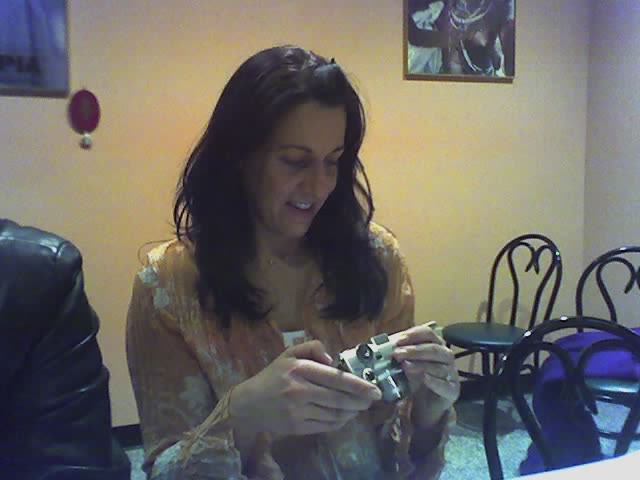
    to begin with, but these last few years have seen us all looking a bit more like a convention of actuaries or insurance brokers than I'd like. (Not that my corduroy-jacket, red chinos and Che t-shirt is the sort of thing a self-respecting human would wear in public. No, indeed. My look was recently described by the long-suffering Valerie (pictured here with rakish chapeau) as "artist-outpatient".

    This year, though, I have to say that my favorite moment came right after I'd cadged a few drinks at the big Seelbach Hotel reception. Grant Jenkins had just regaled a small group with his "the time I crashed Emmanuel Levinas' apartment" anecdotes, when he and I decided to lead a small group away from the Official-Name-Tag-Wearing-Deluxe-Rubber-Chicken-Death-in-Life-Conference-Dinner down to the funky Afro-Caribbean restaurant and dance bar three blocks to the south. As we poured out of the hotel I saw that we'd gathered quite a crowd -- maybe 15 in total -- who trailed behind us like geese in flight. I felt like the pied piper, or at least the co-pied-piper. The real life of these events, I thought, as I talked merrily away with Jenkins, Mark Scroggins, Cate Ramsden, Piotr Gwiazda (with whom I'll be reading in Austin) and a crowd of grad students (mostly, I think, from IU-Bloomington), always seems to happen in the interstices of the official events.

    But sentimentality aside, there was some good stuff at the conference itself. I started off at a panel with on "Forms of the Spiritual in American Poetry." Philip Beard kicked it off with a good paper on Robert Lowell. Instead of going back to the well-travelled territory of Lowell's early flirtation with Catholicism, Beard talked about Notebook as an exploration of negative theology -- the exploration of the nature of the divinity through a series of cancellations of what it is not. For the most part, the things Lowell chooses to cancel are the ideas of the divine that connect with the idea of the Big Bearded Father, and what he's left with is a more general sense of caritas. As with any discussion of Lowell that gets to the heart of things, the talk touched on the idea of Oedipal struggle. Lowell always seems to be caught in that matrix — he can't stand the idea of submission to powerful authority figures (which is why "a savage servility slides by on grease" is probably his most memorable line -- he just can't stand the sight of those smug conformists). But then again, he's always on the verge of sliding over from rebel to overbearing alpha male, an irony best caught, I think, in the image of Lowell in Buenos Aires, hopped up on one of his manic sprees, mounting the various equestrian statues of the city. Is this an ironic deflation of heroic figures? Is it a weird, misguided attempt to supplant or emulate them? Both, I suppose. I ran the idea by Beard after the panel, and he didn't object, so I'm hanging on to it for the time being.

    After Beard, Norman Finkelstein took the stage. He'd sent me a copy of his book of criticism, Lyrical Interference, which I'd read at O'Hare while waiting for my flight. I think I see why he wanted me to read the book: he covers a lot of my recent blog-topics, but in much greater depth and detail. He makes especially good points about the intersection of poesis and critical writing, a topic I'd just been writing about for Avant-Post. His paper was on the somewhat unlikely topic of Michael Palmer and spirituality. He managed to make the link between Palmer and spirituality via an interesting quote from the medieval German mystic Meister Eckhart, who held that poesis was always heresy, that literary form was inevitably a matter of scandal to orthodoxies. I'm not up on my Eckhart enough to know the exact context or import of his ideas, although it certainly made the inclusion of Palmer into a panel like this one possible.

    I was very glad to see a panel on Harryette Mullen, then a little befuddled when I noticed it wasn't just on Mullen, but on Mullen and Julia Alvarez. An odd combo, I thought, before remembering that the American academy still operates on somewhat crude categories of identity-politics ("two women of color! put them on the same panel!"). What the hell, I thought: what could the Oulipo-inspired work of Mullen really have to do with Alvarez's sonneteering? As I listened to the papers, though, I began to think that the connections were stronger than I'd realized. Mullen's Sleeping with the Dictionary and Alvarez's sonnets both take up form as a generative formal restriction as a means of getting beyond habitual perceptions. Oulipo is, in the end, a formalism. And long may it wave. (NOTE: although I've complained about the prevalence of suits at this year's conference, Grant Jenkins, who gave a very sharp paper on Mullen, upped the rock-n-roll quotient considerably with his new hairstyle).

    My favorite panel, though, was one with only two papers: Mark Cantrell on Christian Bok's Eunoia and Mark Scroggins on the San Francisco poetry wars of '78. Cantell did a good job of contrasting the different kinds of reading required by the paper version of the book and by the rather fabulous electronic version. (As a guy with a lot of lamentable ebay purchases, though, I've got to say that I found entirely false Cantrell's assertion that the stakes of online experience are low because everything can be reset).

    Scroggins covered the Barret Watten/Robert Duncan fracas with amazing detail, which I'd planned to recount, but I find that the job has been done for me.

    I'd hoped to stick around to the end of the whole shindig, especially for Piotr Gwiazda's paper, but events arrayed themselves in such a way that I had to leg it back to Chicago early Sunday morning, without coffee, nudged in line by a pair of blue-haired women with aggressively mid-Atlantic accents and a strong desire to make it through the metal detectors before me.

    Sunday, February 26, 2006

    Louisville Haiku


    Back (earlier than planned) from the Louisville conference, to which I've been going for a decade or more. Distilled from those many years of experience at the estimable shindig, the following lines about its admirable and industrious leader:

    It's Alan Golding --
    Every year I am surprised
    He wears an ear-cuff.

    (More to come -- let a fella recover from the conference before you start making demands on him already. I mean, sheesh...)

    Wednesday, February 22, 2006

    Points South


    I'm escaping from Chicago and heading south, first to get my literary groove on in Louisville at the 20th Century Lit Conference, and then down to Austin, where I'll be giving a reading at what seems to be on the verge of becoming an institution in its own right: the fringe-events surrounding the generally gawdawful, resolutely anti-intellectual, networkers-in-full-on-self-promotion AWP Convention. (Do I sound bitter? Sorry. I mean, I'm sure your panel will be good, but look around in the corridors at the hotel sometime. Doesn't the posturing, posing, and pussyfooting sort of creep you out, just a little? I mean, even more than at the MLA?)

    Prophetic Statment of the Day: Someday, far in the future, the AWP fringe will devour the core events, as happened with the Edinburgh Fringe Festival so long ago.

    Anyway. The Austin reading, which will be MC'd by G. Matthew Jenkins, will be held on Thursday, March 9 at 8pm at The Bouldin Creek Cafe in what Jenkins (an actual Texan) tells me is the low-key hipster "So-Co" neighborhood.

    On the off chance that you want to buy me a drink in Louisville, you can look me up at the Seelbach.