Friday, November 04, 2011

Your BlackBerry is a Poem


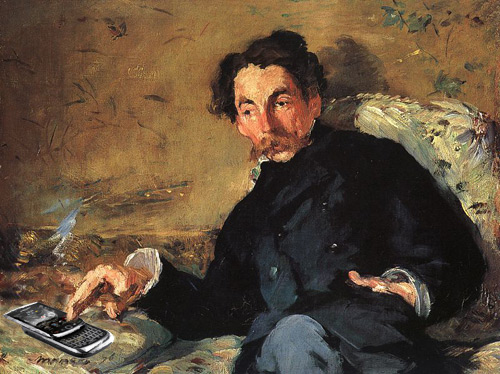
A post I wrote about the appropriation of the symbolist poetics of Mallarmé and company by contemporary advertising and branding is up on the Poetry Foundation's Harriet blog.  Check it out.

Thursday, November 03, 2011

Fifty Cult Books, Some of Which I've Read


I'm as skeptical of "top 50" or "top 100" lists as you are, chain-smoking over-caffeinated neurotic cynics that you are.  So when an English friend recently sent me the Telegraph's list of the "Fifty Best Cult Books," I was all set to start complaining about it.  Then I read my friend's note, appended to the URL: "here's something to attack."  If there's a real value to lists of this kind, it's that you can attack them, as my friend suggested.  Such lists, like the contents of anthologies, provide wonderful opportunities for arguing and howling with derision—pleasures not to be disdained!  They also allow one to remember one's own encounters with the listed books.  And by encounters I don't just mean reading experiences: books are (for the moment—we hover on the cusp of an electronic era) physical artifacts, things one runs across in particular times and places.  So here are my off-the-cuff notes on my experiences of the books on the Telegraph list.  I reckon I've read about two thirds of the fifty.


*

Slaughterhouse-Five by Kurt Vonnegut
         I read the bejesus out of Vonnegut when I was a teenager.  I even read God Bless You Mr. Rosewater.  I wrote a blog post once about how Vonneget comes by his absurdism honestly, unlike most of the young guys who read him, who are only going through a brief phase of junior-varsity level absurdism, as I was.


The Alexandria Quartet by Lawrence Durrell
         My mom likes the books of Durrell's brother, Gerald, who writes about exotic animals.  When I was in junior high I got mixed up about this, and bought a copy of Lawrence Durrell's Black Book as a gift for her.  Do not repeat this mistake.


A Rebours by JK Huysmans
         It gets dull as hell in the middle, but there are some really good bits, like the part where the protagonist holds a funeral for his libido, and the chapter about how he builds a kind of pipe organ for making combinations of perfumed scents—after which, when he catches a breath of fresh country air, he passes out.  But beware: reading this will diminish Wilde's Picture of Dorian Gray for you, since you'll see how totally derivative it is.  If this book is the Beatles, Wilde's is Badfinger.  Or maybe ELO.


Baby and Child Care by Dr Benjamin Spock
         About three years ago, just before my daughter was born, my wife and I loaded up on books about babies and parenting.  It's sort of our approach to things to research the hell out of them ahead of time (you can take the happy couple out of grad school, but…).  Never read the books.  Turns out this parenting thing is experiential.  Who knew? 


The Beauty Myth by Naomi Wolf
         Never read it.

The Bell Jar by Sylvia Plath
         I teach Plath's poems to freshmen, because the early ones are technically very fine, and therefore a good way to show students what technique is good for.  The later poems are shrieky and over-the-top, but they tend to like that.  As for The Bell Jar: I dunno.  Maybe I went out with too many girls who read it.  I keep my distance from the thing.

Catch-22 by Joseph Heller
         The Telegraph says "literary history would be entirely different if Heller had followed his original intention and called it Catch-18: it was changed to avoid confusion with a Leon Uris book."  Too true!  It'd be as if Shelley has called his sonnet "User-ma'ra" instead of "Ozymandias," which was just a Greek garbling of the Egyptian original.

The Catcher in the Rye by JD Salinger
         I hate Salinger.  I hate everything about Salinger.  Pretentious, precious, and unaccountably over-rated.  But this is all probably the result of having read it for the first time when I was in my late 20s.

The Celestine Prophecy by James Redfield
         If you ever see me reading this, rip it from my hands and use it to slap me upside the head.

The Dice Man by Luke Rhinehart
         Never heard of it.

Chariots of the Gods: Was God An Astronaut? by Erich Von Däniken
         My parents were a bit too old to be hippies, though my dad had been a kind of beatnik.  But they had hippie friends in the 70s, hangers-on at the university art department where my dad taught.  One of them had a house where the doorways were hung with dozens of little hand-made brass bells, and all the toys were unpainted wood.  They had a copy of this book, and they were very keen on talking to their plants. 


A Confederacy of Dunces by John Kennedy Toole
         I wanted to like this book, because I love walking around New Orleans.  But I did not find the protagonist charming.  I wanted him to pull an Edna Pontellier and just swim out into the Gulf and be done with it.

Confessions by Jean-Jacques Rousseau
         I love this book.  Not only do I love the full candor about the contradictory nature of the soul, I like the way Rousseau confesses both his crimes (he probably got a servant fired and thrown into prostitution) and his misdemeanors (pissing in the teapot when he was a boy).  He's a sexual oddball too: likes to be smacked on the butt by a girl pretending to be his teacher. So if that's your thing, he's your guy.

The Private Memoirs and Confessions of a Justified Sinner by James Hogg
         I've had a copy of this somewhere since the mid-90s, but despite the great narrative gap in the title ("Justified sin, you say? Do tell!) I'm just not motivated enough to crack it open.

Dianetics: the Modern Science of Mental Health by L Ron Hubbard
         I read part of this as research when I was writing the John Matthias chapter of my book Laureates & Heretics.  Matthias' poem "Bucyrus" is based, in part, on the lunatic teachings of Hubbard.  I thought the poem was bizarre, but it's got nothing on its source.

The Doors of Perception by Aldous Huxley
         This is better than people think it is.  I keep coming back to Huxley's description of the mind as a "reducing valve" that filters out the "irrelevant" parts of experience, unless we derange it a bit and see things anew: it's actually helped me explain Kant a few times, and I think it's a useful concept for discussing not only LSD experiences, but the disinterested perception of art.

Dune by Frank Herbert
         Back in high school I lent my paperback of this to a friend.  I was very insistent that he return it in good shape, since he was known for being a bit of a barbarian.  He read it and got it back to me, but instead of talking about it with him I started to give him a big lecture about how it was important to handle things with respect.  Just then my grip faltered and the book slipped, the cover tearing in half.  He laughed and I deserved it.

The Hitchhiker’s Guide to the Galaxy by Douglas Adams
         Everything I had to say about adolescent absurdism in that post about Vonnegut (link above) applies here.  But I don't think Adams has a profound experience of absurdity: his is absurdity  more the mild, suburban, youthful kind that you and I experienced.

The Electric Kool-Aid Acid Test by Tom Wolfe
         Whenever I read Wolfe I think there's no need for sociologists: Wolfe does it better.

Fear of Flying by Erica Jong
         Never read it, never going to read it.

The Female Eunuch by Germaine Greer
         See my note on Fear of Flying.

The Fountainhead by Ayn Rand
         I actually did start reading Atlas Shrugged once, just to see what the asshats were on about.  I don't think they're on about much.  And don't think Rand ever got over the Soviets taking her father's small business away.

Gödel, Escher, Bach: an Eternal Golden Braid by Douglas R Hofstadter
       The Telegraph says this is 
"about what it means to think, and how that happens, this is written in the spirit of Lewis Carroll. Pattern recognition in the work of geniuses. Loved by maths geeks and anybody with Asperger's syndrome and anyone with sense. But at root a chess textbook."  That's about right, I think.

Gravity's Rainbow by Thomas Pynchon
         I think I missed the window to read this.  It's a Cold War book, right?

 The Holy Blood and the Holy Grail by Michael Baigent, Richard Leigh and Henry Lincoln
         Never heard of it.  But the Telegraph says it's like The Da Vinci Code, so I don't think I'll be getting a copy.

I Capture the Castle by Dodie Smith
         Knew a young woman who thought highly of it.  Told her I'd read it.  Hadn't.  That was a long time ago.


If on a Winter’s Night a Traveller by Italo Calvino
         Along with the passages of The Prelude in which Wordsworth talks about how he can't pick a topic, this is one of the great literary stuttering sessions: a whole set of beginnings, left hanging.

Iron John: a Book About Men by Robert Bly
         I'm just not going to go in the woods and beat drums with you guys.  Sorry.  But good luck with that.

Jonathan Livingston Seagull by Richard Bach and Russell Munson (1970)
        
Odious treacle.  But I was happy to read this, from the Telegraph: "Richard Nixon's FBI director, L Patrick Gray, ordered all his staff to read it. Later, he resigned for gross corruption, a fitting punishment for his dreadful taste."

The Magus by John Fowles
         Go see Anthony Quinn in the movie version instead.  The book isn't bad, butAnthony Quinn is notably absent.

Labyrinths by Jorge Luis Borges
         Erudition both real and imagined, fun-house mirrors reflecting other fun-house mirrors: what's not to like?  The only problem is that if you get truly hooked on Borges and are of a completist disposition, you'll end up reading the sonnets he wrote late in life, and Borges will be much reduced for you.

The Leopard by Giuseppe di Lampedusa
         The jacket of the paperback I've owned for something like 15 years boasts that this is one of the greatest novels ever written.  I begin to wonder whether I'll ever get around to finding out.  I mean, I even left it on a side table for a while, but it just ended up being used as a coaster.

The Master and Margarita by Mikhail Bulgakov
         I was on a thesis committee for a young man writing about this book.  Read both the thesis and the book, liked them, but the thesis defense turned out to be all about Russian social history.  I listened and nodded before voting to approve the project.

No Logo by Naomi Klein
         I'm on her side.  But this thing would have been much better if it were, say, 15 pages long.

On The Road by Jack Kerouac
         Back in my undergraduate days I had a big orange Viking Critical Edition of this.  I read it in the apartment of the guy from whom I used to buy pot (he's now a radio D.J. in Montreal).  One day his brother came in from the benighted small town where he lived and borrowed it.  He played drums in a band, and lent it to the bass player, who lent it to the bass player in another band that went on tour in a crappy van.  I lost track of that band somewhere on the Canadian prairies and the book with them.  It was exactly the right way to part from that particular book.

Fear and Loathing in Las Vegas by Hunter S Thompson
         I devoured this thing one weekend around 1990 instead of reading whatever I was supposed to read for class.

The Outsider by Colin Wilson
         If it had been the fifties, and I had been twenty, I think I'd have liked this.  But it was a couple of years ago, and I was forty, and it wasn't doing much for me.  Some books are too much the product of their time and place to mean much outside of those co-ordinates.  Others (like Catcher in the Rye) seem keyed to a certain age group.  This one, I think, is tied to both time and generation.  I wonder if its moment will ever come round again.

The Prophet by Kahlil Gibran
         "Where does one find other books like this?" asked a short, squat, vaguely street-person like Latin American man in a sky blue suit and dark glasses who had cornered me in the old Aspidistra Bookshop where I worked.  "Where," he continued "are the books on how one lives?"  I sent him to the self-help section, which I consider a failure on my part.

The Ragged Trousered Philanthropists by Robert Tressell
         I really want to read this someday, since it seems like the good ole left-wing religion.  But when I say "I really want to read this," the statement  needs to be measured against my continued inaction.  Maybe I don't really want to read it that badly.

The Rubáiyát of Omar Khayyám tr by Edward FitzGerald
         When I'm feeling sentimental, I kind of like this.  When I'm feeling cynical, it seems like kitsch.

The Road to Oxiana by Robert Byron
         Never read it.  I think I only ever read travel writing when it appears in Granta.  I've loved old issues of Granta ever since I read the one called "While Waiting for a War" back when I was a freshman.  That's the issue where I fist encountered Hanif Kureishi's work.  I still love The Buddha of Suburbia, My Beautiful Laundrette, and Sammy and Rosie Get Laid.

Siddhartha by Hermann Hesse
         Back in grad school I shared a house with a biologist doing a postdoc.  A German colleague of his dropped by once looking for him, but he was out.  The German saw my complete set of Hesse on the shelf and, in an Arnold Schwarzenegger accent, asked "do you like Herman Hesse?" I've always been a bit ambivalent about Hesse, thinking him good but didactic.  But I didn't want to insult a German writer in the presence of a German, so I said "yes, yes I do, very much."  "Ach," said the German biologist, "I hate Herman Hesse."  

The Sorrows of Young Werther by Johann Wolfgang von Goethe
         I put this on the syllabus of a graduate seminar I and a senior historian colleague were teaching.  I taught it as a kind of statement about the turn to morbid emotion brought about when the middle-class protagonist is shut out of the position he deserves by aristocratic snobbery.  "Nice little Marxist reading," said my historian colleague, before demolishing it with the great snowplow of German romanticism.

Story of O by Pauline Réage 
       "A guaranteed detumescent," says The Telegraph.  Opinions vary.

The Stranger by Albert Camus
         Apparently a lot of books on this list make me think of my post on Vonnegut and absurdism.

The Teachings of Don Juan: a Yaqui Way of Knowledge by Carlos Castaneda
         I know a guy who keeps saying he's going to write a book about this.  Somehow that seems wrong.  It just feels like this book should have been abandoned after Jimmy Carter lost to Reagan.

Testament of Youth by Vera Brittain
         Never read it.

Thus Spoke Zarathustra by Friedrich Wilhelm Nietzsche
         I really don't think Nietzsche should have attempted this.  Except for The Birth of Tragedy, all of his best work is in the epigram and the fragment.

To Kill a Mockingbird by Harper Lee
         Do you wish she'd written more?  Not me.  I think it's kind of perfect just to have this by itself.

Zen and the Art of Motorcycle Maintenance: an Inquiry into Values by Robert M Pirsig
         When I was 14 I objected to my English teacher about the books we were reading, saying they were juvenile.  She said I could write an essay on something else if I wanted to.  I declared I would write on Zen and the Art of Motorcylce Maintenance, which seemed to my young self to be both sophisticated (zen) and badass (motorcycle maintenance).  When I got the essay back, her sole comment was "did you read anything beyond the jacket?"  I had not.
Saturday, October 29, 2011

What’s the Matter with American Poetry? Rita Dove’s Revisionist Canon


What’s the matter with American poetry?  Apparently, the problem is Allen Ginsberg.  And Sylvia Plath.  And Susan Howe, and Alice Notley, and James Schuyler.  Also Louise Glück.  Also Louis Zukofsky, and all of the other Objectivists.  That, at least, is the conclusion one might draw from Rita Dove’s new Penguin Anthology of Twentieth Century American Poetry, which bills itself as “an unparalleled survey of the best poems of the last century,” and includes none of the poets named above. 

I’ve done just enough editing myself to know that standing up and saying you’re editing an anthology is a bit like standing up and saying you’re a target—and the larger the scope of the anthology, the larger the target.  It’s worse, too, when you’re editing a book that includes living poets: at this point you might as well consider yourself a walking bull's eye, and be prepared to suffer the slings and arrows of outraged poets everywhere.  In any anthology, there will be grounds for disagreement: the poor editor has a limited amount of space, and in the end will find that he or she has to select one poet out of dozens with valid claims for inclusion.

Dove’s anthology does a good job in some respects, especially in being attentive to the claims of poets of color.  In other respects, it takes positions over which reasonable people might disagree.  I’d have argued for Notley and Schuyler, but I can understand that other people might find their work to have been in some way—aesthetically, socially, in terms of influence—less worthy of inclusion than other poets of their respective generations.  Other people will have their own list of poets they’d have wished to see: one friend of mine lists Kenneth Rexroth, Barbara Guest, Robert Kelly, Jerome Rothenberg, Clark Coolidge, Ed Roberson, Bernadette Meyer, John Taggart, and Eileen Myles, among others.  The street runs the other way, too: I imagine most people who thumb through the table of contents will think some of the poets listed ought not to be there, especially if it meant excluding someone else: me, I find it difficult to believe that Laurie Sheck and B.H. Fairchild should have precedence over some of the excluded poets.  But again, I can see that there’d be room to argue, and both Sheck and Fairchild have written fine poems.

When it comes to excluding both Sylvia Plath and Allen Ginsberg from an anthology purporting to represent 20th century American poetry, though, we’re not really in the territory of ordinary disagreement.  We’ve entered a place where some sort of explanation is required, because what’s being proposed is a radical redrawing of the map of American poetry.  I’m open to such a redrawing, but I need to know why it’s being done.

Speculation runs wild.  Some take a fairly charitable view: one reviewer sees the exclusion of Plath and Ginsberg as proof that Dove “is her own woman,” bravely going off in her own direction.  Facebook has lit up with chatter on the anthology, very little of it positive, at least from what I've seen. It’s been noted that many of the excluded poets publish under HarperCollins imprints, and one source claims that HarperCollins wanted some very steep reprint fees.  If this is the case, one wonders whether it might have been a deliberate attempt to torpedo a rival press’ anthology.  Some of these issues are touched on in Dove’s introduction, in which she complains about permissions fees.  One wonders if this can be the whole story: Penguin is by no means an under-capitalized venture, and people at the press must have known that glaring exclusions like this would seriously hurt the academic market for the book.  But what else could explain the exclusions?

I’ve heard from someone in the publishing industry that Dove may harbor some particular animosity for Plath, based on the perception that Plath could be deeply insensitive about other people's suffering (I do not know if this is true).  There's the appropriation of Holocaust imagery to discuss family unhappiness in "Daddy," for example, or the use of Hiroshima imagery, and of course there's 
 the very charged language in one of Plath’s better-known poems, “Ariel.” Here’s a passage:
God’s lioness,  
How one we grow,
Pivot of heels and knees!—The furrow

Splits and passes, sister to  
The brown arc
Of the neck I cannot catch,

Nigger-eye  
Berries cast dark  
Hooks—

Black sweet blood mouthfuls,  
Shadows.

There’s no denying the presence of unsettling language, and there’s not much in the context to mitigate against a feeling that this is offensive to our 21st century sensibilities.  I am acutely aware that I will never know how it feels to be African-American and come across that offending word in an anthology of poetry.  But I do know that it’s the sort of thing I cringe at reading in a classroom setting, and for which I provide a lot of commentary, without making excuses (the same thing happens when I teach Heart of Darkness, or Hemingway’s “The Battler”).  I’m told—and I want to emphasize that I do not have this at first hand—that this sort of racially charged language, in combination with Plath's cavalier use of imagery drawn from some of the great atrocities of the 20th century, might lie at the root of Dove’s problem with Plath.  It might be a matter of a disdain for Plath's real or perceived insensitivity that led to her exclusion from Penguin's version of "the best poems of the last century."

I wonder, though, if this can be true, because Dove does include John Berryman in her anthology.  I think it’s correct to include his work: to my mind, Berryman is the greatest American poet of his generation, greater than Lowell (in whose shadow he once stood), greater even than Bishop (in whose shadow he stands now).  But if you’re looking for wince-inducing, culturally insensitive language, you’ll find it in Berryman’s Dream Songs, which make extensive use of a blackface minstrel show motif.  I think it was right to include him in the anthology.  But if Berryman’s in, why not Plath?

In the end, I don’t know the reason for the exclusion of Plath.  If (and I emphasize this is an if) it has to do with real or perceived insensitivity in her work, I think Rita Dove is well positioned to make explain the point.  Indeed, I can think of few people who could do it better (how I wish Reginald Shepherd had lived to write about this!).  As my friend in publishing suggests, it would be far better for Dove to provide a full, in-depth explanation for the exclusion than to simply edit Plath out of this representation of American poetry.  One might say Dove owes the world this explanation, not only to defend her editorial choices, but to inform us about how Plath looks from where Dove stands.

Of course there's a sense in which arguments about anthology contents may soon look a lot like arguments about what channel to watch on television.  Just as the DVR has made it possible for each of us to have things our own way—watching the football game while
recording the movie for later, then getting the reality show on demand— technology promises to make most of the arguments about anthologies disappear.  Limited page space and editorial variance from our own preferences become less and less pressing as more and more American poetry finds its way onto the internet, thanks in no small measure to the Poetry Foundation.  As one Facebook friend of mine put it during a discussing of Dove's exclusion of Ginsberg and Plath:

Howl and Kaddish are both on the Poetry Foundation website, along with 39 poems by Plath. Has anyone tried teaching entirely from their online anthology yet? Glad to let Ruth Lily's endowment pay HarperCollins's fees, rather than my students.... I may have to try this experiment in the spring.
We should all be interested in how that experiment turns out.

Friday, October 28, 2011

Occupy Arcadia: Mythos of an Emerging Movement


“What,” ask the pundits, “do the Occupy Wall Street people want?” When they deign to answer their own question, they tend, if they are uncharitable, to say that the protestors don’t know what they want, that any real message is lost in a miasma of different agendas.  The more charitable type of pundit tends to say something more along the lines of “the protestors know what they’re against — economic inequality and the power of money — but they don’t know what they’re for.”  I’ve spent enough time at the Chicago manifestation of the movement to see the iota of truth in both the charitable and the uncharitable analysis, but in the end both analyses miss the significance of what’s happening.  To get at that significance, it’s important to drop the usual categories of analysis — left and right, cultural and economic, idealist and realist — and come at matters from an angle where things appear less familiar.  Otherwise, we risk reducing something truly new into one or another version of what we find familiar.  So bear with me while I propose a means of analysis that might seem quite strange: it’s the strangeness that we’re after, here, since the familiar categories of understanding have proved remarkably ineffective.

Mythos and Movement

As the scholar Malcolm Bull argued in New Left Review (March-April 2010), Greek mythology presents a coherent typology for understanding the relations of power, production, and knowledge.  In his view, the Greek mythos can be mapped out on a pair of axes thusly:


Olympus is the realm of pure power, in its various manifestations.  It is the dwelling-place of Zeus, the figure of pure executive power, and of Hercules, the figure of physical strength.  It deals with realities, and does so by ruling over them, by authority, by influence and manipulation, or by sheer force.  It is the realm of mastery.

Hades also deals with realities, but does so differently.  It is the realm of production, where Hephaestus works at his forge: his realities are those of existing materials, of the strengths and limits of bronze and silver and gold.  Many people who know their myths have been puzzled about why Aphrodite is married to the lame, ugly, Hephaestus — but at a symbolic level, it makes perfect sense: while he is the figure of artisanal, or even industrial production, she is a figure of sexual reproduction.  Together they cover the realms of inorganic and organic production.  If Olympus is the realm of mastery, Hades is a subordinate realm, the world of labor set against the Olympian world of command.

Parnassus deals less with existing realities than with the free play of speculation: it is the realm of Athena and the life of the mind, and of Apollo and the poetic.  The muses dwell here, and it is to Parnassus that scholars and intellectuals repair.  Like Olympus, it is a privileged realm, but unlike Olympus, it is not a world of power.  To put it in modern terms, one might think of Olympus as the realm of executives, and Parnassus as the world of tenure, think tanks, and foundation grants.

And then there’s Arcadia.  This, too, is a realm of free play rather than of existing realities with all of their limitations.  But unlike Parnassus, this isn’t a world of concepts or philosophies or epic poems: it’s a wild realm, a realm of potential energies.  It’s the world of Pan, who dwells in forests and open meadows that have not been brought under cultivation.  It’s the world of Diana the huntress, another forest-dweller defined in terms of potential: she is, after all, the virgin goddess.  Everything about Arcadia is about the primitive state of things, from which other things might emerge.  

Hermes, the messenger god, is a special case: he inhabits the very center of the map, at the intersection of the axes: this is central to his function as the messenger god, and to his function as the god of boundaries and those who cross them.

Once one grasps the general structure of mythological relations, a lot of things become clear about the significance of the myths: when Apollo and the faun Marysas (a figure of Arcadia) have a musical duel, won by Apollo who then flays Marysas, we have a kind of martyring of naïve or potential artistry by the established forces of Parnassus.  One can see its relevance to, say, aristocratic culture’s disdain for folk culture, or the sophisticated formalist’s soul-crushing dismissal of emergent talent. 

But we’re a long way from talking about Occupy Wall Street.  What happens when we try to view the movement through a conceptual framework as defamiliarizing as the Greek mythos?

Occupying Olympus, Occupying Hades, Occupying Parnassus

The first thing that should be clear about Occupy Wall Street is that it isn’t a movement based in Olympus.  Unlike the Tea Party, which was bankrolled by the enormous fortunes of the Koch Brothers and for which Fox News served as something like an advertising and P.R. firm, Occupy Wall Street has little or no connection with the realm of worldly power.  Even when those in powerful positions, such as President Obama, make gestures of sympathy to the movement, they do so in ways both unconvincing and uncomfortable.  Michael Gerson of the Washington Post put it clearly enough:

President Obama’s awkward, unreturned embrace of Occupy Wall Street is among the strangest developments of the 2012 campaign…. Obama has been the unrivaled leader in fundraising from the financial sector in recent years. Senior staffers with Wall Street connections have occupied the White House for some time now. Banks and financial-service firms have been some of the main direct beneficiaries of Obama’s economic policies.  And Obama himself has often sought to defuse public criticism of Wall Street.… Last year, he went out of his way to defend large bonuses for the chief executives of ­JPMorgan Chase and Goldman Sachs: “I know both those guys; they are very savvy businessmen. I, like most of the American people, don’t begrudge people success or wealth.”

A stronger case can be made for Occupy Wall Street as a movement based in Hades, under the protection of Hephastus (if that sentence doesn’t defamiliarize the political categories, I don’t know what will).  Unions, for example, have intermittently swelled the ranks of the protestors in New York, Chicago, and elsewhere.  But the key word here is “intermittently”: the Occupy protests are not union-centered rallies, like those we saw in Wisconsin earlier this year.  Union leaders don’t call the shots.  If they did, we probably wouldn’t hear the punditocracy’s complaints about the lack of a clear message: instead, they’d be writing about how the demands of workers for decent wages and benefits are unreasonable in a globalized economy.

What about Parnassus?  Is this where the real center of the movement rests?  There are certainly plenty of students to be found at the demonstrations, and a few professors (full disclosure: my tenured feet have occupied a few sidewalks and parks in Chicago).  But the disproportionate representation of students is certainly a matter of greater opportunity to show up, rather than of significantly greater motive.  As one man said at a recent demonstration, “you students, you’re my voice: I work 60 hours a week to keep my house, and I look after my kids, and I just can’t get out here often.”  Some polls suggest that the majority of Americans support for the movement: this isn’t an ivory tower thing, not in its essence.  Veterans, working stiffs, union guys, moms with kids in tow, office jockeys, street people, and others are all in evidence, and though they applaud when Cornell West speaks, they’re not lining up behind him: they’re standing beside him.

Et in Arcadia Occupy

This leaves us with Arcadia.  But what exactly is Arcadia, anyway?  In the Greek mythos, it’s all about what might-yet-be.  It’s where Paris stands when he judges who has the greatest beauty: Hera, Athena, or Aphrodite.  This is significant: he’s choosing between representatives of Olympus (power), Parnassus (knowledge) and Hades (production), and as he makes the choice from the only position outside of their realms: in Arcadia, the world of the not-yet, the potential.

This, I think, is the proper location of the Occupy movement in the Greek mythos, at least at the moment. 

A few days ago I was arguing with the historian D.L. LeMahieu about the nature and meaning of the Occupy movement, and I’d begun with the proposition that what we were seeing was a resurgence of the now-old New Left paradigm: the language of class, anti-capitalism, and economic justice returning after a long eclipse.  LeMahieu refuted all that, claiming that what we were seeing wasn’t a return to something old, but the birth of something new.  Sure, there were old left-wing slogans.  But this was part of the mulch out of which something very new was being born.  We weren’t going to see a new socialism, because socialism was the countervailing force that tried to civilize 19th and early 20th century capitalism: it was a response to a kind of economics that doesn’t really exist anymore.  We’re in a new phase of economic development, with transformative technological forces and the entry two billion of new workers into a global marketplace.  We had an unprecedented economics (which developed out of our old economics), and it would create an unprecedented politics (which would also develop out of our old politics).  I’m convinced LeMahieu was right: we’re not going to get a return to something old, even if the new thing we get takes up and transforms the old political paradigms. 

In a way, the very fact that the pundits have had a hard time grasping what the protestors want is a sign that what’s coming together is something truly new.  It doesn’t fit easily into our paradigms.  It’s not a student protest, it’s not a labor protest, it’s not a rally orchestrated by one or another of the political parties.  Slavoj Žižek got at the nature of things in his address to the protestors in Zuccotti Park:


So what are we doing here? Let me tell you a wonderful, old joke from Communist times. A guy was sent from East Germany to work in Siberia. He knew his mail would be read by censors, so he told his friends: “Let’s establish a code. If a letter you get from me is written in blue ink, it is true what I say. If it is written in red ink, it is false.” After a month, his friends get the first letter. Everything is in blue. It says, this letter: “Everything is wonderful here. Stores are full of good food. Movie theatres show good films from the west. Apartments are large and luxurious. The only thing you cannot buy is red ink.” This is how we live. We have all the freedoms we want. But what we are missing is red ink: the language to articulate our non-freedom. The way we are taught to speak about freedom— war on terror and so on—falsifies freedom. And this is what you are doing here. You are giving all of us red ink.

…. Remember that our basic message is “We are allowed to think about alternatives.” If the taboo is broken, we do not live in the best possible world. But there is a long road ahead. There are truly difficult questions that confront us. We know what we do not want. But what do we want? What social organization can replace capitalism? What type of new leaders do we want?….We are not Communists if Communism means a system which collapsed in 1990. Remember that today those Communists are the most efficient, ruthless Capitalists. In China today, we have Capitalism which is even more dynamic than your American Capitalism, but doesn’t need democracy. Which means when you criticize Capitalism, don’t allow yourself to be blackmailed that you are against democracy. The marriage between democracy and Capitalism is over. The change is possible.


I’ve only felt the political ground shift beneath my feet twice in my life.  The first time was in the aftermath of September 11, 2001, when one could feel a horrible lurch toward authoritarianism and fear.  The other time is now.  I don’t know where it’s all going any more than you do.  But unlike last time, I have faith that it’s moving in the direction of hope.