
Sorry, folks, but I'll be taking a blog-hiatus until sometime in early or mid August, when I & my crew return to Chicago from Amsterdam.
Houd het echt!


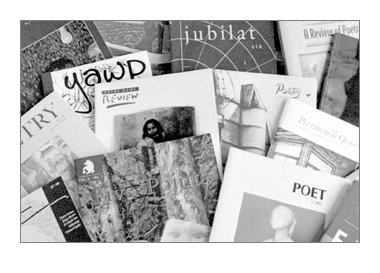
TiVo picked up IFC's new Punk: Attitude documentary for me a week or two ago, and I finally got to it this weekend. Maybe it's the wave of Gabba Gabba Hey nostalgia gently lapping over me that's got me thinking about starting another poetry magazine. I've always had a soft spot for the do-it-yourself attitude of punk, and it has informed my attitude toward the institutions of poetry, if not my aesthetics (sorry, Henry Rollins, but I can't get down with your poems, even though I like your film reviews on IFC).
The big stars for the kids into punk were never the same as the big stars for the square community, so the punk fans, brilliantly, decided to act as if the big stars didn't rate, and their own heroes were the real headliners. Sure, not many people were on board for their projects, but in a society as high-tech and prosperous as ours all you need is the will to do things on your own terms and you can get pretty far: your own zine was easy if you snuck into the photocopy room of your high school or had a pal who'd let you sneak into Kinko's; by the time you got to college you and your pals could let the band crash at your apartment as incentive to let them come to your town on what was somewhat grandiously called their national tour; for a surprisingly small outlay of cash you could just about have your own record label, or at least dub tapes by the dozen. The bulk of people would never care, but all you had to do was not care right back. Which left you more energy to care about unjamming the photocopier in your high school office quietly, so the janitor wouldn't notice you were in there making issue #1 of Prairie Hardcore: the World's Finest Guide to Manitoba's Punk-Rock Scene. (I know, I know, history and the internet have not been kind to the word "hardcore," but back in the day, children, it refered to a kind of music, a special, magical music that could blow the top off of your adolescent head with its ability to channel your rage and skepticism toward vaguely-defined authority figures. Sort of like rap but, you know, not about money). And all you had to give up for this degree of freedom was any chance that any significant number of people would be paying attention — but didn't some guy once give some encouraging words about the relative merit of gaining the whole world and losing your soul?
Anyway. I was in a you-should-get-off-your-ass-and-start-editing-again-because-it-matters-even-though-you-said-you-wanted-to-write-more-instead frame of mind (do the Germans have a word for this?) when I stumbled across Tony Tost's discussion of poetry journals. It's worth a look, but for a summary I'll just crib from Josh Corey's comments. He tells us that Tost sees only two kinds of journals in the poetry world, and that Tost years for something more. Tost, says Corey, defines the two types of journals as:
...the omnibus of "arrival" (here comes the omnibus!) and the mag that seeks to advance a particular aesthetic or communitarian position. I'm sympathetic to his desire for something new, something more self-interrogative, than either existing model seems able to provide. More like a diary in which the entries are written by other people; an unrefereed blog (or e-mail list) will obviously fail to achieve this. What is the guiding principle of such a diarist? Something beyond the merely personal, as Tony says: something more about knowledge and investigation. Investigation of a particular theme or topic would be one way.
I've used slightly different terms when talking to myself about poetry journals (don't worry, peeps, I don't do this out loud, except on the El, late at night, while leaning too close over well-dressed people coming back from the opera). What Tost calls the "arrival" I've called the phone book, simply because such journals show about as much personality as the white pages. The aesthetic/communitarian journal is the one I call the pulpit, although surprisingly few of these journals actually make the position they're advocating explicit in any kind of preachy statement.  Mostly they rely on presenting work from a fairly well defined coterie to make their point. Michael Anania, in one of the brilliant essays in In Plain Sight, points out that while many of these mags have called themselves avant-garde, most are actually more concerned with one or two seminal figures from an older generation, and with their aesthetic progeny, than they are with anything wholly new. They are champions of other-streams, not necessarily of the radically new.
So. I like Josh & Tony's ideas about what a worthwhile journal would look like, but I still have a hard time thinking about how such a thing would be put together. "Self-interrogatory" and "investigative" are great ideals: they propose the journal as a specific conversation about something in particular among people who all want to get their angle on the topic clear. This is like the pulpit in being focussed, but it is more open-ended, it has no answers in mind, just a few urgent questions to the bottom of which it actually wants to get. To that end, a few (debatable) notions on what would have to go into such a journal. Inevitably, I'll end up saying a few things about my last journal, Samizdat, which ran for ten issues, had some hits and some misses, and has a partially completed website archive of the first seven issues online.
1. Mission.
What does The Iowa Review want to talk about? You really can't tell in this kind of phone-book/omnibus journal. Some of these skew a little more toward the scenic or the indeterminate aesthetic, but in the end they simply aren't meant to be there for the exploration of certain possibilities. Mission doesn't mean party-line, here, but an area to investigate. A topic.
2. Editorial.
Someone — an editor or a group of editors — should take responsibility for the issue, and say something specific about what was chosen and why it is important. (Imagine what the editorials for most phone-book style journals would look like if written honestly: "Billy Collins is in here because he's a big name, we deliberately added some women because we realized that, left to our own devices, we'd have stuck to old white guys, and we took a chance on some of this stuff we don't really understand because we're afraid of appearing unhip. Enjoy!"). I mean, it's a good excercise for the editor, who has to think through his own choices for 700 words or so (Tony and Josh's "self-interrogotory" ideal), and it's good for the readers, who can see whether theory and practice add up, who can agree or disagree, who can get into the conversation. Writing these was my favorite part of editing Samizdat, and the part of the magazine that generated the most mail (fan, hate, and deranged, in roughly equal proportion).
3. Reviews.
I'm stunned at how many journals don't run these. I'm also stunned at how many of the reviews that do get printed are kind of empty, giving little more than a sensibility reacting to a stimulus (like too many poems in this regard). The best reviews, I think, are those that try to put the book into one or another big picture (not necessarily a totalizing picture -- nowadays you'd have to have serious cojones and a good dose of delusion to try that). Group reviews are a good, and underutilized, form for going at this: you get a chance to pull a bunch of strands together, to say "Poet X is good but when you read Poet Y's new book you start to wonder about the task X set for himself. Poet Y does something so much more ambitious, you think of Poet X's work as less interesting somehow." Also, the review that pairs unlikely poets is good, and allows the reviewer to reflect on the nature of the poets' different projects (one of the first reviews we ran in Samizdat paired Reginald Gibbons and Rosemary Waldrop). You need reviews, I think, and you need them to be more than "here are some passages that played over my exquisite sensibilities like a gentle breeze on the strings of an aeolian harp.
4. Probably not a lot of special issues on particular poets.
We ran a few specials for Samizdat: one on Scandinavian poetry (I was living in Sweden), one on John Matthias, and a popular one on Pierre Joris and Jerome Rothenberg. I'm proud of all of these, and I think they're useful resources for people who want to check out the topic, but now I think that this sort of thing is best served through books, archival web sites and that sort of thing. They interupt the flow of discourse, and if a journal is to be a conversation or investigation, it would be a rare special issue that played a big role in that. Maybe one could run a notice or summary of the issue, and then direct people on how to get to it. Don't get me wrong: there are some special issues I really love. But they seem more like books to me, and their focus is often on commemoration more than on the following-up of particular questions.
5. Selection of poems
There should probably be a place for long poems, or whole sequences, serialized if they have to be (we did this with Michael Barrett's "Babylons" in Samizdat because I was such a rookie when I accepted it I didn't realize that it would have maxed out the whole first issue). Also groups of poems that make sense together, or that interrogate one another (as in the reviews of multiple poets above) would be good. And more poems by fewer poets would help to give a journal shape and avoid the "here comes everyone" feel of the journal-as-phonebook.
6. Frequency
This is the tough part. Monthly would be good, or a short journal every two weeks. If people are going to participate in an investigation together, the fat quarterly is less useful than the slim, somewhat casual set of documents that shows up every few weeks. The old French notion of cahiers (workbooks) is a possible inspiration.
7. Independence from institutions
You need this if you aren't going to end up looking over your shoulder at the powers that be, worrying about your funding. Institutional affiliation leads, eventually and almost inevitably, to the occasional or perhaps not so occasional worship of false gods like circulation, respectability and being in step with the norms of "the field." I mean, look at what's become of university presses: designed to publish books that aren't commercial, their editors find themselves worrying about what the university suits will say about low sales.
8. Gemeinschaft
Gemeinschaft, or the idea of a community linked by bonds other than the institutional or administrative, is hugely important for a poetry journal. Phone-book style journals tend not to have it, while Pulpit-style journals sometimes do (sometimes, though, they become too in-groupish, and the jockeying for position becomes something a field biologist specializing in chimpanzees or wolf packs couldn't even unravel). About the worst possible way to staff a journal is to recruit people who have some kind of institutional connection to the mag but very little personal connection or enthusiasm for the journal itself. Too many (but not all) university-based journals end up with a staff of grad students who share only the vaguest of common interests. They're usually given little power and, consequently, don't invest much more in the job than the average convenience store clerk does in his — that is, they may be able to steal some candy (networking with people at similar journals in the hopes of getting some play for what they do care about: their poetry), but by and large they'd rather be elsewhere. About the only journal I know of that is guided by grad students and is really first rate is the Chicago Review,, and I imagine there's a connection between the quality of the magazine and the fact that the powers that be actually let the grad students run the whole show. Given responsibility, they make a real investment in the job. (Oh yeah, there's also the fact that they tend to be PhD students, and have a different set of agendas and concerns than the inhabitants of the ordinary MFA mill).
9. Cultivating a sense that something is going on out there
We've all seen journals that seem to exist in some kind of weird vacuum, as if poems were written in a kind of no-place, as if there weren't a field of poetry (let alone a field of power) with which those poems interact. Back in the eighteenth century, when journals were just getting started, Addison and Steele decided that The Spectator should have regular departments named after the various coffeehouses around London. Each department would cover the kinds of topics you'd find discussed in the hangout for which it was named (one for stock news, one for literary talk, one for "gallantry," etc.). I'm not saying a journal should try to cover the whole world, or even try to cover literature and politics together (as The Potomac has tried to do recently, with mixed results). A column on gallantry among poets would be kind of fun — I've even got a piece I could write on seeing Christian Bok try to pick up women at several readings — but this isn't really what I've got in mind. Rather, part of the "self-interrogating" and "investigative" element of a journal could involve articles and poems that address the situation of poetry in the field as a whole, and in the larger field of power in the world.
So.
How much of this could be accomplished, and what kind of effort it would take, are questions I'm not prepared to answer. Whether a substantial number of people would care is not a question that interests me much, but others might have interesting things to say about that. One question that seems particularly important here is that of just how much of all this the poetry blogs are already accomplishing. Blogs can be updated frequently, are good places for editorials and for reviews (though fewer people than you'd think seem to use them for this), and they're great for carrying on mutual investigations of topics. That's something, and it has got me wondering whether the journal is really the form we need right now. The kid who snuck into the copier room to make his zine loved ink on paper, but hey, when the alternative was a Commodore 64 with a 300 baud modem, who wouldn't?
And as a practical demonstration of the idea of blogs as a good way to carry on self-interrogating investigations of poetry, let me point out some remarks of July 14 by Henry Gould, in which he takes terms from the contingent poetry discussion on this and other blogs and applies them to his own poetry.

Fallen from a Chariot, Kevin Prufer's new book, is one of those collections of poems that is written as a book: the four parts hold together. The first section is all elegy for a woman who died in a car wreck, and the section serves as a kind of overture, giving us most of the images that will recur throughout the collection: falling gods, death, birds, a crashed car. I imagine the car wreck to have been something real in Prufer's experience, in part because the elegaic note rings very true, and in part because Prufer has looked at cars as emblems of mortality before (as in his earlier poem "Death Comes in the Form of a Pontiac Trans Am"). Subsequent sections pick up the theme of death as a fall, but take it elsewhere (notably to ancient Rome in the second). He embroiders more and more symbols into the fabric of the book as he goes along: doomed airplanes, a ship reminiscent of The Titanic, poisonings, fallen empires, more birds, more fallen gods, more wrecked cars.
The point of comparison for me is Eavan Boland. Like Boland (especially in her collection In a Time of Violence), Prufer writes a poetry that works best by accumulation: themes and images recur, and they take on more significance as the variations pile up. Prufer used to write a fairly formal line sometimes, with a fairly strong sense of meter, but this book gives us a flatter, more prosaic line, also like much of Boland. There are two respects in which Prufer's got it all over Boland, though: incantation and interpretability. He's got more of the first and less of the second and good for him, I say.
We find his incantation here and there, where the language of elegaic longing becomes prayer-like, and this gives the lines an intensity and slight formality that raises them above the level of chopped-up prose. No one will ever say of him (as my students have repeatedly said of Boland) that reading the poet's essays and reading the poet's poems amounts to pretty much the same thing. This is nice, but less interesting than the matter of interpretability. Don't get me wrong, here: Prufer is no indeterminist, no post-avant or Jorie-Graham style spinner of faux-sophisticated fashionable nonsense verse. In fact, he writes in very clear sentences. But it is at the level of intersecting images that his book becomes something quite subtle. The variations on consistently repeated images make them quite nuanced and polyvalent, and hard to paraphrase. This is symbolism in the classic sense of the word, and it is wonderful to trace the patterns as they evolve though the book (which is, symbolically if not syntactically, a bit of a rhizome). Boland always seems to me to be very programmatic, to have decided where she wants to go and what she wants to mean, and in the end this is a limitation. Prufer seems more guided by a set of images the full import of which is not entirely disclosed, even to him. When I write a proper review of the book I may spend some time tracing them out, although my editor would have to be generous with space for me to do them justice (my copy of the book is pretty much scrawled over now, with notes and letter-codes for symbols).
The thing that interests me the most, though, is the way that Prufer decides to treat something quite immediate and intimate (elegy for someone he loved) through the long ago and far away. He loves to play with the idea of a past and a present that are oddly simultaneous, or with a large-scale historical moment that is somehow also something much more local. I'm saving all my best examples for the real review, but here's one I don't think I'll use there, because the two moments that seem simultaneous are more literally related than in the ones I most admire. Here, the death of the Emperor Augustus and the (much later) fall of the Roman Empire seem simultaneous (by the way: Prufer's lines are indented at places, but my html skills just aren't up to showing how, sorry):
Finally the great must — all of them —
So Augustus
put the poison fig to his lips to taste and fell
back in his bed so his soul was lifted away
A hand from the blue squall of sky The sea
crying over its beach A flower
each petal twisting
from the branch The empire slipped with a cough then a gasp
Fell loose jawed Fell slack
alone and asleep
The personification of the empire in immediate juxtaposition to the image of the dying Augustus gives us a sense of the empire and the man as somehow the same, or at least as oddly commingled. There's a lot of this sort of thing (a kind of verbal double-exposure) in the book, and it unites the historical (Rome's fall) with the personal (the death of a woman in a car wreck) and the mythological (the fall of a god to earth) as well as the natural (birds fallen from the sky, or swooping down to feed from the water) and the technological (airplanes and ships doomed to crash or sink). It is one way for a poet to get away from the cliches of the personal scenic mode, and to make something as old as an elegy new.
Now that I've lived with Fallen from a Chariot for a few days, though, I don't think it is really a book of contingent difficulties, of the sort of thing you have to look up. For one, the history it gives us is familiar, coming as it does from territory well explored in I, CLAVDIVS and on The History Channel. For another, there's very little sense of the alienness of the past. It exists, here, as a way of adding emotional heft (even sublimity, through scale of tragedy) to the present. The Romans don't seem that different from us — in fact, if that were Prufer's goal, he wouldn't have them walking around on the decks of cruise ships or playing cards. Prufer conflates past and present in order to better serve his descriptions of the present. There's nothing wrong with this, although my preference is for poems that give us the past in all its alienness, and, when they bring the present into the equation, do so by showing us how we are the guests of the past, interpolated into something that is in many ways remote and poorly understood, but that is nevertheless constitutive of who we are. (Geraldine Monk, Susan Howe, John Peck, Geoffrey Hill, Ammiel Alcalay, John Matthias, Peter Riley, Allen Fischer are the poets I think of when I think of this approach to the past). I've been trying to understand the nature of my preference for such an approach (what I'm calling Contingent Poetry), and my sense that it is somehow an important approach. I suppose it is because it doesn't just assert that "then is now is there is here," (which is Prufer's admirable task, and a great bursting of the narcissistic bubble of much contemporary poetry). It makes us see the alienness of our sources, and the alienness within ourselves, until they become familiar, and then we become what we already were, but with a new degree of consciousness.
Anyway — Prufer's book is moving as elegy and adventurous in its scope. He's prolific and not prone to repetition, so I'm looking forward to where he may take us next.

Last night Another Chicago Magazine held its launch party and reading for the new double-issue at Hideout. The aptly-named bar is hidden among warehouses in an unotherwise unpopulated sidetreet, and if you're not on the lookout you'll miss their little fenced sandlot and their much-battered Old Style Beer sign. The decor consists of old Christmas lights and the kind of wood paneling you see, for the most part, in super-8 movies shot in teenagers' basement rooms in the seventies. They've got Pabst Blue Ribbon in cans and Summit on tap. It is my new favorite bar on this earth.
Arriving with the lovely and talented Valerie from the leafy 'burbs of the north shore, I wasn't even sure if I was in the right place at first, but when Valerie suggested we park behind a group of hipsters disembarking from their car, I felt my hipness quotient go from zero to sixty in no time flat: said hipsters turned out to be Health & Beauty, a band the Valerie books for U. of Chicago gigs. Later I noticed that members of the Passerines had also turned up. So Another Chicago Magazine seems to rate with the Hyde Park bands.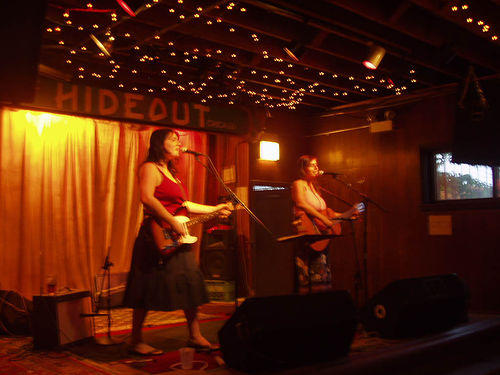 Royalchord, a two-woman band from Australia opened up. They were great, but had me a bit worried: Simone Muench told me I'd be reading first, and the band played very down-tempo, Cowboy Junkies alt-country style songs. Fortunately DJ Birdy Num Num raised the energy level before the readings started, and Jacob Knabb worked his mojo as manic MC. I read short (nobody ever complained that a poetry reading wasn't long enough), and was followed by Kristy Bowen, Matt "if I'm shaking its because I have ricketts" Guenette (in town from Madison), Jason Bredle and many others. Sadly, my ride got an urgent phone call and I had to bail before the end,
  missing Kristy Odelius' reading, although I can say she was sparkling in both shirt and conversation beforehand. I was also glad to run into an old student (and new poet) Steve Halle, who turned me on to this article — sadly, he caught me as I had to rush, since my ride had already left the building. The article is both right enough and wrong enough to merit some thinking, by the way. So I'll add it to the to-be-blogged queue, along with my forthcoming Kevin Prufer post and (probably) a mulling-over of Mark Scroggins' new post on Adorno and style.
But I digress. I was impressed by the standing-room only crowd, liberally dishing out applause (I refer you to the cans of Pabst Blue Ribbon for an explanation — and to jello shots, one of which was forced down my throat by a sparkling poet). ACM seems to be flourishing, and, despite the absence of Mary Biddinger, who's too busy becoming an Ohio homeowner and tenure-track professor to make it into town, the event was a hit. It is encouraging to see this kind of enthusiastic, big, smart poetry crowd miles away from a university. And I think I'm setting up base-camp in Hideout for the rest of the summer.
By the way — those of you following the Contingent Poetry conversation might be interested in Ton Van't Hof's comments at 1hundred1. You'll have to be able to read Dutch, or go to the always-off-base Altavista Babelfish for a semi-useful translation.
Despite wanting to jump into what looks like an interesting discussion about poetry and paraphrasability going on in blogs by K. Silem Mohammed and Henry Gould, and despite having promised to say something about Kevin Prufer, today I've got something else in mind, something that connects, in a sideways manner, with contingent poetry. My unlikely starting point is Adam Kirsch's new book of litcrit, The Wounded Surgeon: Confession and Transformation in Six American Poets. There are no surprises to this book for those of you who've somehow found yourselves browsing through copies of The New Criterion, the unintentionally funny neoconsevative cultural screed journal (there's a great game, by the way, in to picking up a copy, seeing who the article is about, and predicting at the outset exactly what will be said. I've got about an 80% success rate, but a novelist friend of mine who asks not to be named is batting a thousand). Kirsch, in that journal, consistently condemns anything that doesn't fit into the New Formalist paradigm for poetry -- you know: buh-dump-ta-dump-ta-dump-ta-MOON, buh-dump-ta-dump-ta-dump-ta-JUNE -- the sort of thing a really good formalist would wince to hear. In this book, he praises those poets we've come to call confessional for what he sees as their rejection of modernism. In essence, he recruits Lowell, Bishop and company into his little war on modernism.
Wierdly, there are points where I find myself in complete agreement with Kirsch. He lets fly, for example, at Jorie Graham's Swarm for its foggy indeterminacy. But where I've been hoping for a turn away from indeterminacy toward a poetry of contingent difficulties (see the Contingent Manifesto for details), Kirsch plumps for iambics and regular rhyme. Where I see a re-engagement of some ideas that the Modernists sniffed around as a good thing, Kirsch sees Modernism as the treason of the poets.
Reading Kirsch, I sometimes felt like he and I spoke different languages. Then my copy of The Nation clunked into my mailbox (revealing my political differences from Kirsch, I suppose -- I'm a standard quartlerly-magazine-with-no-subscribers leftist, he seems like more of a standard back-pages-of-the-ideological-magazines-with-big-right-wing-money-behind-them neocon). John Palatella reviews Kirsch's book, and makes plain one of Kirsch's main shortcomings: when it comes to modernism, he's myopic.
As Palatella points out, Kisch's Modernism is the narrowed and watery doctrine of the New Critics -- so when Lowell ditches everything he'd learned at Kenyon in Life Studies, that's enough for Kirsch to claim Lowell as a Modernist apostate. There's not much of an excuse for this kind of narrow-minded, shortsighted, historically uninformed error anymore -- not, at any rate, since the publication of volume two of Jerome Rothenberg and Pierre Joris' anthology Poems for the Millenium. In the introduction to that book Rothenberg and Joris describe the period of New Critical hegemony after World War Two as a time in which the poetic energy of the prewar years had been drained away by the institutionalization of a tamed and truncated version of modernism. These years witnessed “an ascendant literary ‘modernism’–hostile to experiment and reduced in consequence to a vapid, often stuffy middle-ground approximation.” There was a willful forgetting of the openness of modernism, and a turn to “a fixed notion of poetry and poem, which might be improved upon but was never questioned at the root.” The task of poets coming of age in the fifties and sixties, argued Rothenberg and Joris, was to find what had been lost, to revive the electrical energy of the force that had crackled through poetry at the beginning of the century. They call the fulfillment of this task “the second great awakening of poetry,” and the second volume of their anthology is an archive of that awakening. (Aha! Cry the surviving subscribers of Samizdat magazine, "Archambeau is quoting himself out of laziness!" a charge to which I offer no more defense than a White House spokesman offers to the charges that Karl Rove must, by Bush's own logic, be fired). Given this woeful misunderstanding of the range of Modernism, where but to New Formalism is a guy like Kirsch to turn for an alternative to the decadence of indeterminacy?
So. Strange bedfellows, on the one hand: Kirsch is as against indeterminacy as I am. But our senses of literary histroy are so different, there's no way we could agree on an aspirational future for poetry.
One of my usual gripes about American poetry takes the form of ill-humored grumbling about the prevalence of two ennervating traditions: the self-obsessed post-confessional navel-gaving of what Charles Altieri calls the Scenic Mode (the stuff of many an MFA workshop), on the one hand; and the indeterminate poetry of a watered-down old-school experiementalism of what Ron Silliman calls the Post-Avant, on the other (also the stuff of many an MFA workshop nowadays). One of my standard coffeehouse complaints about these kinds of poetry has been their inadequacy as ways of dealing with the self. Michael Anania nailed it, I think, when he said that "a great deal of contemporary poetry struggles between the conventionally Romantic, forever warm first-person singular and the somewhat shop-worn, post-modern inter-textual no-person plural." But wait! Signs of life appear on the horizon! Two new books, Kevin Prufer's Fallen from a Chariot and Albert Goldbarth's Budget Travel Through Space and Time arrived in my mailbox yesterday, and already I'm excited about the way the two poets treat the self. For them, the self is neither the isolated navel-gazer of the scenic mode nor the dissolved, death-of-the-author entity of the post-avant. Both poets find ways of seeing the self in relation to the history that conditions and underwrites it. They look to the long ago and the far away as ways of understanding the nature of the personal and the near-at-hand. In a way, what they're on to is a poetics of echo-location.
For example, consider the risky and apparently unpromising beginning of one of Goldbarth's poems:
I was like a taster that the kings use;
if the grapes are fatal, the taster dies.
And so all of my male friends my age
were almost as anxious waiting
for the report on my prostate biopsy
as I was.
 This does not seem, at first glance, to bode well. It has the look of that post-Robert Lowell, personal stuff, without the grand agonies that gave Lowell power, and without the sense of liberation from musty, New-Critical, highly-wrought poetry that Lowell gave us so long ago. I mean, at least Lowell could write "my mind's not right," while Goldbarth seems to have moved from problems of the mind to problems of the prostate — dramatic problems, if you have them, but less sublime than Lowell's madness. But — and here's the good stuff — the poem doesn't stick to these very local, personal problems, at least not directly. It takes an odd and interesting turn, and places the treatment of these individual problems in the context of (wait for it) the American Revolution. You get the oddest sort of parallels between modern urology and Revolutionary history and, surpisingly, it works. There's something of the metaphysical poets' famous yoking together of the apparently unlike here, a kind of virtuoso quality that you fear you're not going to get when you read those opening lines.
More later, on Prufer this time, who's got an interesting way of placing the personal in the context of Classical history. But I've got a list of articles and reviews I've promised to write that's become about knee-high (including a full-dress review of Prufer and Goldbarth for the Notre Dame Review). So off to work.
Also: I'll be giving a reading Thursday night at 9:00 at Hideout in Chicago (1354 W. Wabansia), with Jason Bredle, Kristy Odelius, and others, including (as the Chicago Reader ominously puts it) "surprise guests."
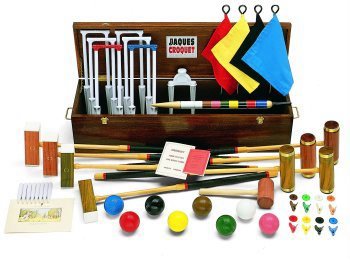
The little brunch party I threw this weekend was officially designated Wafflepalooza, but, as the summer breeze continued to ease its way over Lake Michigan and the mimosas kept flowing into the afternoon, the event segued into a new identity, the first official meeting of what I am pleased to call the Chicago and North Shore Croquet Association. And let me tell you, we dealt out some hurt. Lisa Alcala, Mary Moss and Alan Moss (artist and famed illustrator of the American Science and Surplus catalog, and future designer of the C & NS Croquet Assoc. tee-shirts) had to leave before the full tournament, but the remaining members witnessed rough-terrain play of a savagery not seen since the Punic wars. Sara Ellis took an early lead in the nine-wicket cut-throat event, but suffered an irrecoverable setback when she was unsportingly roqueted back beyond the starting point by a disreputable literary critic after clearing the seventh wicket. Ben Goluboff, playing the black ball, looked set to take the lead but was challenged first by myself and then by Jason Salavon. Glouboff, set to clear the final wicket, was roqueted not once but twice right out of the field of play and into the rough in the nearby Adams-Hart estate. Rallying to re-enter play from beneath some underbrush, he showed admirable game but was unable to challenge for the lead again. Meanwhile I, having sent Goluboff off to the bushes, left myself open to a stunningly aggressive attack by Salavon at the eighth wicket, and was saved only by some rough terrain. Ornithologist Caleb Gordon and the lovely and talented Valerie Archambeau played with spirit but, caught up in mutual recriminations and subject to Gordon's penchant for the two-ball croquet attack, neither were factors in the final phases of the game. Tippling Gadabouts beware: the noble sport of croquet has entered a new phase. No more the regulation whites on the well-manicured lawns, no more the gentle tock-tock of ball and mallet. The Chicago and North Shore Croquet Association has arrived, and we've been dealin' hurt since 2005.
You may well be too careful, when making jambalaya, to rub your eyes vigorously after the indiscreet handling of cayenne peppers. But if you aren't, you'll understand the kind of burning I have in mind when I say that there's a certain kind of blather about writing that I hate with a burning passion. Lynn Freed lays some of this irksome jive down in the most recent issue of Harper's. "EEEEEEEOW but that burns!" Yelped I, leaping about the room on one leg after reading her article, "Doing Time: My Years in the Creative Writing Gulag." "But why?" you ask, "why do gyrate so, groping madly for the eyedrops, Archambeau? What irks?" Good questions, class. Let me explain.
The problem with creative writing professors like Freed (and I think we've all met them) comes from their belief that technique is somehow stifling, that the nature of successful writing somehow (it is never really explained just how) can't be described. When Freed describes her own writing, during those periods when she's teaching, as "intended, crafted, lifeless" she tells us a lot about her assumptions. Deliberate work is lifeless work, she thinks, crafted work is dead work. Indeed, when her students ask her perfectly sensible questions about technique, she not only fails to give decent answers, she resents their having asked:
"How do you build a character with internal monologue?" someone asks. "How do you set up an unreliable narrator? How do you shape the narrative arc?" I shake my head. Despite all my years in the creative writing classroom, I still have no idea how to unravel the mystery. These concerns are red herrings, I say. So are the relative merits of the first, second, third persons, active and passive voice.
Freed feels obliged to say something useful, since the classroom context, so at odds with her belief that "writing cannot be taught" demands it, and it is in this context that she resorts to vague exhortations about the struggle for voice. "What do you mean by voice?" ask her students. "Trying to explain something I understand only sketchily myself, I resort to metaphors — a thumbprint on the page, the inimitable sound of Maria Callas."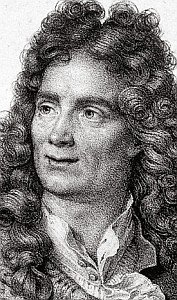 Where, one wonders, do ideas like Freed's — shared by so many people inflicting themselves on students in creative writing programs across the land — come from? I can think of two sources, one neoclassical, the other Romantic. The neoclassical source comes in the works of the seventeenth century French poet Nicolas Boileau-Despréaux, author of the immensely influential "Art of Poetry" and synthesizer of many notions about poetry from the classical world. He's the guy who gave us "a certain je ne sais quoi" as the essence of good art, and this idea is at the root of our rot, at least some of it. Here's what Michèle Longino Farrell has to say about Boileau's idea:
Boileau also translated Longinus's treatise On the Sublime, from which he derived his notion of the je ne sais quoi that distinguishes the truly great work of art or isolates the moment of greatness in a piece. This phrase was much in circulation among the seventeenth-century arbiters of taste and surfaces regularly as an attempt to explain attraction for persons or works of art. The fact that this latter-day "sublime" defies definition, as the term so much as states, hints at the arbitrary manner in which it could be deployed by the gatekeepers of the republic of letters to admit a selected elite of writers and to exclude others deemed unworthy.
So there you are. The nature of good writing, a believer in this precept of the je ne sais quoi says, is something I know and you don't and I can't explain. This is the ultimate defense against self-criticism, since you never have to examine your (unexplainable) preferences. It is the ultimate defense, too, of conservative taste, since what is good is simply good, and work that tries to do something different has missed the point. What point? Whose idea of the good? Such questions are not answered, even to oneself. They are dismissed with a superior shrug. In the contemporary writing classroom there's a surprising amount of this, and one wonders just what it is for. In Boileau's world there was, at least, a clear social function for this belief: it allowed the courtiers to keep the rabble at bay by refusing to even argue with them about their tastes. But what could the end be for this idea now, except to allow profs who'd rather not think about aesthetics to continue in their mental slumber? Sadly, that may be enough to keep the idea around.
The Romantic source for Freed's set of ideas is most clearly seen in some of Wordsworth's minor poems. Take, for example, "The Tables Turned," with the famous quatrian:
Sweet is the lore which Nature brings;
Our meddling intellect
Mis-shapes the beauteous forms of things:--
We murder to dissect.
Set aside the fact that these are the words of a character, set aside that this poem is itself set up, Blake-style, in dialogue with a companion poem, set aside the fact that Wordsworth's greatest poetic achievement in The Prelude is an analysis of the creative process, set aside that Wordsworth's "Preface" to Lyrical Ballads is a major critical document and an analysis of poetic technique. Set aside all this, and you can take away a degraded notion of the Romantic artist as a mysterious and inexplicable creature. Set aside all this — as so many do — and you can think of technical understanding as anathema to art. And you're only a step away from the place where you see "intended" and "crafted" as synonyms for "lifeless."
So why, specifically, is this unholy combination of a degraded Romanticism and the most asinine element of Neoclassical aesthetics such a bad thing, when imported into the creative writing classroom? I suppose there are several reasons. One is the simple discourtesy of refusing to answer the legitimate questions of students, another is the self-defeating position one puts oneself in as a teacher who refuses to see the subject as teachable. One may as well grab a chisel and carve “abandon all hope ye who enter here” over the classroom door. But more importantly, there’s the problem of devaluing technique in favor of the idea of “voice” as some mysteriously individual authenticity that somehow hovers above mere technicality as the source of art. Not only would the dismissal of intentional, crafted, technical writing send James Joyce into exile from the Republic of Letters, it would lead to the triumph of the most cliched, because least examined and least honed, techniques. I remember Stuark Dybek, at the last Lake Forest Literary Festival, talking about how the technical elements of writing can feel constraining, then saying "craft is the only access, the only access, we have to the imagination."
One wonders a little why people like Freed teach writing, given their sense that it is unteachable, and their belief that knowledge of technique stifles creativity. To her credit, Freed admits that she “feel[s] like a fraud” — though you’ve got to wonder why she wouldn't walk away from a gig that upsets her so much. It can't just be the money, since the ratio of labor to payoff is so low compared to the other things you could be doing while feeling like a fraud (real estate, anyone?). Like a lot of writers, she seems weirdly torn between yearning for a tenured position and contempt for the work that such a position is meant to make possible.
Is there a name for the set of beliefs about writing and the teaching of writing that people like Freed hold? I’m not sure. But I do know there is a name for people who profess things they don’t believe.
(For a theory about Freed's hatred of teaching that is so out there it is almost certainly true, check out Mark Pritchard's Blog.)
When, in the early nineties, I translated this poem by the mid-century Spanish poet Blas de Otero, it seemed to come from another world. Now, as the Fourth of July flags flutter in a country where reporters can be forced out of their jobs for criticizing the regime, where politicians order prisoners held indefinetely without trial, where elections are manipulated by the ruling party, Otero's world looks, sadly, more familiar. One wonders: was it for this that the American people struggled? Was this what Jefferson and Franklin had in mind? It may be banal to say this, but, very sadly, it needs saying: to love this country means to criticize corruption and incompetance at the highest levels.
Blas de Otero's poem is called "Que Cado Uno Aporte Lo Que Sepa." I've translated it as "From Each According to What He Knows" (this version is in my book Home and Variations):
From Each According to What He Knows
It's true, you know: you can love a person,
a little toad — don't step on it —
and also a continent like Europe,
always split or wounded or crying horribly.
Some words distrub us, you and me,
"treaty," "theater of operations,"
"end of major fighting," "nothing serious,"
and others too.
But people, they believe all that,
hang bunting, run flags from the windows,
as if it were true,
as if such a thing...
It happens, I've seen them myself,
all Easter hats and roses.
In '39 they called the poor men out to Mass,
pulled fuses from a few bombs,
and set off fireworks along the water:
at it again.
After, I heard voices in the next room,
a woman screaming, mad and awful.
We knew,
we knew more than enough.
Eric Selinger and Mark Scroggins have started knocking another ping-pong ball back and forth across their blogs: this time it is a question about evaluation. Mark begins by quoting Donald Davie, who looks at two of the great judgmental geniuses of litcrit and approves:
That I cannot concur in either Leavis’s or Winters’s way of dividing the sheep from the goats, is beside the point: what I esteem in both of them is their common insistence that sheep there are, and goats there are; that in the arts, as between the genuine and the fake, or between the achieved and the unachieved, there cannot be any halfway house.
Now, I know that we all do, in fact, pass such judgments all the time. Maybe the virtue of Davie's remarks lies in reminding us of that simple fact: we pass judgments, and we should be prepared to articulate and defend them. Maybe this is one of the "things to do with poems" we should add to our list. On the other hand, do I really want to spend class time trying to convince a student--or hallway time, to convince a colleague--that he or she shouldn't like something he or she enjoys?
Good news, everyone: William Gass will be headlining the &NOW Festival of Innovative Writing/Lake Forest Literary Festival next year.
I was on the phone with Steve Tomasula the other day, working out the details, when Steve and I realized we'd both been at the release party reading for Gass' massive novel The Tunnel, but somehow missed each other. Actually, I think I may not have known Steve at the time: I was just a punk grad student and used bookstore clerk, and I he had a real life and was working for Bill Gates. Be that as it may, it was a hell of a reading, with a full house. Gass had started writing the novel the year I was born — meaning it was 27 years in the making, and the novel and one of its first readers were born together.
Gass is one of the great laureates of loathing: The Tunnel examines hatred better than any other book I know. I remember overhearing Gass at the Arts Club one evening, telling David Antin that he wanted his publisher to print the book in Gothic script like an old German Bible, with the sentences scarring the page "like so many strings of barbed wire." He said something about being upset that he couldn't get a limited edition made with pop-ups (really), but by then the hors d'oeuvre trays were out and I, placing appetite above intellect, left off eavesdropping and made a bee-line for the snacks.
1. Names
Mark Scroggins has named names: the luminaries of contingent poetry include: Ammiel Alcalay, Geoffrey Hill, Geraldine Monk, Peter Riley, John Peck, Allen Fischer, Robert Sheppard, Susan Howe, and John Matthias, along with early Ronald Johnson, and forerunners Charles Olson and (at times) Robert Duncan. Steve Burt has dropped in another suggestion from the forerunners zone: Basil Bunting. So anyone who wants to put together an anthology of contingent poetry is halfway there already!
Let me name another name here, not a contingent poet, but a guy who's condensed some of my cloudly observations into a 100-proof shot of contingent poetics: Henry Gould. Henry tells us that contingent poetry involves "the idea of poetry being infiltrated by, or overlapping with, the "speech-acts" of history, which never really disappear." Nice, and so much clearer than what I'm going to try to say in the "Adverbial Contingency" part of this post!
2. Discarded Dichotomy
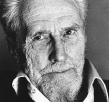
I was mulling over the idea of writing an entry in which I riffed on an old distinction of Donald Davie's, from Ezra Pound: The Poet as Sculptor, between the poet as stone-carver and the poet as caster-of-plaster (Davie seems to be in the air lately: he's cropped up on Mark's blog too). I thought I'd say something about how the contingent poet works with existing documents and with language in the context of its history. Maybe, I thought, I could claim that this was like the poet as stone-carver, who worked against (or with) the resistance provided by his documentary materials. In contrast, we could see a lot of contemporary indeterminate poetry as a matter of plaster-pouring: that is, of using language without a sense of the resistance of actual historical text. But I was bothered by two things. Firstly, the simplicity of such a dichotomy meant that it would create about as much confusion as it would clarity. Secondly, the Poundian connotations it would create for contingent poetry struck me as a bit off (Pound was Davie's master stone-carver). I couldn't quite put my finger on the nature of my problem with Pound as a model for contingent poetry, though — until an email from John Peck dropped into my in-box. Peck (as always) had something important to say, and a condensed way of saying it. In this case, it involved a distinction between Pound and Olson that could, I think, go a long way toward isolating what is important about contingent poetry. Pound, said Peck, was a poet of the verb, and Olson a poet of the adverb. Let me (by quoting and glossing) explain:
3. Adverbial Contingency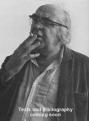
 Peck set up his Pound/Olson distinction by picking up on my comment about synchronicity being an important part of contingent poetry (Peck knows about this stuff, having studied for a dozen years at the Jung Institute in Zurich, so I bow to his superior knowledge here). He says:
Synchronicity is best backed not by the OED but by the joint work of Jung and Pauli in their combined papers on the theme, in the 1950s. The meaning referred to in that OED summary is the result of acausal orderedness, as Jung's translator has it. And that perspective, which submits all of our rationality, discernment, and God-Almightiness to a different grid of meaning than the kinds which submit to the analysis of intention, will, or any of the Aristoelian modes of causaltity, has a number of consequences which only a patient engagement with...materials can work out.
So what, you ask, could this have to do with Pound and Olson? Find out in this next installment:
One corollary of [this] for our own explorations, perhaps, would be the dialogue between Pound and Olson. If Olson can be trusted as a witness here, he was more sensitive to this synchronistic dimension, or intution, than was Pound, his great catalyst in what you are naming as contingent poetics. Pound's hash has never been settled on these scores--is he to be taken as an egoistic fascist, or as a Taoist submitter to the contingent "process" of the several Eastern metaphysical tradtitions? or both? But his hash need note be settled now for us to register Olson's protest against Ezra, namely that Pound was driven by his passions to drive "the beak of the ego" through his (contingent, textual, linguistic-record) materials.
This strikes me as dead-on. While Pound was very much a worker of documents and historical text, he was also very much a poet who would consciously, deliberately bend these materials into illustrations of his utopian dreams. Hence the didactic quality that (to my mind) sometimes mars the work. Hence the accuracy behind Gertrude Stein's famously catty quip that Pound was "like a village explainer, excellent if you are a village, but if you are not, not." (Pound's quip against Stein — that she was an "old tub of guts" was just as mean spirited, but not nearly as witty). Peck goes on, saying:
It occurs to me that Pound's way and Olson's way diverge along lines which philology can illuminate in its good old-fashioned manner.... Pound's egoism, in Olson's view, would correspond to Pound's dogged application of Fenollosa on the Chinese written character as a model for his poetics: to paraphrase that application, reality is not a noun but a verb. Pound's suspended lobes of syntax, which come almost to dominate the later Cantos, typically depend from a relative pronoun — "that" — which can refer either to an unexpressed verb preceding, or to the verb explicit in the suspended phrase itself; or electrically to both the implicit and exlicit verbs in the suspension. Those cantilevered lobes typically express a wish that a certain action be possible, or a certain alignment of civic forces, or configurations of justice, be enacted (when in fact they remain frustrated). These little phrases may seem wistful and fragmentary, but they entail whole genres: utopias simply, and thoroughly, elaborate what such compact suspensions compactly project as syntax.
Right. Bear with Peck on this, because it gets good. So: Pound gets his utopianism into the very syntax of the poetry. I admit to having been a bit bleary about this for a moment, but a quick consulatation with my colleague down the hall, Ben Goluboff cemented the notion in my mind. What we're dealing with here is the optative mood of wishing, combined with a kind of syntactic ambiguity that allows for the pronoun "that" to depend from both an explicit and an implicit verb. My copy of The Cantos is elsewhere, and Ben, having just moved to the enviably commodious corner office of a retired colleague, regrets to say that his is in a box somewhere, but here's an example he concocted (not Poundian poetry, but it illustrates the point: "I wish that the cavalry had come sooner, God still in his Heaven and all right with the world." We've got the explicit wish, as well as an implicit one, in which we assume that the word "that" and the verb "to be" applied to the bit about God ("that God were still in his Heaven...") and so forth. Peck's right about this as a mannerism of the later Pound, I'm sure. (A valuable prize to anyone who sends me a really good example from the late Cantos).
But here's the important bit: what we get with this structure is a sentence haunted by an implicit verb, and in a way Pound's poetry gives us the sense of a world haunted by Pound's own utopian wishes in the form of implicit "would that it were so's." His poetry depicts reality as something that he wishes (even wills) he could make into his ego's desire. He works with document and historical materials, but he wants to bend them to his utopian (and, in many views including mine, dystopian) will.
But how is Olson different? "It seems to me," says Peck:
...that Olson's own suspended lobes of syntax, his self-interruptions, his open parentheses, together correspond to his fascination with those syntactic and relational capacities which English suppresses — thus his commentaries on the Middle Voice for verbs in Greek, for example. And that these structures in Olson's work, prose and verse alike, predispose him to turn away from the reality-as-verb view, and rather toward one in which reality is an adverb: not the substantialist quidditas of nouns, nor the dynamic (and egoic?) energics of verbs, but rather the relational and qualifying process foci of how, when, and where. In your phrase, the contingencies of X rather than their indeterminacies.
So in Olson we don't get the world as ego-guided verb (the world as "would that it were as I willed it") but the world as adverbial. I take Peck to mean something like this: that Olson doesn't project a direction on to his material, that he doesn't try to make something happen, but that his goal is simpler: to understand and describe the specific nature of our experience. The poem won't supply the yearned-for direction of history (verb); it will describe the quality or nature of a dynamic history (adverb). It won't answer questions about what history means or why it is as it is: rather, it will say something about how it is as it is. Here's Peck on this, describing how the Olsonian project feels to him: "What? I dunno, and why? who knows, but how, perhaps, can instruct me, if only I will really look and inquire among the materials of what has been rising/happening/taking place." And this is contingent, in that it is a matter of the specific, proper-noun world of history.
Just as I was mopping the sweat off my brow (something that happens every time I read one of Peck's 400-pound-per-square-inch emails) another email from him popped up on my screen, with this bit, which helped to cement the Pound-Olson distinction for me:
The adverbial function of Olson's poetics ... legitimizes the ego's position by atomizing and reconsituting the ego that Olson saw at work in the cussedly independent Pound. It takes the "bird's beak" and reassembles it in an Escher-like cotillion of Getstalten that fold through each other as they get thrown into upheaval by a stiff whiff of change.
Rather than forming history to the ego's desire, as Pound did, Olson sees the ego as constituted by complex fields of history.
All of this reminds me of what Kristin Prevalet said about Ammiel Alcalay, as well as some of the things Michael Anania had to say about John Matthias' poetry in "Talking John Matthias," from issue nine of Samizdat, which I suppose I should have added (along with the other missing issues) to Samizdat's website. So: if this sense of a self interpollated into history is common to Olson, Alcalay and Matthias (and distinguishes them from Poundian egoism) I think we're on the way to understanding some of the core elements of contingent poetry.